

An extravagantly blinged-up young woman promenading through Game City mall in the high noon of the government’s Youth Grant season might imagine that she is the most glittering, most abundantly-stocked jewellery store in human history. The fact of the matter though is that, as far as big-balling trendsetting goes, she is going nowhere. Fashion historians would carbon-date her style back to 9th century Nqoma on Tsodilo Hills which, like present-day Extension 5 in Gaborone, was an enclave of elite capitalist overachievers. For more than 400 years, Nqoma had one of the highest geographic concentrations of wealth in Southern Africa and did robust transcontinental trade.
During an archaeological dig at the Nqoma site, Duncan Miller, a PhD candidate at the University of Cape Town in 1992, found fragments of jewellery that strongly suggested that residents of this area were unusually dedicated purveyors of luxury. The jewellery was in the form of rigid and flexible bangles, beads, chains, ear rings, pendants and finger rings made from either iron or copper.
Courtesy of a Canadian mining company called Tsodilo Resources Limited that we now know that the Tsodilo area is sitting on the mineral-rich African Copperbelt but that is a story for another paragraph.
Decades before Miller did his research, one of his lecturers, Edwin Wilmsen, had investigated the economic activity of pre-pastoral in western Ngamiland and come to the conclusion that for perhaps 400 years, Nqoma was the residence of an elite “and an important trade centre in a transcontinental network as early as the 9th century.”
Next to Nqoma was Divuyu whose artefacts have been carbon-dated to between 550 AD and 760 AD. According to Miller, “iron and copper were worked at Divuyu, making this one of the earliest known sites for extensive metal working in Southern Africa. Ngoma forms a link between this first known appearance of metal working in the Kalahari and the development of major chiefdoms in the region towards the end of the first millennium.” Artefacts found at these sites – both of which are atop the Female Hill – indicate trade connections with the Indian Ocean coast and Europe. The artefacts include imported glass cane beads as well as mollusc shells, including money cowries.
Miller’s thesis investigated the metal working in Botswana and Tsodilo Hills’ sites were suited to the task because the area’s arid climate “led to particularly good preservation of a large number of iron and copper artefacts.”
By grand design, the history taught in schools begins with Europeans coming upon Africans “running around naked”, which characterisation is chiefly motivated by the proclivity of a colonial mindset to construct a superficial racial hierarchy that placed whites over blacks. However, while Europe is too generously credited with developing Africa, there is little mention of the fact that it was the richest man in recorded history (Mansa Musa of Mali who only this year was so recognised by Forbes magazine) who (inadvertently) provided financial support for the Italian Renaissance which was the earliest manifestation of the general European Renaissance. Understandably, schools don’t teach this sort of knowledge because post-Industrial Revolution education was purposefully designed to manufacture workers to serve the industries. Then again it should not be a problem that schools don’t teach learners this African history because some, like the father in Esperanza Spalding’s video (“Black Gold”), take it upon themselves to close this information gap.
Far from slighting Africans, “running around naked” actually serves as confirmation of the fact that the first wave of freshly-landed European settlers unleashed untold sexual terrorism on black women who, forcibly disrobed, would have been forever fleeing from their heavy-breathing attackers. This is the only context in which “running around naked” makes perfect sense because Africans had a fully evolved haute couture culture. There is linguistic circumstantial evidence which is borne out by mere existence of clothing vocabulary in African languages and additionally, archival records assembled by Europeans themselves bear this out.
In 1661, a Danish surgeon called Pieter van Meerhoff gave the following account to Jan van Riebeck, the Dutch explorer and founder of Cape Town, after his first contact with the Namaqua: “Their dress consists of all kinds of beautifully prepared skins … gorgeously ornamented with copper beads….
Their locks they thread with copper beads, covering their heads all over. Around their necks they have chains, slung round them 15 or 16 times. Many have copper plates suspended from those chains. On their arms they have chains of copper and iron beads which go round their bodies 30 or 40 times… their legs are encased in plaited skins, ornamented with beads…. Their only industry is working copper and iron, for which they make very neat beads and chains.”
In 2013, on the glossy leaflet of a Game City clothier, “beautifully prepared skins gorgeously ornamented with copper beads” would read something like “a wide range of pure-leather apparel festooned with copper studs.” Some of the Namaqualand jewellery has been traced back to Tsodilo Hills.
In a work published in 1969 that Roger Summers, who was then senior keeper of antiques in the National Museums of Rhodesia worked on with Chris Dunbar, early European prospectors in Southern Africa are said to have found that “nearly every viable outcrop of gold or copper-bearing rock had been explored in the past.” In the case of Botswana, that would partly have had to with the efficiency of pre-historic copper prospecting.
Over time, the mining activity in Tsodilo Hills declined alongside the stature of the centre itself. However, almost 12 centuries later, Tsodilo Hills may be restored to its previous economic vitality and be able to trade with not just Europe but rest of the world.
Hundreds of millions of years ago, there was a super-continent called Gondwana which incorporated present-day South America, Africa, Middle East, Madagascar, India, Australia and Antarctica. Over time, it began to break up in stages – which explains the matching shapes of the coastlines (and perhaps the superior footballing skills) of western Africa and eastern South America. This sort of geological processes lead to the formation of minerals. The break-up of Gondwana resulted in the formation of what geologists call the Lufilian Arc, an 800-kilometre-long belt that extends across eastern┬áAngola, the Katanga Province┬áof the southern┬áDemocratic Republic of the Congo┬áand the northwest of┬áZambia. The Lufilian Arc contains the 520 kilometres mineral-rich African┬áCopperbelt, which runs in a north-westerly direction from Zambia into the Katanga Province in the DRC. As of 2010, the African Copperbelt provided about 25 percent of the world’s copper and about 80 percent of its cobalt. It is now being asserted that this belt extends into Botswana.
In more recent times, Tsodilo Resources Limited made a stunning discovery about this belt.
Operating on the assumption that the Lufilian Arc could possibly connect to northwestern Botswana, the company hit pay dirt when it discovered mineral deposits identical in age and composition to those in the Zambian Copperbelt.
Tsodilo Resources Limited has now entered into a C$2.5 million private placement and strategic alliance with base metals miner First Quantum Minerals which has plied its trade in the Zambian Copperbelt. Explaining this alliance, Tsodilo Resources Limited chairperson and CEO, James Bruchs, said that his company hoped that First Quantum’s Zambian experience would come in handy as Tsodilo Resources Limited explored for African Copperbelt-type base metal targets in northwest Botswana.
“These rocks are in fact the south-westerly extension of the Zambian Copperbelt and clearly hold great potential for Copperbelt-style targets,” Bruchs said when this alliance was announced.
Writing in Inside Mining, Maarten de Wit, a chartered geologist with the United Kingdom’s Geological Society, asserted that “the finding of Tsodilo Resources in northwest Botswana has a rich potential for an extensive new base metal field. When good science and new technologies are brought together in fresh way, it often leads to exciting new discoveries.” The article was headlined “Copperbelt in Botswana.”
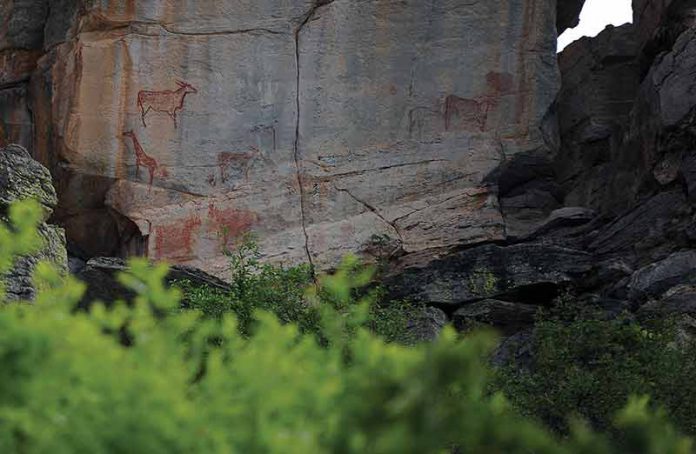
Tsodilo Hills is a cluster of four hills that have been personified as Male, Female, Child, and Grandchild and are not too far away from the Okavango Delta. Soaring 410 metres above the ground, the Male is the highest peak in Botswana. Among previous residents of Tsodilo are Basarwa who created the world-famous rock art on the stone faces of the hills. The Hills have more than 4500 rock paintings and the most popular is on the Laurens Van Der Post Panel. The latter is named after the internationally-renown South African conservationist who brought Tsodilo Hills to the attention of the world and helped pioneer the notion that the Hills were an important cultural and historical asset. His campaign may have benefitted from the fact that he had friends in very high places: he was a close friend of future English king, Prince Charles and godfather to his son, Prince William.
Called “The Louvre of the Desert” by some, Tsodilo Hills have the highest concentration of rock art in the entire world. The Louvre is a museum in Paris, France – the third largest in the world and with more than 8 million visitors a year, the world’s most visited. Having been declared a national monument in 1924, Tsodilo was declared a world heritage site by UNESCO in 2001. On account of this status, Tsodilo is, in terms of cultural and historical significance, ranked alongside the Victoria Falls in Zambia/Zimbabwe, the Leaning Tower of Pisa in Italy, the Pyramids in Egypt, Robben Island in South Africa and St. Peter’s Basilica in the Vatican which is believed to be the burial place of St. Peter, one of Jesus Christ’s disciples and the first Roman Catholic Church Pope.
There is full awareness on the part of the powers-that-be about the immense potential of the hills and concrete steps are being taken to help unlock it. Through the Diamond Trust, a corporate social investment venture between De Beers Diamond Company and De Beers Holdings Botswana, some P10 million has been injected into a five-year project to turn Tsodilo Hills into an international-grade tourist money-spinner. With this level of funding, Tsodilo is the Trust’s flagship project.
According to the project’s Sustainability Plan, while Tsodilo Hills has historically received an average of 5000 visitors annually, there is potential for the volume to increase with proper utilisation. To that end, the Plan recommends that a comprehensive business plan be developed. Last month, the minister of environment, wildlife and tourism, Tshekedi Khama, officially opened the Tsodilo community campsite and craft centre which are part of the P10 million project sponsored by the Diamond Trust. Besides the viewing of the rock art, the Plan recommends a raft of tourist attractions like mokoro (canoe) safaris, hiking trails, bush walks and traditional San houses. According to the Implementation Schedule of the Plan, a consultant should have drawn up an inventory of Tsodilo attractions by November this year.
For animal lovers there is the bonus of Tsodilo Hills being the only place in the world that is home to the Rock Gecko as well as being in a part of the country that is rich in bird life. According to BirdLife Botswana, some 450 bird species have been recorded in the Okavango Delta which is one of the great bird sanctuaries of the world. The Delta is also the best place in Africa to see the Pel’s Fishing Owl. When officiating at the World Bird Migratory Day at Mogoditshane Senior Secondary School this year, the United States ambassador, Michelle Gavin, said that bird-watching is a lucrative $80 billion-a-year industry that Botswana should position itself to reap rich rewards from.
A constellation of all these factors point to the real possibility of the Tsodilo region becoming an economic powerhouse as well as embroidering its status as an important contributor to the national economy. To the discourse of wealth redistribution politics, United States president, Barack Obama, has introduced the maritime metaphor of “a tide that lifts all boats.” He said this when trying to weasel out of answering a direct question that sought his views on giving black Americans preferential treatment as atonement for the injustices they have suffered throughout American history. Obama said he would prefer to empower all groups and not just one. Wealth distribution in the Ngamiland area makes for an extremely disquieting contrast and in ways both literal and figurative, the waters of the Okavango River have typically lifted and kept afloat the motorboats of mostly white tourist operators. Hopefully, the coming tidal wave of mining and tourism dollars would also lift the wooden dugout canoes of the indigenous communities in the Ngamiland area. This seems a fair expectation at a time, when – at least concretely at a rhetorical level, there is effort to eradicate poverty.

