

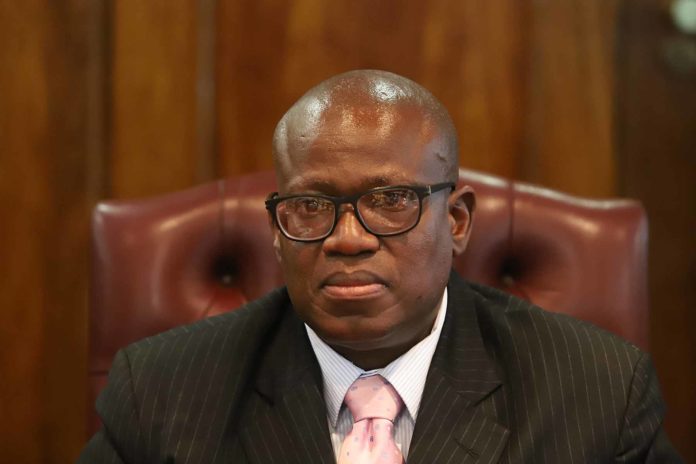
“Honourable Minister of Technology from Botswana!”, gushed an overzealous Huawei commissionaire.
Sporting a charcoal suit and black wingtip derby shoes, the bespectacled Thulaganyo Segokgo looks every inch the part as he strides into the room with a handful of aides on tow.
The Minister of Communications Knowledge and Technology’s tour of the Huawei exhibition room at Africa Com 2022, Cape Town, was expected to last 30 minutes. Segokgo, a tech enthusiast is however blessed with less elitist stereotypical tendencies , such as an engaging sense of humour, a maverick streak and much more than just a working knowledge of hi tech.
As Segokgo engaged with the parade of Huawei futuristic technologies, dropping knowledge bombs and exploding the stereotype of the sexagenarian technophobe, the apparently enthused tour guide punctuated each of the minister’s comments with a cascade of “ exactly!”s and “absolutely!”s.
Sifting through the forward looking technology for what would work for Botswana, the minister would once in a while turn to face his aides and suggest: “Lets look at it from the perspective of village connectivity.”
About and hour and a lot of tech jargon later, Minister Segokgo is standing in front of the last booth in the exhibition room and the Huawei guide is introducing him to a colleague. This time the guide dropped the “honourable” prefix and replaced it with expository superlatives, suggesting professional homage: “This is the Minister of technology from Botswana. He is very knowledgeable and very technical.”
While most Batswana know the “honourable minister” who strode into the Huawei exhibition room an hour earlier, very few are aware of the very knowledgeable techie standing in front of the last exhibition booth, one of Botswana’s tech pioneers who was among a small team of experts that developed the country’s ground breaking motor vehicles number plates technology in the 1990s.
It is the later Thulaganyo Segokgo who is carrying the heavy responsibility of President Mokgweetsi Masisi’s knowledge based economy on his hunched shoulders.
A colleague and I are sitting with Minister Segokgo in one of the Huawei backrooms as he unpacks Botswana’s Digital Transformation Strategy. He explains how the Covid-19 pandemic has demonstrated that “resilient economies of the future are digital economies.”
Digital resilience creates economic advantage through agility, positioning an economy to pivot fast, adapt to fluid conditions, maintain seamless business continuity, and capitalize on market opportunities.
While the Minister has rolled back his sleeves and knuckled down to turning Botswana into a knowledge based economy, most of the heavy lifting is happening in drawing rooms and construction sites, far from Batswana’s everyday routines. It is however believed that when it finally reaches our daily lives, the changes will be seismic. To most techno newbies, a peep into a future digitized Botswana would seem like a scene from a sci-fi movie.
“Batswana will be able to access most government services online depending on the level of security and risk.” The minister revealed that they are currently exploring “ how to onboard Batswana to access government services online.”
Farmers will also be able to grow their businesses through the application of innovative tools and new business models. Many people in the value chain, including smallholder farmers, will have access to real-time data and computational power making possible more effective selection and timing of product-to-market decisions. Digitized agriculture data is also expected to create network effects to drive scale. The country is expected to have a Silicon Valleyesque tech industry, well maybe not a Silicon Valleyesque tech industry but an explosion of tech start ups as government increases its sand box.
“ All online services are being developed by Batswana start up companies. A lot of these companies are incubated at our Digital innovation Hub. We are creating a sandbox through the incubation and the citizen empowerment procurement drive”, he says.
In fact, the future is already here. Minister Segokgo explained that “ I have done my licence renewal from the comfort of my home through Poso online.”
“We do not want to leave any Motswana behind. But first we need to build our infrastructure just as we built our roads. So far we have 10,600km of fibre covering more than 200 towns and villages.”
The network boasts a capacity of 48 channels at 200G per channel, with an easy path to upgrade to 400G as traffic demand increases.
The backbone network is not only vital for service providers in Botswana, but also handles an enormous amount of international traffic, playing a crucial role in both Pan-African and global connectivity for the entire country. “ We are still doing more work. We are looking at covering 500 villages by 2023”, explained the minister.
So far, Botswana’s digitization indicators are looking up. The latest World Bank Review indicated that, “ Digital technologies are paving the way for economic growth and new service delivery models across Africa. On key digital indicators, Botswana fares similarly or better that regional neighbours, but is lagging behind global peers with the same income levels, illustrating the potential to enhance performance. The digital economy in Botswana rests on several relatively strong individual strategies, policies and regulations.”
Botswana has embarked on a drive to make ICTs affordable to citizens. This is in line with the government’s objective of transforming Botswana from a commodity-based economy to a knowledge-based one.
An earlier report by Alliance for Affordable Internet (A4AI) entitled “The Affordability Report” revealed that Botswana currently ranks No.2 in Africa in internet affordability. And this is a huge jump.
Botswana made one of the largest leaps in the A4AI Affordability Drivers Index, (ADI) two years ago, moving up nine positions. This was the closest that a sub-Saharan African country has gotten to the Top 10 in the current model, while also taking the highest score in Africa for broadband strategy. In considerable part, this leap was fueled by the adoption of a new broadband strategy in mid-2018 that has been an exemplar for the region.
Four years ago, the country’s broadband was incredibly expensive, ranking among the highest in Africa.
While Botswana’s commodity prices are rising, the cost of data and internet use is falling significantly.
The price reductions on mobile broadband by public telecommunications operators are underpinned by increased demand. During the months of June and July 2020, Botswana Communications Regulatory Authority (BOCRA) embarked on a mission to reduce broadband prices to enhance the affordability of services.
BOCRA engaged mobile operators to discuss opportunities for reducing prices for mobile broadband or data bundles. The outcome of the engagement was a substantial reduction in prices for data bundles and a substantial increase in volumes at unchanged prices by Mascom Wireless and Orange Botswana. Prices for BTC data bundles remain unchanged as the service provider posited, they were competitive.
BOCRA notes that there were price reductions by up to 46% between 2019 and 2020. Price reductions for mobile broadband occur every twelve to eighteen months. The most notable price reduction over the years is an offering of P149.00 for an 800MB package of 30 validity in 2016, which in 2020 was converted to P149.00 for 8GB, making the package tenfold cheaper. It is anticipated that the price reductions would translate into increased adoption of digital solutions and usage by consumers.
Minister Segokgo explained that this is despite Botswana’s low population spread over a huge expanse of land and the high transit costs the landlocked country has to pay. “Botswana is currently looking to increase sea access points” he says. And this will mean even lower broadband costs.
According to BOCRA, in comparison between South Africa, Kenya and Namibia, it is noted that all the selected countries are on the coast, making international broadband internet connectivity more affordable. In the case of Botswana, transit passage to the undersea cables for carriage of international internet is leased through the Indefeasible Right of Use (IRU) in Namibia and South Africa. The aspect of geographic location places Botswana in a compromised position in terms of competitiveness.
Mobile broadband prices in Botswana are generally lower than prices in South Africa and Namibia by considerable proportions. In contrast, Kenyan operators offer much lower prices than Botswana, and this is not unexpected given population density, level of development of telecommunications/media/technology and geographic position of Kenya.
Another upside is that the adoption of mobile broadband in Botswana has grown tremendously, reaching 101 subscriptions per 100 head of population in March 2020. Fixed and fixed wireless broadband reached three subscriptions per 100 head of population while household access to broadband stood at 63%, with the most prevalent access technology being mobile broadband.
Mobile broadband has become more affordable, with prices being reduced by up to 46% for 30-day prepaid packages in 2020. In Botswana, broadband is embraced as a facilitator of information exchange and commerce. Broadband is largely offered via mobile infrastructure which has high penetration level of over 160%. Fixed wire-line and fixed wireless broadband penetration are minimal at a total of around 3.5%. It is only recently that there were major network development plans that would increase outreach and penetration of fixed wire-line and fixed wireless broadband.
The number of mobile broadband subscriptions has increased by 16.3% (284,812) from 1,752,547 in March 2019 to 2,037,359 in March 2020. The significant increase in uptake of mobile broadband is attributable to several reasons including ownership of more than one SIM-cards by consumers to enjoy different mobile offers by operators; improved affordability due to recent price reductions; reduced movement during extreme social distancing leading to extensive use of electronic platforms; self-service on utilities as well as surfing the internet to apply for movement permits. An increase in the number of subscriptions is expected during 2021 and beyond as Botswana moves towards a digital economy and, operators introduce more affordable products and services in the market.
The 2018 broadband strategy in Botswana makes specific recommendations for a coordination committee to carry the plan’s targets into implementation and reserves space on this committee for multiple governmental ministries, the private sector, academia, and consumer advocate.
Asymmetric Digital Subscriber Line (ADSL) is the most prevalent type of fixed wired broadband and is provided through BTC network infrastructure. BTC plays in the wholesale and retail ADSL markets, meaning that they offer wholesale ADSL to ISPs and then compete with the ISPs in the retail market. ADSL is mainly offered using a standard copper telephone line. One of the advantages of ADSL is that it can be priced affordably based on the contention rates. The disadvantage of ADSL is that it can be unreliable in terms of throughput which depends on the distance from the telephone exchange. BOCRA has noted a decline in fixed-broadband subscriptions over the years from 59 590 in March 2017 to 29 352 in March 2019 and a slight increase to 33 628 subscriptions in March 2020. The depicted decline was attributable to data-cleaning and validation that was conducted over the years that resulted in the deletion of an invalid count of customers.
In line with its mandate of facilitating the provision of, among others, affordable communications services throughout the country BOCRA approved price reductions for fixed broadband internet services offered by Botswana Telecommunications Corporation (BTC) with effect from 23 June 2021.
The approval ensures a reduction in prices of fixed broadband internet services by up to 40% for a 3-year package allowing consumers to access higher internet speeds at affordable rates.
In terms of fixed wireless broadband, BOCRA noted that as of December 2020, residential customers constitute the highest number of fixed wireless broadband subscriptions at 89% of the market. The largest number of residential subscriptions, at 50%, is for the 256Kps to 2Mbps customer segment. Residential customers prefer the speeds primarily because of affordability factors. On the other hand, the business customers mainly subscribe to speeds of 2Mbps to 10Mbps and such subscriptions constitute a significant 87% of the market.
A comparison between June 2019 and June 2020 indicates that residential access has increased by 46% from 18,977 subscriptions to 27,676. The growth in residential subscriptions is attributable to customers who were working remotely due to extreme social distancing as prescribed by the COVID-19 protocols and as such businesses had to connect their employees for business continuity. Fixed wireless subscriptions by businesses also increased by 32% from 2,500 subscribers in June 2019 to 3,292 subscribers in June 2020.
Further analysis showed that urban areas consist of 96.24% of fixed wireless broadband subscriptions and 3.63% are subscriptions in rural areas. Agricultural areas account for 0.09% of subscriptions. Internet Service Providers (ISP) have plans to roll out more fixed wireless broadband in the rest of the country in 2021 and beyond. This will increase access to the internet in villages, bringing connectivity closer to the National Broadband 2018 Strategy targets, lessening Botswana’s digital divide.
The minister further explained that Botswana is currently “moving from analogue to digital and thereby freeing up spectrums for deployment.
He says “ the endgame is that we are now moving towards a cloud technology. Data is currency and we want to control our own data. We are looking at Botswana cloud. The Botswana Fibre networks, (BoFiNet) is building a tier 111+ standard vendor-neutral Data Center at the Botswana Innovation Hub that will improve performance efficiency and reliability of business critical infrastructure in the ICT sector.
The state-of-the-art facility, owned by the State-owned wholesale provider of national and international telecommunications infrastructure, will host at least 400 racks in 1, 000 square meters of white space.
The Data Centre will enhance the country’s ICT infrastructure and bring the internet, public, private cloud and the global digital economy closer to Botswana.
During the data centre ground breaking ceremony last year, Minister Segokgo explained that, “ the construction and operation of this Data Center is envisaged to create at least 273 jobs. We also anticipate creation of more jobs as the Data Center becomes operational and more services are introduced such as cloud services, internet of Things (IoT) Software as a Service and many more.”

