

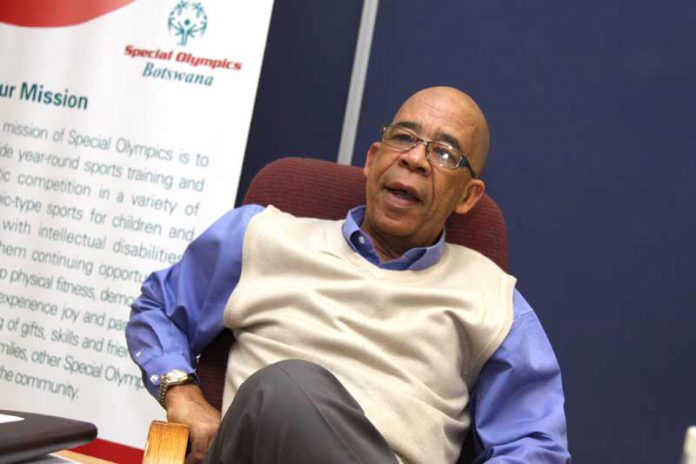
It is said you’ve never quite experienced an aerobics workout until you’ve been to Ross Tebele’s class. The man himself is something of a reluctant star, who tries hard to downplay his iconic status. Rather, he prefers to talk about the dedication of his travelling crew, the men and women who follow him throughout the week to the different Gaborone gyms where his classes are always packed.
He has come to know most of these people by name and face.
“These people spend a lot of money by rotating around the gyms each day. It’s really humbling. These are the people who drive me to always strive to bring out the best. When people show that level of confidence in you, you are challenged to be always at your pick,” he says.
Tebele belongs to the old generation of aerobics instructors, and most of his peers have long stopped. His association with the sport dates back to the 1970s, and he credits another legendary figure in the field, Thuto Thuto, as not only his first instructor, but the man who paved his way to the stage.
“I attended Thuto’s class once, and I enjoyed it so much that I became a regular. One day he asked me to me to take the class through a warm-up session. Eventually, on some days he would ask me take the class, and I have been at it since then. Today I feel sad when I can’t go to an aerobics class,” says the man who teaches a class a day from Monday to Friday.
In any field, trailblazers never have it easy because they dare to veer off the beaten track and venture onto unchartered territory. It’s like walking against the slope and the wind. At the time people like Thuto and Tebele began aerobics, they were derisively dismissed as bopharamesese ÔÇô sissies. That came out of the perception that aerobics was a ladies’ thing, and men had no business in the studio ÔÇô unless, of course, if they had a hidden agenda.
Tebele observes that the stereotype has somewhat waned, and what remains is a remnant which finds expression in the notion that aerobics isn’t physically challenging. Tebele tells many a story of weightlifters who sometimes saunter into an aerobics class aiming to show the girls a thing or two about real fitness.
“Within 15 minutes, the guy would take his towel and disappear not because he can’t grasp the dance moves, but because they don’t have the stamina to cope with the intensity of the workout,” he says. “But the perception that this is a ladies’ thing is gradually dying. If you walk into any class, you’re likely to find an equal number of men and women. At times there are more men than women. The irony is that even back then, there were more male instructors than women instructors.”
Even as he professes his undying love for the sport, Tebele feels time has come for him to slow down, a bit. Matter of fact, he has started doing exactly that. For instance, he has cut down on his participation in aerobathons. He lets in that he’s at a stage in life where even though the heart might be willing, the body can’t cope. Perhaps seeing the confusion on my face, he tells me his age, and my jaws drop so low they almost hit the floor.
“I am 60,” he says.
Reading my surprise, he goes on: “I pride myself in telling people my age, and seeing the expression of disbelief written on their faces. When I am in a class I am at the same level as 18-year-olds and 20-year-olds. I pride myself in the fact that people scramble to attend all my classes”.
I ask him what his charm is.
“I know that people always look forward to my classes, so I make it fun and encourage everyone to enjoy themselves. They pay their own money, and the least I can do is to ensure that they enjoy themselves. If it’s your first time, I tell you to take your time, and not to be discouraged by people who seem to do better. That’s a trait I picked from Special Olympics because we allow people to work according to their ability. I tell my students not to run away after the first class, but to challenge themselves to improve incrementally at their own pace,” he relates.
Special Olympics. What’s the story?
The tale begins with the birth of his first child, a boy, in 1976. Unbeknown to the parents, the boy had been born with intellectual disability. That made him a slow learner. But the condition was only realised when he was enrolled at Northside Primary School. After a term, the principal noted that the new pupil couldn’t keep up with the rest of the class, and shared her suspicion with the parents.
I ask Tebele to relate his reaction when it finally dawned that he had a child who needed special care.
“At the time we learned of his condition, it was difficult because he was the firstborn. We were fortunate that Mrs. Dixon-Warren (the Northside principal) was able to counsel us, and that’s how we managed to survive. Then we started taking him to professionals in South Africa, who confirmed his condition. At the time, there were no facilities in Botswana for people like that. So we ran around as parents and eventually found a school in Zimbabwe. It was an inclusive school where they also taught handwork,” he says.
Having a child who had an intellectual disability drove Tebele to an organisation that was called Association of Parents and Friends of People with Mental Retardation. It was 1989, and it was truly another world and another age, with a terminology that defined the attitudes of the time. There were all sorts of beliefs ÔÇô traditional and religious. The most common traditional belief was that an evil spell had been cast on the family. No, the religious folks would throw in, actually the family had committed an unspeakable sin and God was visiting punishment.
Tebele points out that such ignorance contributes to some families being unable to accept a child who has a disability. He knows of some parents who were driven to tint the windows of their cars so dark that when they were in the vehicle with the child people couldn’t see them, especially the child.
“One of the major challenges is that people with disabilities are pushed to the back of the line not only by society, but even by family,” he says.
Through the work of Tebele and many others, the environment has improved. In place of the Association of Parents and Friends of People with Mental Retardation, we now have a local chapter of the Special Olympics, which Tebele heads on a fulltime basis since last year. He talks of the hard work that Special Olympics has done to bring people with intellectual disabilities from the background to the fore, with Botswana having been a consistent participant at the games since 1991. His own son is a past medal-winner at the games.
Tebele’s work brings him into contact with 49 government primary schools that have a special education unit, with over 2 000 athletes. The Special Olympics trains teachers (the number currently stands at 395) in different sports to be able to provide sports training to children with special needs. There are also close to 800 other volunteers and coaches who are not in school system, men and women from different professions and backgrounds.
After enduring many battles, he enjoys the feeling that comes with a struggle won. He talks of a feeling of great satisfaction that he goes to bed with, each night.
“There is nothing better than helping someone who can’t help themselves and you see them blossoming to reach their full potential, and gain self-confidence. There is nothing better than the satisfaction I feel when I travel to schools and the children rush to me with joy. There is nothing better than the satisfaction I feel when I meet some of them at church or in town and they point a finger at me and say to their parents ‘I know that man; he teaches us football’. What can be more gratifying than when the BNSC nominates you for a Presidential award?” says last year’s recipient of the Presidential Certificate of Honour bestowed in recognition of his work in Special Olympics.
I ask Tebele if believes that everything happens for a reason.
“Yes,” he answers. “I have never been afraid to attack when I needed to attack, so I believe God gave me this child so that I can help those who can’t talk for themselves. There are parents who can’t go to ministries and talk to high officials about their children. Even in my sad moments, never once have I questioned God, and said ‘why me?’. I was sad, but I accepted. When he was in Bulawayo, I was spending a lot of money. But never once did I complain about expense. That’s the beauty of acceptance.”
So what comes first ÔÇô aerobics or Special Olympics?
“Both,” he answers. “They are on par. Special Olympics is a day thing; aerobics is in the evening. When I leave home each morning, I always carry my gym bag, and I only get back home around 8pm. When I am out of the country, come 530pm I get sad and miss what would be happening. It’s an exciting way of life.”
PS: Tebele’s son is now an independent man who is able to do everything on his own. He has a driver’s licence, and he can read and write.

