

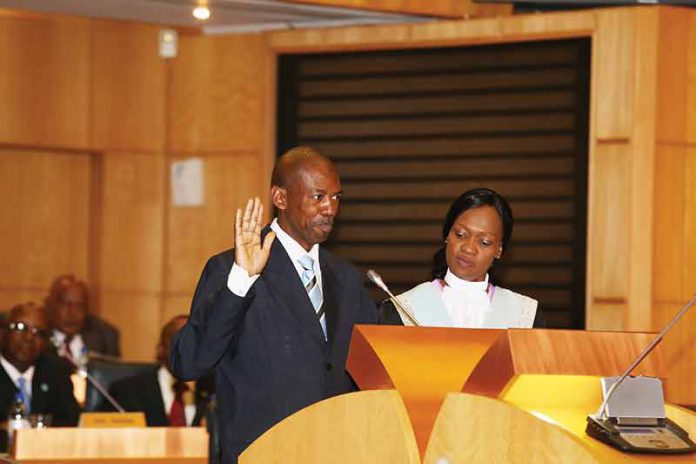
The French say a bad workman blames his tools. So, when in the course of a wide-ranging interview Goodhope-Mabule MP, Kgosi Lotlaamoreng II, lays all blame for the inefficacy of traditional leadership a good distance away from the kgotla, the mind instantly recalls that Gallic lament.
Going back centuries, dikgosi were, more than anything else, business leaders who were only ever relevant when they played an active role in the economic life of their subjects. This was the source of their political power and to innovate on a Mills & Boon formulation, the best way to subjects’ hearts has always been through the stomach.
The Khama III depicted in Neil Parsons’ in “Khama’s Country in Botswana” appears to have been that model business leader. Parsons describes Khama’s Shoshong as “the crossroads between Central and Southern Africa, the Missionaries Road, the ‘Suez Canal’ of colonialism, the bottle-neck and ‘bowling alley’ of Rhode-sians, the Road to the North for capital and to the South for labour.” The village was a halfway house that serviced the Cape-to-Rhodesia wagon-transit trade and the Bangwato kgosi did not allow anyone travelling from south to north to bypass it. In 1878, Shoshong had nine stores, exported 75 tonnes of ivory culled from 12 000 elephants and the following year, its total export of ivory was ┬ú30 000. Khama, who was himself a commercial tobacco farmer, was so important a figure in international commerce that during his 1895 trip to London, most major chambers of commerce feted him. In 1910 when the capital had moved to Serowe, he formed Khama & Co. which he would use to subsidise both black- and white-owned businesses in his territory.
Unable to find a suitable place for dikgosi in the post-colonial political superstructure, the government put some of them in the lower house of parliament – the House of Chiefs which has since been renamed Ntlo ya Dikgosi. The house is constitutionally mandated to serve in an advisory role “on matters of legislation pertaining to tribal law and custom.” While this role gives dikgosi limited political power, it is ahistorical for them because bogosi is about being a business leader, not a tribal law consultant. It is also interesting to observe that rarely do dikgosi ever play such role. Just like MPs in the upper house, members of Ntlo ya Dikgosi spend 90 percent of the meeting time talking about underdevelopment in their respective constituencies and the remainder of it about the need to give them more power. At least according to what is on the public record, the last time the house would have advised the government on legislation pertaining to tribal law and custom would be a decade ago when the Bogosi Bill was put together.
It is suggested to Lotlaamoreng that in one respect, the powerlessness of the current crop of traditional leaders is a natural result of them of not paying adequate attention to commerce, of them not failing to revive their historical role as business leaders by pursuing a largely economic agenda.
On the back of three centuries of brand-burnishing, democracy has cast a winsome spell on the world but the reality is that this political system is little more than a clever and beguiling conceit. As former cabinet minister, David Magang shows in his autobiography, The Magic of Perseverance, the De Beers chairman, Nicky Oppenheimer, has more power in his little finger than all the voters in Botswana’s 49-year electoral history combined. The book quotes instances when the government would place De Beers’ interests above those of the nation. This is not peculiar to Botswana because even in western democracies, policymakers respond almost exclusively to the preferences of the economically advantaged. If dikgosi want Botswana’s democratic system to supply policies that work for them, then they have to build adequate economic power.
The now “de-recognised” Bakgatla kgosi, Kgafela II recognised the primacy of economic power to the enterprise of traditional leadership. A few short years after his investiture, he was vigorously pursuing Khama & Co.-type of commercial ventures that were designed to generate economic benefit for his subjects. Had he stayed the course, over time he would have built massive economic power that would have been a source of political power as massive. Unfortunately, along the way Kgafela decided to decant his energies to less productive “culture revival” misadventures that were the direct result of him fleeing to South Africa to avoid prosecution.
“Our problem is that dikgosi don’t have the economic means and as civil servants they are not allowed to embark on business ventures,” says Lotlaamoreng adding though that on itself, the tribe can undertake such ventures.
The rebuttal to the latter point is that as leaders, dikgosi should show the way.
“Yes, but still the tribe itself must show interest in such venture,” the kgosi-MP counters.
Obviously, this line of questioning is not bearing fruit and it seems like an excellent time to segue to a different but related subject. When leaders like Robert Mugabe of Zimbabwe, Omar al-Bashir of Sudan and Bashar al-Assad of Syria have deviated from the democratic norm, Botswana (and indeed other states) has publicly condemned them. The question to Lotlaamoreng is whether dikgosi should not adopt a similar approach if one of them deviates from tribal law and custom. To drive the point home, the writer recounts to him details of a private conversation with a member of Ntlo ya Dikgosi around the time that Kgafela had unleashed tribal age-regiments on his subjects and everybody else living in the Kgatleng district. This member condemned what the Bakgatla kgosi was doing, stating that in terms of Setswana culture, offenders are tried at the family level first and if the issue was not resolved, then it would be processed through the upper levels of the ward and the main kgotla. What was happening at this time was that all too often the two lower levels of the traditional judicial framework were completely disregarded. This being a misrepresentation of Setswana law and custom (which dikgosi are custodians of), an attack on the prestige of the bogosi institution itself as well as denigration of people whom this culture represents, shouldn’t Kgafela have been publicly condemned by his peers?
Evidently shunning the idea of such condemnation, Lotlaamoreng responds by saying that dikgosi have royal uncles who serve as advisors.
“If dikgosi ever need any advice or have to be called to order, the cultural norm in Setswana is that his uncles will provide such service,” he says.
At this point, the mind-eye forms a vision of a late 13th century Parisian baker telling a dissatisfied customer that the crust of his baguette is not flavourful enough because the baking stone cracked, because the only type of flour he could get from his Lyons-la-For├¬t miller doesn’t hydrate the water properly, because the vents of the oven appear to be clogged, because … Because un mauvais ouvrier bl├óme toujours ses outils.

