

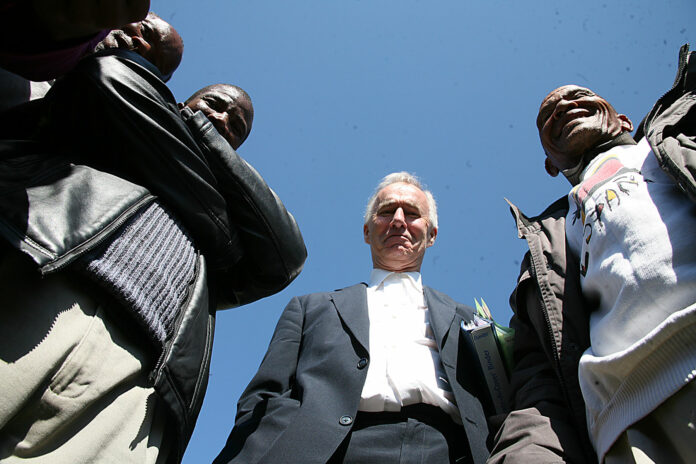
Basarwa of the Central Kalahari Game Reserve (CKGR) with the backing of Survival International are contemplating waging and igniting a fresh campaign against diamonds from Botswana mines to be labeled conflict diamonds.
This was triggered by a recent court of appeal judgement in which the family of Gaoberekwe Pitseng was ordered to bury him in any place outside the Reserve.
Family spokesperson Mogolodi Moeti said the courts and money from diamonds haven been used by the government as weapons against Basarwa. “Money from diamonds are used to fund cases that involve Basarwa and the Government. The government is using its financial muscles derived from diamonds to unleash terror on defenseless and a cashless community in the form of Basarwa,” he said.
Moeti reiterated that his tribesmen were suffering because the Botswana Government was using resources it derives from diamond morning to continue ill-treating Basarwa.
“The government is not implementing the 2006 judgement which was in our favour and also found that we were forcefully relocated from our ancestral land. We would like to make sure that the international community is made aware that we continue to suffer despite claims that Botswana is a democratic country,” Moeti said.
United Kingdom based Survival International Director Fiona Watson this week also revealed that their campaign would shift into high gear in the near future.
“Pitseng’s family are consulting their legal team about legal options now. For example, they may decide to take the case to an international court such as the African Court on Human and Peoples’ Rights. When they have made a decision, we shall consult with them about the campaign,” said Watson.
She said they agree with a new United Nations’ report which found that the Botswana Government’s decision to not fully implement the 2006 Roy Sesana judgement is a systematic plan to force Basarwa who were not applicants in the case out of the CKGR.
“It is becoming increasingly clear that the government’s aim is to ensure that in the future there will be no Basarwa/Bushmen living on their ancestral land in the CKGR, in a flagrant violation of the 2006 Sesana case high court ruling which ruled that the CKGR Bushmen were illegally and unconstitutionally evicted from their land in 2002, and therefore have the right to live there,” said Watson.
She added that; “Persecution of Basarwa hunters, (whose right to hunt in the CKGR was recognised in the 2006 case) continues.”
According to Watson; “The government’s desire to empty the CKGR of the Bushmen flies in the face of mounting scientific evidence that Indigenous peoples like the Basarwa are the best conservationists of the natural world.”
Suggesting that Botswana has not been honest on its position on why it was not implementing the High Court decision and relocation of Basarwa from CKGR, the UN Committee found that; “Contrary to the State Party’s assertions that the Central Kalahari Park is not intended for human habitation, reports from United Nations mandate holders indicate that the Park was originally created in 1961 to enable the San peoples, ancestral inhabitants of the Kalahari Desert, to live there according to their hunting and gathering traditions while respecting wildlife.”
The Committee urged Botswana to fully implement the High Court’s decision by allowing all ethnic groups originating from this reserve to return and settle there unconditionally.
Meanwhile, the Court Appeal judgement by Justice Mercy Gaarekwe ruled in favour of the State. Justices Lakhvinder Walia and Leatile Dambe agreed on the findings contained in Gaarekwe’s judgement. Gaarekwe found that the deceased son’s Lesiame or his father have failed to establish any right to bury him in the CKGR. “Neither did he challenge the decision by the Council and the Department (of Wildlife) to refuse to bury the deceased in the CKGR. This appeal as such us unmerited,” said Gaarekwe. She directed Lesiame to bury “the deceased’s body either in New Xade where the deceased was resident or any other place of choice, outside the CKGR, and in a place where there is a designated cemetery within seven (7) from this decision.”

