

The Managing Director of Botswana Development Corporation waxes lyrical about the big story that is his company.
It is a story of rags to riches.
And in many ways he is correct.
A year after the company was established in 1970, it registered a profit of 48 000 Rands.
Botswana was still an appendage of South African Rand Common Monetary Area.
And Pula as a sovereign denomination had not yet come into being.
Two years into operation BDC balance sheet stood at below a million Rands.
The entire complexion changed after BDC invested about 500 000 Rands in a company that was then called Prince Brau, the forerunner of today’s Sechaba that owns the blue chip Kgalagadi Breweries, an offshoot of the giant SABMiller.
Thanks to BDC’s founding philosophy, the corporation’s investment in Sechaba today stands at P800 million. At P3.6 billion, the BDC balance sheet is easily among the biggest for any company in the country.
“The phrase ‘commercially viable’ appears no less than 28 times in our founding constitution,” says Bashi Gaetsaloe implicitly implying that BDC has not too many options but to go back to its founding ideals.
It is also a tacit admission of the fact that the last few years have been difficult, with the company putting in millions on investments that turned out to be ill-advised, the most glaring of which was the Palapye Glass balance where close to a billion Pula went down the drain – literally.
In a rare admission of tempestuous times besetting his company by a chief executive, Gaetsaloe says 2014 was a “very challenging” year.
As a holding company BDC made a loss of P78 million.
The Group made a loss of P8 million.
While the figures may drive even the most infernal optimist to lose their sleep, Gaetsaloe is somewhat unfazed.
He insists (and is up to a point correct) that the gloomy figures belie what is am otherwise strong set of fundamentals.
Revenue is up and expenses are down.
“Indicators show we are on the right track. Like expenses, impairments have come down significantly. We are not out of the woods yet, but we are on the right track.”
Going forward BDC will be aiming big while becoming smaller and more responsive. Gaetsaloe says the company will continue to shed non-performing assets.
He is unapologetic that BDC is not an empowerment agency. This effectively means that the company will henceforth not be putting any more money on businesses that are not making returns.
Emphatically, the company will not be engaging in small scale businesses.
The most ambitious part of it all is when he says the target is to double the business in five years, which is by any measure a tall order.
“The new BDC will pioneer and unlock value. We will ask and answer the big questions facing Botswana; solar energy, dairy, affordable homes. Our target is to finance businesses that will export. BDC will start investing outside the country because we believe that we have been too insular and too inward looking for far too long. It is also our intention to broaden our portfolio base while also spreading risk,” says Gaetsaloe.
The optimism is shared by his Chief Finance Officer, Magdeline Tsiane who says the fact that Profit Before Tax rose is by and of itself instructive. Better days are ahead.
She says the 10% decline in revenue is mainly a result of a reduction in trade operations experienced in 2014. A number of member companies also experienced difficulties.
“Although we made a loss there is a significant improvement in the shape of the company. We are confident that next year, results will be much better,” says Tsiane, before blowing what is by now a familiar trumpet of an exceedingly healthy balance sheet that has also undergone some growth.
Taking the financial results at face value it is clear that BDC, while awash with assets, it does not have sufficient cash reserves to see through its mandate, much less achieve its latest ambitions.
This is not the first time BDC finds itself in this situation.
In the late nineties, the shareholder had to inject over half a billion Pula in equity to see the corporation through a crunch that was by comparison nowhere as deep as the current one.
But given the prevailing economic dynamics, expecting any cash from the shareholder is a like hoping against hope. And Gaetsaloe is abnormally conscious of this reality.
This leaves BDC with the only option of approaching the private market.
“There are a number of stakes on the ground,” says Gaetsaloe. “One of them is that Government has no money. If we are as good as we say we are, somebody in the market will back us with their money. It may not be the first bank, it may not be the second, may be not the third. But somebody will certainly come forward.”
Instead of injecting cash as was the case in the past, Government has this time around been forcefully calling for a return on its investments.
At the Government enclave patience is running thin on BDC’s failure to declare dividends.
On behalf of cabinet, the Minister of Trade who is also the political supervisor of BDC has already spelt out his expectations.
He expects BDC to start paying dividends to the shareholder.
He also wants the Corporation to prove that it is living up to its mandate of not only stimulating the economy but also creating jobs.
BDC management may have all the confidence in the future of the Corporation, but evidence shows that few in cabinet have been won over.
And even fewer are fascinated especially on account of highly publicized BDC projects that recently failed.
Among others, the establishment of BDC in 1970 fell on the shoulders of a young economist then working for Botswana Government in the Ministry of Finance.
His name was Baledzi Gaolathe.
He was to serve as the Corporation’s board member for a continuous period spanning over 24 years.
He loved and admired the Corporation for its resilience and for what it stood for. But even he was at the end no longer as mesmerized.
Delivering a keynote speech at Corporation’s 35th anniversary in 2005 he recounted the Corporation’s rich history, but advised that reforms were inevitable. He was by then a Minister of Finance.
Exactly ten years on, and with him now late, Gaolathe’s message about the Corporation’s uncertain future could hardly have been more prescient.
And for someone who had been a BDC insider for that long, he was more than many us overly aware of the storm clouds building in the distant horizon. And that storm has now arrived.
It may now sound like an irrelevant old clich├® to say BDC is an investment arm of government.
But for many out of work Batswana it still is. Thus few of them would be impressed to learn that instead of fulfilling its obligations to the nation, the Corporation spent the last year on a deathbed, literally fighting for its life.
Also worrying is the fact that BDC is currently not making money and also not giving back any dividends to the shareholder.
And will not be for a while.
In the middle of all the bad news, there is still hope.
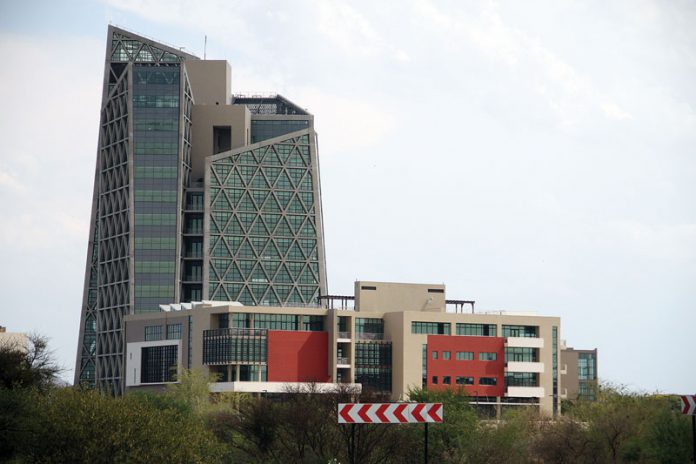
Just last week the corporation announced that it had moved into its new headquarters; a gleaming multi-million Pula structure.
However one looks at it, the sprawling ten storey multi-use landmark with a fully glazed tower is by all accounts a far cry from the 48 000 Rand that was the corporation’s inaugural profit in the early seventies.
Even the famously penny-pinching Baledzi Gaolathe would still find something to console himself with for all his hard work during all those years.

