

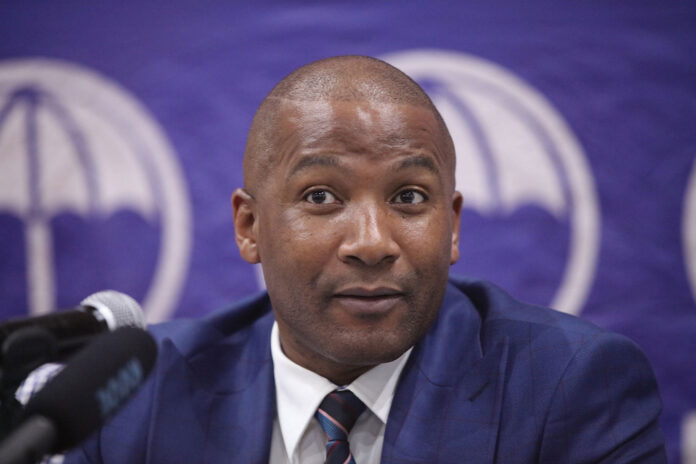
President of the Umbrella for Democratic Change (UDC) Duma Boko launched the coalition’s manifesto with a stark warning about Botswana’s current state. Speaking to a packed Royal Aria stadium in Tlokweng, Boko painted a grim picture of the country’s situation, describing it as a nation teetering on the edge of a precipice due to widespread corruption, a compromised judiciary, and an increasingly authoritarian government.
Boko did not mince words in his assessment of the state of Botswana. “Botswana faces a dire situation,” he declared, as he outlined a litany of issues plaguing the country. He pointed to a judiciary “destitute of any integrity,” oversight institutions that have lost their power and credibility, and a legislature that has become ineffectual and subservient to a president whom Boko described as “rabid” and “uncontrollable.”
He argued that the current government, led by the Botswana Democratic Party (BDP), has brought the nation to its knees, with greed, corruption, and a collapsing economy defining the current era. The hopes that were raised in the 2019 elections, according to Boko, have been utterly dashed, leading to widespread disenchantment among the citizenry. “This is the raw reality. The country is on a perilous course,” he warned. However, Boko emphasized that the upcoming elections offer the people of Botswana a choice—a chance to steer the country in a new direction. “The road diverges in front of us,” he said, contrasting the UDC’s vision with that of the BDP, which he described as offering “more of the same: dictatorial arrogance and institutionalized looting.”
Boko positioned the UDC as the only viable alternative to the current government, arguing that the party is acutely aware of the challenges facing Botswana and is prepared to offer durable solutions. “Our manifesto presents high-impact policy outlines as well as practical and effective interventions,” he said. The UDC’s plan, according to Boko, is grounded in a firm commitment to meritocracy, accountability, and innovation, which he believes will lead to a re-energized democracy and a vibrant economy. “Our country yearns for change,” Boko asserted, urging the citizens of Botswana to join the UDC in its quest to realize the hopes of inclusive growth and improved quality of life for all.
At the core of the UDC’s manifesto is a bold economic plan aimed at creating jobs and driving growth across a wide range of sectors. The party has set an ambitious target of creating between 450,000 to 500,000 jobs within the next five years. These jobs, Boko explained, will be generated through a variety of initiatives, including transformative infrastructure projects such as fast-train networks, water distribution systems, power infrastructure, and smart city transportation systems.
The UDC also plans to elevate the status of Botswana’s “creative economy,” harnessing local talent in indigenous arts, music, dance, and media. This sector, Boko believes, has immense potential to create jobs and generate wealth, particularly through strategic management and the use of modern technological platforms.
Another key aspect of the UDC’s economic plan is the creation of a fairer economic landscape where every citizen has equal access to opportunities, regardless of their background or connections to those in power. This, the party argues, will lead to more sustainable and higher-paying jobs, with the goal of building an economy capable of sustaining average salaries of P10, 000 or more.
Beyond job creation, the UDC’s manifesto outlines a comprehensive strategy for transforming Botswana’s economy. The party aims to achieve an annual growth rate of at least 10%, driven by a diversified and dynamic economy. The UDC envisions Botswana becoming a leader in solar and energy production, creating green jobs and building export-focused, non-mining “megacompanies” that will foster high-productivity sub-sectors and new industries. The party also plans to develop indigenous foods, medicines, and materials through systematic research and development, transform agriculture and agro-processing to increase yields and create more jobs, and enhance Botswana’s tourism product through better coordination and diversification. Botswana’s potential as a transport hub for the Southern African Development Community (SADC) market, as well as a top diamond trading center globally, is also a central part of the UDC’s vision.
The manifesto also includes several social reforms aimed at improving the quality of life for all Batswana. These include the introduction of comprehensive health insurance for every citizen and permanent resident, a significant increase in the old-age pension allowance, and the provision of free sanitary pads to female students in primary and secondary schools. In a bid to ensure that no one is left behind, the UDC plans to introduce a mixed-member electoral system with specially elected members for women, youth, and disadvantaged groups. The party also proposes the launch of a National Community Service program, offering a monthly allowance of P2, 500, and the establishment of a grant fund system for the informal sector.

