

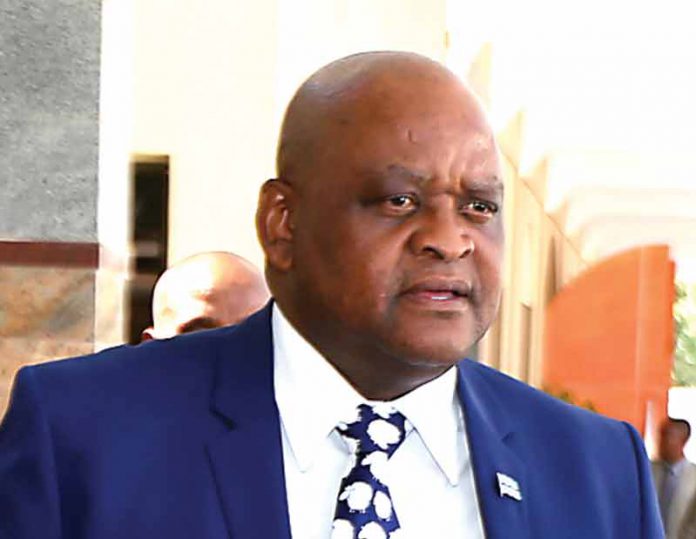
A few days ago, the Deputy Minister in the Ministry of Presidential Affairs and Public Administration Philip Makgalemele confirmed to parliament that money which was intended for the National Disaster Relief Fund (NDRF) was used to establish the Directorate of Intelligence and Security Services (DISS).
Even though, no mention is made of the legality or otherwise of the Directorate in 2008, startling revelations are made of how the hasty inception of that country’s secret service, on the eve of Khama’s ascension to the highest office, led to the diversion of close to P12.4 million in the accounts of the National Disaster Relief Fund (NDRF) from its intended use to the formation of the Directorate of Intelligence and Security Services (DISS). This is because there was no accounting code for an otherwise nonexistent department.
Due to the increasing impulsiveness to hazards such as floods, and more recently, the unprecedented El Nino-related drought in Southern Africa, Botswana’s struggle is not only how she can cope but how to both overcome and mitigate these unexpected hazards. This ensures that the economy and the lives are not crippled in the process.
The current drought which has triggered a second shock-year of hunger and hardship for poor and vulnerable people, with serious consequences that will persist until at least to the next harvest in 2017, must be taken seriously. If Botswana wants to successfully mitigate such calamities, now and in the future, then there is need for financial prudence.
The number of disasters reported in Sub Saharan Africa has surpassed one thousand in the last decade. This puts Botswana in great need of a well defined financial disaster planning because of the ever increasing impulsiveness to hazards due to climate change. The current dry spell should be a red flag for proactive financial and administrative policies to be implemented.
Lack of funding for implementation and the high susceptibility to disasters are just two amongst many other factors that Botswana must pay attention to in order to prevent disasters from affecting our emergency preparedness.
Botswana should take a leaf out of Liberia’s book. When the Ebola virus struck Liberia, many people thought it would be quickly contained. Nothing could be further from the truth. The situation turned out to be the opposite as it took more than a year to be eradicated. According to estimates, Ebola cost Liberia close to $4 billion, a figure way beyond what the government anticipated and budgeted ÔÇô if they ever did budget.
More so, the Ebola virus cost Sierra Leone and Liberia between 7 to 12% of GDP. But the abnormal part is that when you look at the national budgets of these countries, the money that was set aside for disaster management, if ever it were, is nowhere close to the $4 billion it cost to deal with Ebola.
The most probable reason for this disparity is that Botswana underestimates hazards posed by disasters, hence finds no need to commit and set aside funds towards disaster management. It is, therefore, important for Botswana to seriously take disaster management into account when planning their budgets as disasters have the capacity to cripple economies and the recovery from such experiences costs much more both in monetary terms and loss of human life.
Almost all Western countries have a portion of their national budget strictly directed and committed toward “foreign aid”. That is why they always immediately avail themselves in Africa the moment disaster strikes, and that is commendable. I do not see why we cannot copy such models, or at least be disciplined enough to leave that money for emergencies alone, unlike what Botswana did a few years ago when the government allegedly used disaster funds to establish DISS.
I read once that building an economy is similar to building a house; if the area you are building on is prone to flooding then you have to prepare financially to address such hurdles during the building process.
The current drought has proved that Botswana is at an increased risk as she is faced with a growing assortment of natural and man-made hazards which are likely to increase in frequency due to climate change. Therefore, preparedness is the answer as this reduces impact.
There is need for the government to establish platforms and forums that will allow public engagement in the management of country affairs. The public should be involved and allowed to participate right from the budget formulation.
So far, government through the Ministry of Presidential Affairs used over P40mln of tax payers’ money for purposes of replenishing the National Disaster Relief Fund that was dented by the establishment of DIS in 2008. That is the sorry state of affairs in Botswana.
Nothing beats preparedness and Botswana better understand this.

