

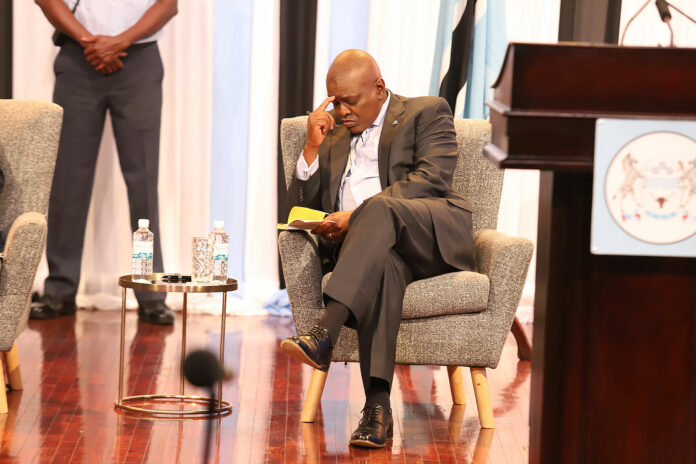
The United States government has put together a blueprint to counter China and Russia’s influence in Botswana. The American Integrated Country Strategy (ICS) for Botswana has highlighted Washington’s fears of a surge in China and Russia’s influence in Botswana. The Integrated Country Strategy is part of America’s planning process that articulates its priorities in the focus country.
The American ICS strategy for Botswana which was approved last year states in part: “A COVID-19 pandemic that extends deep into the ICS time frame could impact the effectiveness of U.S. funded-programs, particularly those that depend on in-person engagements. These risks combined represent a drag on Botswana’s democratic progress, while encouraging authoritarian government tendencies and increased influence from the malign influence of non-democratic states, such as China and Russia.”
The American campaign to fend off “malign influences” in Botswana is spelled out at least five times in the 25 page document. In fact on the first page of the ICS document, the apparent topmost priority for American Chief of Missions is expressed thus: “It is in the interest of the United States that a strong and stable Botswana continues to be successful and remains a partner that can provide positive leadership in international fora and regional bodies, and supports a rule of law founded on sound ethics while fending off malign influences”
Masisi looks east
As China and Russia seek to increase their influence in Africa, the United States finds itself in a defensive position, trying to defend its position on the continent. The American ICS for Botswana, “adopts a core element of the Biden Administration’s Interim National Security Strategy, which seeks to use American influence to strengthen democracies to counter the growing influence of anti-democratic forces.
Botswana’s President Mokgweetsi Masisi has however spoken out against Botswana being used as a geo-political pawn. During his talk at the Brookings Institution in December last year – eight months after the US launched its ICS strategy for Botswana, President Masisi pointed out that Africa does not want to be treated as a site for such competition. The American ICS strategy for Botswana came after a London based global information company predicted that President Masisi will move Botswana closer to China.
In their 2020 country report for Botswana, HIS Markit states that, “Masisi is very likely to forge closer ties with China, in an effort to diversify foreign relations away from those established under the long-ruling Khama family. Relations with China were poor under Khama. Masisi is working to attract greater investment from China into Botswana’s mining sector and there is a low likelihood that this will result in the cancellation of licences issued under Khama to allies of the former president, thus clearing the way for new investment in lucrative mines.”
Hardly two weeks into his presidency, Masisi indicated that he would be breaking rank with Khama over China.
Fielding questions from the floor during the International Institute of Strategic Studies April 2018 Oppenheimer Speech, Masisi said, “China was attempting to do for itself what many have attempted. … China will happen. It does not matter what Botswana thinks or does. China will be China so we have to adapt ourselves to living with China, get the best out of what we have in the relationship and share with them and make them share the values that we have of how sovereign states relate…. China is but a country and the Chinese are but a people. So are we.”
Botswana’s relationship with China is not only a thorn on Washington’s side, but also a sticky issue between Masisi and Khama. Speaking to the South African media in 2019 during a stop-over on his way to India to meet the Dalai lama, Khama said the Masisi administration was against the trip to India because of its cosy relations with China.
“Because of these new-struck relations [between] the current administration of Botswana and China, I think they feel they have to do China’s bidding and have succumbed to pressure from China to have no contact with people the Chinese do not like.” That was hardly surprising: Khama has always been an American blue eyed boy.
Leaked secret document have revealed how the American government compiled a personal profile of Ian Khama which they used to manipulate him to do their bidding A series of secret US diplomatic cables shared with the Central Intelligence Agency, the American Intelligence Agency, National Security Council, Secretary of Defence, Secretary of State, the United Kingdom and France, published by Wikileaks show how the American government compiled a personal profile of Ian Khama which they used to try and advance their “smart power” to reassert US influence in the region.
Immediately after completing Khama completed his first 100 days at the Office of the President, Washington was convinced that they have their man at the Botswana State House. The then US deputy Chief of Mission in Gaborone, Philip R. Drouin wrote in one of his secret reports: …. President Ian Khama has now been in office in Gaborone for just over 100 days, but we have clearly seen a sea change in the Government of Botswana’s (GOB) approach on pivotal issues like Zimbabwe. Just prior to his April 1 inauguration, we had reported that Khama remained a difficult read, holding his cards as then-Vice President close to his vest (Ref G). Since assuming office, we have witnessed how Zimbabwe has increasingly consumed the lion’s share of his focus (Ref F). He has shown us a number of his cards by now, to be sure, but the one he seems to be holding with an anxious interest to play is for Botswana to seek a much deeper security partnership with the United States.
Khama and US “Smart Power”
A year after Khama took over the presidency, the then American Deputy Chief of Mission in Gaborone, Scott Hamilton presented to the US command a three part report on how the US “smart power” in Botswana could be leveraged to achieve American strategic goals in the region.
The report, compiled in August 2009 came seven months after the then US Secretary of State, Hillary Clinton endorsed the use of “smart power” to reassert global US influence.
In international relations, the term smart power refers to the combination of hard power and soft power strategies. It is defined by the Center for Strategic and International Studies, an American think tank based in Washington as “an approach that underscores the necessity of a strong military, but also invests heavily in alliances, partnerships, and institutions of all levels to expand American influence and establish legitimacy of American action.”[
Hamilton pointed out that, “U.S.-Botswana partnership is a model for what smart power could achieve in Africa.” Hamilton further states that, “This is the first in a series of cables that will address the strategic value of the U.S.-Botswana partnership. Subsequent messages will focus in more detail on the thematic areas outlined below, on the prospects for a “coalition for change” of like-minded countries within the Southern African Development Community (SADC), and offer suggestions for increased U.S.-Botswana engagement.”
Hamilton further states that “Mission Gaborone’s operational goals going forward include: –Promoting a more pragmatic and operationally relevant role for SADC in addressing regional challenges. –Ensuring our relationship with the GOB’s Department of Intelligence and Security strengthens our understanding of regional dynamics.”
A month later, in September 2009 then American Ambassador to Botswana and President Khama’s personal friend Stephen Nolan dispatched another “secret” document to the US command that,” Our policy challenge is to encourage Khama to seek to build alliances with like-minded countries within SADC and the AU and try to influence policy outcomes. Being “right” on issues like Zimbabwe is a virtue, but being effective in ensuring change is harder and more important for Botswana’s longer term interests. We see several potential allies for Khama in the sub-region, including potentially Presidents Kikwete and Zuma, depending on the issues, but it is not yet clear that Khama is willing to invest time in this coalition-building effort. Our view in Gaborone is that personal encouragement by senior USG officials would be the first and most valuable step towards a more regionally effective Khama.
US Khama personal profile
To ensure that the US personal engagement with Khama yielded desired results, the US government needed to identify Khama’s soft spot.
A month earlier, in August 2009 Nolan had discovered Khama’s weakness for environmental issues during a Tourism Pitso. In a report he dispatched to among others, the CIA, Defence Intelligence Agency, Secretary of State and the US Africa command believed to be part of Khama’s personal profile, Nolan states that, “It is clear that the GOB (Government of Botswana), and President Khama in particular, place high importance on the growth of the tourism sector, as evidenced by President Khama spending over two hours at the conference. The President rarely commits so much time to any single event. Additionally, Khama’s animated participation and seeming ease while answering audience questions shows that he is well briefed, comfortable, and engaged with issues related to tourism, especially environmental conservation – an issue especially close to his heart.”
Armed with this information, Nolan encouraged American leaders who pursued personal engagement with Khama to soften the Botswana president by engaging him on environmental issues. “Engaging him informally on environmental issues would likely pay significant policy dividends and could lead to his broader regional engagement” states Ambassador Nolan in his three part report “intended to address aspects of the U.S.-Botswana partnership that may be of strategic relevance to the United States.”
Indications are that at some stage, Ambassador Nolan who had a strong liking for president Khama was becoming frustrated with Khama’s failure to win over SADC leaders to his position. In another dispatch to Washington on October 2009 as a scene setter for Khama visit to Washington on November 5-7 to chair the Conservation International annual meeting, Nolan states that Khama “spends less time on working with regional colleagues to effect change on political issues, in part because as a career military officer he has little patience for traditional politics and in part because he thinks regional colleagues are not as committed to good governance and transparency. While we value Khama’s outspoken approach, we should encourage him to work with like-minded colleagues to shape regional consensus in favour of good governance rather than remain distant from a consensus shaped by others. Khama’s visit is also an opportunity to highlight the fact that Botswana is the most stable and reliable friend of the United States in southern Africa, commend Botswana’s stewardship of its resources, encourage additional peacekeeping deployments by the Botswana Defense Force, and — as a prominent environmentalist — solicit Khama’s views on environmental management in Africa.”
US sees opportunity in Khama
After Khama won his presidential elections in October 2009, Ambassador Nolan wrote another report on “Unleashing the U.S.-Botswana Partnership”
The report states: “As Ian Khama begins his five-year term as the President of Botswana, a peaceful, democratic American friend in Africa, our policy opportunity is how to leverage Botswana’s excellent domestic governance and resource management to achieve broader regional goals. We recommend that senior USG officials acknowledge Botswana as a political and economic success story in Africa. We should find ways to publicize Botswana’s achievements and promote the country as a model, thereby “rewarding success.” Khama has made expanding Botswana’s agricultural sector a key priority, so perhaps the new Food Security Initiative is a new area of potential partnership. Second, we should solicit Khama’s opinion on ways that the USG could work more closely on ways that the USG could work more closely in southern Africa with like-minded countries such as Botswana. Khama’s unique insights into the inner-workings of SADC, for example, may aid our policy planning on Zimbabwe or Madagascar. As a committed environmentalist, Khama may also offer insights on how we can engage successfully African countries on important USG initiatives. Our overarching effort should be to encourage Khama to build upon his courageous policy positions with more concerted efforts to work with regional allies. Botswana has matured politically in recent years and is increasingly willing to speak out against a regional consensus it finds distasteful. Ensuring that Khama is effective in the region as well as “right” on the issues offers considerable potential policy benefits for the USG.

