

As the dust settles from the CITES conference held in Panama in November and as Botswana takes stock of outcomes, it is becoming apparently clear that despite Botswana’s prudent wildlife record, which was supposed to be her selling point at the 19th meeting of the Conference of the Parties to the CITES (CoP19), Botswana stood no chance in her appeal for the treaty to lift restrictive measures to allow limited sales of stockpiled ivory.
According to the CITES Secretariat’s assessment, part of the reason why Botswana’s proposal, along with those of southern African countries to sell ivory was rejected was because they did not have concrete plans on how they would implement safeguards for elephants if trade were allowed.
“If adopted, the proposed amendments would have the effect of reducing the quantity of registered government-owned raw ivory of L. africana from the populations of Botswana, Namibia, South Africa and Zimbabwe deemed to be specimens of species of Appendix I. The potential risks of increased poaching or illegal trade in ivory associated with a legal trade in registered government-owned raw ivory stocks, or measures to address these risks, are not elaborated upon,” said the Secretariat’s assessment.
The Secretariat also said allowing ivory sales would open the floodgates to poaching. “It would be helpful to understand how any future trade in registered government-owned raw ivory would be conducted, regulated and enforced, if the proposal is adopted,” the assessment further reads.
Southern African Development Community (SADC) member states believe that if they can show scientifically that the population of a certain species is robust and so judged safe, they should be permitted to trade in that species. However, the treaty frequently disregards such evidence. Instead, if scientific evidence contradicts the possibility of endangerment, they usually force a vote.
Philda Kereng, the minister of environment, conservation of natural resources, and tourism of Botswana, made a significant effort to persuade the parties present that Botswana has a mechanism in place to manage its ivory stockpile, but nobody seemed to pay attention. She also stated at the meeting that Botswana has adopted the CITES Monitoring Illegal Killing of Elephants (MIKE) program to conserve and manage its elephant population.
However, the treaty’s laws are causing alarm among other conservationists as well. Former CITES Secretary General, Eugène Lapointe is unflinching when it comes to championing conservation and recognising countries for their wildlife achievements. Having traversed the halls of the organisation, he has excellent knowledge of the treaty’s activities.
“Southern African countries are fed up with being punished for having been successful with their conservation programmes,” he said at the CoP19 in Panama. He also chastised CITES for ignoring scientific data saying a panel of experts from the Food and Agriculture Organisation of the United Nations (FAO) delivered the most essential advice, but CITES CoP 19 utterly disregarded it.
“Unfortunately, CITES decisions are currently made without respect for credible science and for the Sovereign Rights of independent States,” he said.
Another conservationist, Max Abensperg-Traun, who has worked with CITES on behalf of the Austrian government, backed up this claim. “The NGOs do not win votes for their side by presenting scientific evidence that meet CITES criteria, but rather by using their financial, social and political muscle,” says Max Abensperg-Traun.
Karl Ammann who is a conservationist, photographer, author and documentary film-maker specialising in wildlife trade and crime says dealers in animal body parts know how to evade the CITES system which he says “is extremely weak because there is no enforcement, and people know that nothing is ever going to happen to them”.
He also says “CITES has become part of the problem. They have enforcement tools but they are hardly ever used. CITES is no longer an obstacle to any serious dealer, and allowing body parts of endangered species to be traded legally under the cover of a CITES hunting trophy permit has allowed illegal trade to flourish”.
CITES is a multilateral treaty to protect endangered plants and animals from the threats of international trade which entered into force in 1975. Its goal is to ensure the long-term international trade of the animal and plant species listed in its appendices.
The country’s growing elephant population has long been a source of concern for President Dr. Mokgweetsi Masisi. Despite opposition from various international environmental organisations, he has committed to safeguard Batswana and address the conflict between humans and wildlife.
“We continue to manage human-wildlife conflict which we take very seriously. To address this, Government employs various co-existence strategies through Community Based Natural Resources Management programmes. These are community owned income generating projects that allow them to be part of the human-wildlife conflict solutions,” said President Masisi in his 2022 State of the Nation address (SONA).
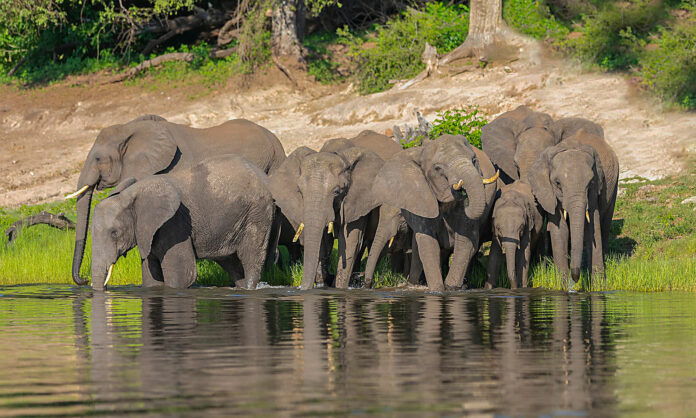
In 2021, the International Union for Conservation of Nature (IUCN) published a report stating that Botswana’s elephant population is increasing. Conservationists estimate that Botswana has the world’s largest elephant population, with 130 000 elephants. For the time being, it remains to be seen how CITES will manage the treaty’s inherent challenges and fulfil their mandate while opposing voices grow louder.

