

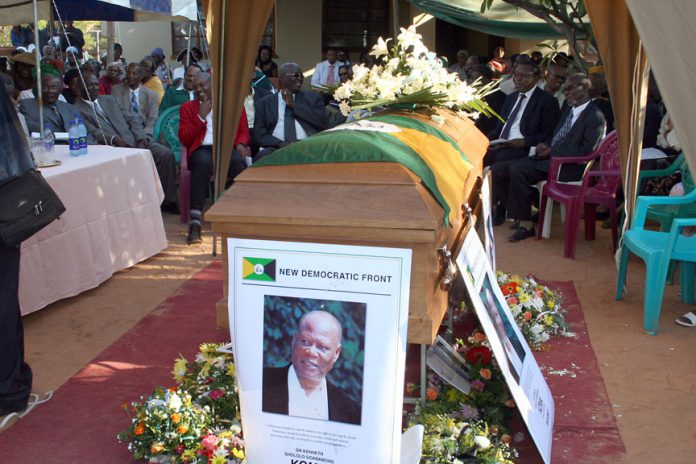
There is a request that all the political parties that grew out of Dr Koma?s contribution should meet after the prayer meeting,? the leader of the meeting announced.
?I am not sure which parties those are but they shall meet.?
An interpretation of the scripture followed.
The facilitator of the evening prayers returned to give further notice.
?Actually, I have been asked to make a clarification about the parties that should meet after the prayers. They are the Botswana National Front, the Botswana Congress Party and the National Democratic Front.?
There was equal uncertainty about whether there would be approval for joint action by the members of the named political parties.
?We have no problem with joint actions on the ground,? a disillusioned activist of the Front confesses, ?but our tongues were tied at the meeting because we were not sure that the leaders would support a unified programme of the political parties.?
Ironically, the man who had spent forty of his most valuable years in the quest for a ?united front? would leave a legacy that would make his funeral a platform for the expression of the very divisions that he found when he arrived on the Botswana political scene around independence.
Who would have imagined that the BNF, which rid itself of Koma at the Kanye congress, would be counted, together with its chief antagonist in the opposition, the BCP, among those who should bury him whilst daily announcements said that the NDF would also hold prayer meetings in Gaborone?
The puzzle was as difficult to solve as Koma?s reasons for failing to bury Mareledi Giddie, for a long time the Secretary General of the BNF and by Muscovite logic, his immediate successor.
Giddie?s cardinal sin had been to go the way of PUSO, the People?s United Socialist Party, and causing confusion at the 1984 elections about the Front?s interpretation of the Nkomati Accord.
Between 1984 and ?94 the conflict between the veteran socialist adherents and the careerist insurgents who now dictated the policy lines of the organisation took deeper root.
The socialists were ideologically ostracised from the decision-making organs of the party.
Despite the energies that they put into election campaigning, none of them, except Koma, made it to parliament, serving rather as rearguard candidates who would stand wherever the party had failed to raise credible contestants.
Most notably, Lenyeletse Koma and Mareledi Giddie were the traveling salesmen of the organisation who failed to make a reasonable personal livelihood whilst the councillors and parliamentarians reneged on their obligation to contribute part of the earnings from political office to the organisation.
Lenyeletse Koma was ultimately expelled from the party for, among other things, questioning the selfish behaviour of the new elite of the BNF.
Kenneth Koma, in his belief that people could be educated into acceptance of the socialist ideal, created a group of ?permanent organisers? who, in effect, took the place of the veteran campaigners.
Whereas the Workers Party, PUSO and others broke away from the BNF in order to refine and pursue its socialist mission, those that were formed after the triumph of the careerists over the socialist were sworn to stop Kenneth Koma and the socialists.
They were determined to undermine that section of the Front that shared his socialist ideals even if they were irked by his manner of pursuing that common cause.
Progressively, as Koma sought to ingratiate himself to the new elite that also held desperately needed financial resources, he shifted the party from the socialist position reported in Thomas Tlou?s ?History of Botswana?, to increasingly ambivalent political positions.
In the heat of the ?struggle for Gaborone South? between 1983 and 1985, Frank Marumo, a veteran campaigner, wondered: ?What does he mean to suggest by saying that we are interested in a coalition government with the very people against whom we are fighting the struggle??
Kenneth Koma had pointed to his cousin Gaolese Koma and Gaositwe Chiepe as patriots with whom the Front could enter into a coalition government.
No sooner had he made that statement against the grain of the radical mood of the time and his most articulate spokespersons, than he also began to describe the BNF as the ?Botswana National Front Party?.
Clearly Koma realised that not only had the theoretical ?united front? he envisaged in the late 1960?s failed, but even the BNF had become more of a monolithic mass party as opposed to an amalgam of various organisations ? or a front across class lines – with a few shared goals; ?monolithic? not to deny variety of opinions, but rather, to denote submission to a single policy, payment of dues to one party and obedience to a single set of disciplinary or organisational rules.
That, in contrast to the ?multi-organisational united front? which implies varied sources of political authority, payment of dues to varied organisations and submission to different sets of disciplinary rules.
More importantly, there would be adherence to a number of agreed principles and freedom of each faction of the front to pronounce those of its own policies which it does not share with the rest of the partners.
Increasingly, Kenneth Koma introduced a new vocabulary and rhetoric that undermined the revolutionary vigour of the socialist spirit of the ?60s and described the philosophy of the Front as ?centrist? in character, a tendency seemingly borrowed from the continental labour movement of Europe in order to combat Thatcherism.
Koma believed, perhaps, that if he shed the socialist rhetoric of the past, the Front would attract, or cease to antagonise, the more liberal sections of the capitalist bloc thereby averting their outright resistance to a takeover of ?the communists? in Botswana.
This wavering theoretical position left the socialist sections of the Front wide open to ideological humiliation by its adversaries at the Botswana Democratic Party and the careerist elite inside the Front, which was in charge by 1989 when Mikael Gorbachev opened the flood gates to the ?collapse of the communist bloc.?
The socialist youth at the BNF stood resiliently by the training they received from Koma and saw to his demise and humiliation at the Kanye congress.
They acquired for themselves, the label of ?University of Botswana intellectuals? whose only contribution to the Front was confusion and persistent factional feuding.
An informant commented: ?Lona ko Gaborone koo, ra re lo tlhophe Central Committee ya phathi, fa lo tswa lo tlhopha SRC,? (Student Representative Council).
Koma found refuge at the National Democratic Front where he and his former study group prot?g?, Dick Bayford, stayed out the last days of his political activism. Bayford had also built his credentials doing legal work for South Africa?s ANC and so replacing Michael Dingake as the draw card that would keep Koma and the leftist sections of the Botswana polity linked to the liberation movement in southern Africa.
Dingake made the gentlemanly gesture of attending Koma?s funeral despite Koma?s contemptuous remark that characterised their relationship going towards the Palapye debacle where the BCP was spawned: ?Ke ne ke re ke bone teemane, ntekwake ke tshotse marago a lebotele.?
The remark did not endear Koma any further to the already disgruntled sections of the Front left who believed that, in Dingake, they would lose yet another asset that might have given them leverage with the ANC.
What was done was done.
Dingake arrived on the eve of the funeral and sat with BNF veteran, O.K. Menyatso and Harry Tlale in the shade of the tree opposite President Festus Mogae and his predecessor, Ketumile Masire, who sat under a tent.
If looks are anything to go by, it did appear from Masire?s personal disposition that he felt something deeply about the passing of Dr Koma. Lady Olebile Masire had visited on Thursday afternoon. Masire and Koma are of one political generation.
The speeches were spoken but the numbers did not tell the same story as the words of praise and adulation for Dr Koma.
Patrick Van Rensburg, who had contributed greatly to the debate about the future of the Front before Palapye, spoke. This despite the fact that the earlier veterans believed that his attempts at the brigades were a utopia that could not be sustained under the nascent capitalist economy of Botswana.
Moupo said his bit, as did Bayford and the author of Koma?s biography.
No busloads of BNF comrades arrived. Fewer former comrades at the BCP showed up.
Apart from Dick Bayford, it was a great mystery attempting to sort out the NDF comrades from the average mourning villagers.
The most active sections of the traditional ?tebelelo? were the fellows who had gathered the wood in the morning and dug the grave.
This gave them license to be properly looked after as the pots cooked into the night and the morning of the funeral.
For three days before the funeral one could only marvel as the churches prayed for a man who was avowedly communist and, at worst, a scientist who gave a good part of his time to traditional healing in much the same way as the ordinary peasant.

