

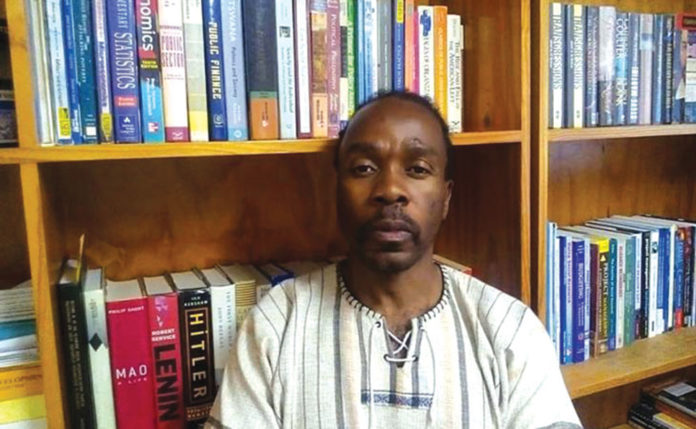
A professor in Public Administration and expert in public finance at the University of Botswana, Emmanuel Botlhale argues vehemently that democracies always affirm the sanctity of gender equality. However, there is often a lack of fit between policy pronouncements and reality. That is, some population sub-groups, particularly women and the girl child, suffer gender inequality.
In his 2020 research titled “Gender Equality in Botswana: A unfulfilled Agenda”, Professor Botlhale argues that “treating population sub-groups equally will ensure gender equality. The world over, there is gender inequality and, therefore, some population sub-groups, particularly women and the girl child, suffer gender injustice. Therefore, they disproportionately suffer from diseases of poverty”.
Professor Botlhale states that to arrest the effects of gender inequality, governments adopt gender instruments. The record is mixed; successes and failures, with a preponderance of the latter. The gender inequality situation is most acute in Sub-Saharan Africa and “Botswana suffers from the same malaise”.
The public finance expert posits that in most societies, particularly patriarchal ones that are mostly found in the developing world, women and the girl child are treated as second class citizens, and therefore, are victims of gender inequality. Throughout history, gender issues have been dominated by the need to put an end to discrimination against women. Amongst others, this includes women empowerment.
The empowerment of women and the establishment of gender equality are crucial democracy. In this regard, it is submitted that “democracy is as much about citizenship rights, participation and inclusion as it is about political parties, elections, and checks and balances”. The quality of democracy is determined not only by the form of institutions, but also by the extent that different social groups participate in these institutions.
The paper also argues that the most potent tool to fight discrimination and also empower women is through the provision of gender rights. Gender rights refer to the fight for gender equality, which is generally achieved when women and men have equal access to the same opportunities regardless of gender or sex. This includes fair play and equal participation in government and society, as well as equal value and respect placed on the needs, characteristics and behaviours of women and men.
Scholars have argued that gender equality benefits everyone. So, there are efforts to actualize equality at local, national and multilateral levels. On the international stage, contours of fundamental human rights have been expanded to include equal rights of men and women. In this regard in 1945, the United Nations re-affirmed the sanctity of fundamental human rights as to include equal rights of men and women.
In pursuit of its re-affirmation of equal rights for both men and women, the UN in 1946 established UN Commission on the Status of Women (CSW) as the principal global intergovernmental body exclusively dedicated to the promotion of gender equality and the empowerment of women.
In 1975 the UN General Assembly amalgamated all the treaties on women into one instrument being the Declaration on Elimination of Discrimination Against Women. The declaration was then expanded and re-drafted as the Convention on the Elimination of All Forms of Discriminations Against Women (CEDAW), which is described as an “international bill of rights for women”. Gender rights are also enforced by regional conventions and bodies.
According to the UN, gender equality refers “to the equal rights, responsibilities and opportunities of women and men and girls and boys”. It is vital note that “equality does not mean that women and men will be the same but that women’s and men’s rights, responsibilities and opportunities will not depend on whether they are born male or female”.
Equality is not equity and, in this regard, some scholars state that “gender equality denotes women having the same opportunities in life as men, including the ability to participate in public sphere”. Gender equality denotes the equivalence in life outcomes for women and men, recognizing their different needs and interests, and requiring a redistribution of power and resources.
Although there are many traditional and cultural practices in any given society, the most relevant one regarding gender issues is patriarchy. Patriarchy is the term used to describe the society in which we live today, characterized by current and historic unequal power relations between men and women whereby women are systematically disadvantaged and oppressed. It is also described as “a social system where men are in authority over women in all aspects of society” and that “it is invisible, yet visible through family, community and state, in formal or informal settings”.
This patriarchy takes place across almost all spheres of life but is particularly noticeable in women’s under-representation in key state institutions, in decision-making positions and in employment and industry and it is therefore argued that “gender inequality is a direct result of patriarchy” and “minimal representation and limited access to resources is an effect of the patriarchal control of men women in the public sector”. The cumulative effect of patriarchy is gender inequality which has many and varied effects such as inequities in educational achievements, pay and political representation.
In Botswana all manner of discrimination is outlawed by the constitution, hence any conduct that is construed to constitute discrimination is ultra vires the constitution. “Despite constitutional fundamental rights and freedoms of the individual that guarantee fair and equal treatment under the law, women and the girl child disproportionately suffer gender inequality due to an entrenched culture of patriarchy. That is, while gender discrimination is outlived in a de jure sense, things are different in a de facto sense. Largely due to patriarchal tendencies, there is gender inequality,” argues Professor Botlhale.
Professor Botlhale also observed that while Botswana was among the top 10 in terms of over performance on gender equality, its record was mixed. While it was among the top 10 (4/10) in economic performance and human development, it was not part of the top 10 regarding law and institutions. The gender gaps mean that Botswana is failing to deliver on the gender equality agenda, hence, this is an unfulfilled agenda.
He also argues further that since the overall performance on gender equality is not satisfactory, it is clear that some population sub-groups suffer gender injustice, meaning that the government and other stakeholders need to do more to promote the cause of gender equality in a myriad of ways.
“The policy response to this malaise is a raft of gender equality policies and related instruments. Overall, in the developing world, particularly Sub-Saharan Africa, the record is mixed; success and failure, with a preponderance of the latter. Simply, a review of the literature shows that Botswana also has a mixed record in terms gender equality,” submits Professor Botlhale adding that there is no correlation between signing international gender instruments and passing of gender policies on the one hand and realization of gender equality on the other.
As a way forward, professor Botlhale proposes that a genuine commitment to gender equality sufficiently instanced by the constitutionalisation of gender rights, together with gender equality reporting mechanisms be put in place. The initiatives will ensure gender equality and also burnish their democratic credentials.

