

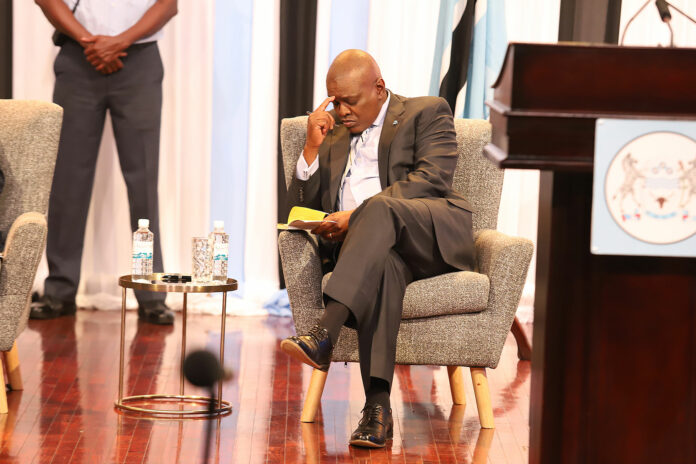
What does the president know and when did he know it?
This famous line which brought down President Richard Nixon’s administration in America may come to haunt President Mokgweetsi Masisi after it emerged that government cooked up a consultancy report in a bid to justify its controversial plan to parcel out the fragile Chobe National Park (CNP) to citizen tourism investors – allegedly with powerful political connections.
During a recent media tour of the Chobe National Park, Minister of Environment, Natural Resources Conservation and Tourism Philda Kereng confirmed that government has issued an expression of interest advert to citizen investors who wish to build 75 bed lodges inside the game park.
Sunday Standard investigations have turned up information that Minister Kereng has hitched her plans on a high-profile record-tampering subterfuge to make a case for the construction of lodges inside the ecologically fragile game park.
Consultants who were funded by the United States Agency for International Development (USAID) to conduct a management plan on behalf of the Botswana Government have distanced themselves from the government’s doctored report.
Responding to Sunday Standard queries, lead consultant of CNP management plan report Dr Lin Cassidy confirmed that she has written to the Permanent Secretary Ministry of Tourism and the Director Department of Wildlife and National Parks (DNWP) requesting them to remove consultants’ names from any possible post-USAID-funded amended versions of Volumes 1 and 2 of Chobe National Park and Volumes 1 and 2 of Moremi Game Reserve management plans reports.
Cassidy also told Sunday Standard that, “I can confirm that, as lead consultant, we did indeed write a letter to the PS (Permanent Secretary of MENT (Ministry of Environment, Natural Resources and Tourism) asking that all names of the team members, as well as the company name, be removed from any version of the plan that may have been amended after it was approved by DWNP. We cannot be considered authors of a document which we do not know the content of.”
Cassidy stated in her letter that: “We have learned that the versions of the management plans referred to above, and that we submitted to DWNP and which were accepted and approved by DWNP, may have been changed since our submission and completion of our contract.”
Cassidy indicated that if there have indeed been material alterations to the plans as submitted, “we – for reasons of professional due diligence – need to ensure that any post-submission amended version of any of the four documents referenced above are not attributed to the USAID-funded team who drafted the submitted and approved plans.”
She added that, “Please therefore ensure with immediate effect that – should any such materially altered version of either plan become adopted and circulated – all traces of the company name “Lin Cassidy Consulting (Pty) Ltd”, as well as all traces of the names of the team of technical experts, are removed entirely from any and all versions of the four documents that have been amended since our submission and completion of the contract.”
Asked if the ministry acceded to their request, Cassidy said, “We have never had any reply from the ministry, nor has the revised version been shared with us.”
However, she said, “we have heard informally from someone who obtained a copy of the amended version, that they did not find any reference to the names of either team members or the company in that version.”
Documents passed to the Sunday Standard point to a systematic effort by government to suppress evidence uncovered by the consultants which showed how plans to build more lodges inside the Chobe National Park would destroy the country’s most bio-diverse game park.
There are complaining that not only is the government’s report dodgy, but was deliberately designed to violate the Chobe National park on a false premise.
Sources close to the development say the revisions to the Chobe Management Plan illustrated the significant if largely invisible influence of powerful citizen tourism interests who feel the industry has been sown up by foreigners.
The original report by the consultants comes close to making the same observation: “Because there is a perception that opportunities for wildlife-based tourism are all taken up outside the Park, it appears that CNP is being turned to, to fill that opportunity gap for citizens.”
The government’s Chobe management plan which runs contrary to scientific advice in believed to be aimed at placating the powerful citizen tourism lobby at the expense of the game park that supports Botswana’s lucrative tourism industry.
According to the original report, the consultants had commented that, “This zone (riverfront where the new lodges will be situated), while of extreme ecological importance due to the permanent surface water provided by the Chobe River, is at the same time strongly modified through both human and wildlife usage – particularly in the eastern half.”
They stated that in terms of wildlife management, “it is vital to leave wildlife corridors of this zone to provide undisturbed access of wildlife to water, and in order to allow migration of wildlife between the heart of CNP and the floodplains in the Zambezi region of Namibia.”
They further indicated that the, “ zone is in close proximity to Kasane on the eastern side and Ngoma on the western side, which provide tourism accommodation external to the CNP but which rely upon the CNP for activities in addition to supporting industries for tourism. Most of the high intensity use comes from day-trips, which are rare in much of the rest of the park.”
The consultants had also found that currently there is a sense that Botswana’s wildlife resource is being over-exploited for the short-term gain of maximum gain from tourism revenue.
“Because there is a perception that opportunities for wildlife-based tourism are all taken up outside the Park, it appears that CNP is being turned to, to fill that opportunity gap for citizens.”
Warning the authorities not to be complacent, the consultants said, “However, this has consequences for the long-term sustainability of the Park and its ability to support tourism anywhere.”
They indicated that part of the pressure comes from a situation where multiple agencies independently, rather than collaboratively, have been assigning use and development rights within CNP, without considering the longer term ecological consequences, or the planning framework.
“There appears to be a risk of ‘offending’ the tourism cash-cow and its promoters, to the extent that ordinary management practices, let alone best practices, have been pushed aside,” the consultants warned.
It is understood that behind the scenes, USAID has also expressed disapproval to the numerous alterations which the government have made to the original report.
In its written response toSunday Standard queries, USAID was diplomatic and skirted around questions posed by this publication.
“The U.S. government respects Botswana’s sovereign decision making and management of its natural resources. We value decision-making processes that take into account subject matter expertise, input from stakeholders and local communities, are in accordance with national law, and maintain transparency from start to finish,” US Embassy in Botswana spokesperson Ephraim Keoreng said on behalf of USAID.
Keoreng further indicated that, “As part of USAID’s five-year $32.4 million Resilient Waters program, USAID supported the review and update of the Chobe National Park Management Plan (CNPMP). This process started in 2020 and the final version of the draft management plan was submitted to DWNP in late 2021.”
Pressed further, USAID indicated that, “Public concerns about inadequate environmental impact assessments processes and consultations with stakeholders and local communities warrant very close attention.”
“We will continue to engage with our partners including government, commercial, and civil society groups, and we will encourage a transparent assessment process consistent with U.S. government conservation goals,” the agency said.

