

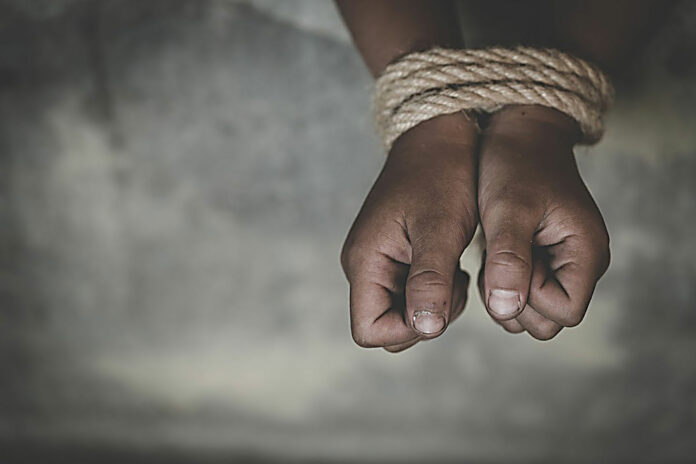
Every year, scores of boys and young men fall victim to human traffickers. Dozens of these young boys and men are susceptible and vulnerable to traffickers mainly because of their homelessness and poverty. The United Nations Office on Drugs and Crime states that an estimated 25 percent of trafficking victims globally are men. The Global Report on Trafficking in Persons also notes that that 27 percent of all victims detected globally were children, and that of those, one in three victims were boys. Sadly, boys and men hardly appear in these reports as most attention is often given to women and girls. So, in the process, boys go unreported, unnoticed and unhelped not only in Botswana but around the world.
Human trafficking and modern slavery are often used interchangeably to describe a gross violation of human rights involving the use of force, fraud, or coercion to obtain some type of labour or commercial sex act. Every year, men, women, and children are trafficked worldwide – including right here in Botswana.
The U.S State Department identified child exploitation as an issue in Botswana. They note that Botswana has remained in ‘Tier 2’ category for almost the last decade. ‘Tier 2’ refers to countries whose governments do not fully comply with the minimum standards of the Trafficking Victims Protection Act (TVPA), but are making significant efforts to bring themselves into compliance with those standards. The U.S State Department also notes that traffickers in some cases exploit young Batswana working for extended family who may be denied access to education and basic necessities. “Criminals exploit some Batswana girls and women in prostitution within the country, including in bars and along major highways. Organized trafficking rings subject some Batswana women to trafficking internally or transport women from neighbouring countries such as South Africa and Zimbabwe and subject them to sexual exploitation,” states part of the report.
A man who was once trafficked more than a decade ago but managed to escape the clutches of traffickers and start a new life says while we should never turn a blind eye towards the plight of young girls and women, we must pay attention to young male victims and survivors who are targeted by sex traffickers.
“Over the past few years, much attention has been given to women and girls which is perfectly fine. However, what is concerning is that young male victims and survivors hardly get the attention,” says *Lesego adding that Botswana does not have proper services to protect, assist and serve young boys and survivors who are victims of trafficking so that they are able to start a new life.
*Lesego says while there is a myth and fixed idea that male trafficking victims are inevitably labour trafficking victims, the truth is that there is a significant number of male trafficking survivors that are sex trafficking survivors.
“By speaking out I hope to destroy the myth that boys are not victims of the sex trade because this is what precisely happened to me but it was overlooked,” he says. This corroborates the idea by some anti-trafficking experts that public understanding of sexual exploitation of boys is about 15 years behind that of girls.
On why male victims of sexual exploitation are often overlooked, *Lesego says their stories are stifled by stigma and a world that has trouble seeing them as victims at all. *Lesego’s story started like so many others, with a manipulation of trust. When he was 20 years and struggling, he met a man through Meta (then known as Facebook) who offered him a place to stay. However things quickly took a shift as the man forced him to provide clients sexual massages. His story is unusual but not rare because an increasing number of boys and young men are being captured by traffickers and then sold into the sex trade, which the public generally assumes applies mostly to girls and young women.
Now *Lesego and a small but growing fraternity of male survivors across Botswana are talking about their experiences in the hope that researchers will add their details to what is immensely an underreported problem.
This publication sought to inquire about the exact figures and scale of victimisation of young boys and male survivors of trafficking from the relevant authorities, but the efforts bore no fruit due to the complexity and nature of this dark trade. However, a former law enforcement officer who spoke to The Telegraph on condition of anonymity says he “clearly remembers a couple of young boys who were victims of trafficking.” He said due to economic hardships many young boys are left with no other choice but to look for jobs which is classified as child labour because it deprives them of their childhood, interferes with their ability to attend regular school, and is mentally, physically, socially or morally harmful. “That is how some fall prey to sex traffickers,” he said.
Linah Kaodi who mainly counsels and helps victims of sex trafficking to right their lives says most of the victims of traffickers are people who have had a rough upbringing at home, suffered child abuse or are homeless.
“Human traffickers target people who are weak and vulnerable in the society and people who are not in a position to make their own decisions,” says Kaodi. She also adds that most boys who have been victims of traffickers had a negative association with a male figure and usually grew up in a household where there was no father figure.
No two trafficking stories are the same although there might all be laced with some similar threads that exist among the diverse survivors. Fortunately *Lesego seems to have bounced back from his riotous youth. After months of counselling and embracing his new life, he seems to be on the right path once again.

