

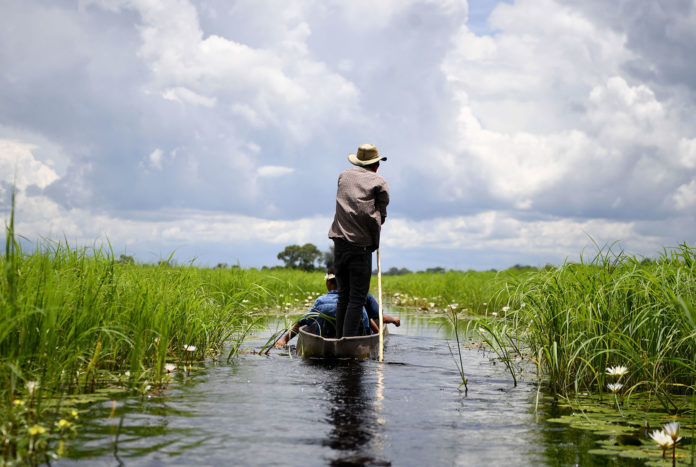
You would be forgiven for thinking that the Okavango Delta is not in Botswana. Enter the two-word noun on your Google search engine and the query will invariably turn up the answer alongside names of Hollywood A-listers or British monarchs, instead of your usual Tebogo, Ditiro and Loratos.
This rough and tumble precinct is insulated from thousands of Batswana living in neighbouring villages by cut-throat prices and stretches of unforgiving jungle. There are only a few dirt -roads here, and plenty of things that can kill you, from marauding elephants and dangerous predators to armed poachers. This is a real-life Man vs. Wild minefield, where humans and animals are jostling for space and resources. The number of lives lost over the years is staggering. And that is the whole point. The Okavango delta was deliberately designed to be a tourist bubble, exclusive to high end international tourists and those who serve them.
A few Batswana who manage to make their way into this hard-to reach, “unspoilt wilderness” find a lot of white faces, single malt whiskeys, five-star meals served around a crackling fire and what the Okavango Delta official website describes as “Incredible jaw-dropping design, luxurious, modern decorated suites.”
Most foreigners on excursions to this multi-millionaire sanctuary fly in directly from Johannesburg or Cape Town through Maun to dirt air strips in the wilderness that look like the kind of airline landing fields you find in a faded photo in a history book.
Far from the public eyes, this provided a perfect opportunity for a network of wealthy elites to hijack the delta, forming a shadow state. As the Botswana state receded, these powerful tourism interests with links to political leaders started filling in the blanks with their own ideas about how a country should be run.
The Sunday Standard pieced together information from Companies and Intellectual Property Authority (CIPA) independent investigations and a number of tourism research reports, and a disturbing picture emerged, confirming fears that the Okavango Delta is a ‘shadow state’, where a small network of individuals and companies – most with links to former President Lt Gen Ian Khama and his family have captured the wetlands and the government bureaucracy.
Worse still recent research finding indicate that the Delta is steadily falling into the hands of one or two companies with links to the Khama family. These companies are slowly buying out small tourism companies and putting them out of business. For example, the Okavango Wilderness Safaris, in which the Khama family has a financial interest owns and manages a total of 22 lodges in the Delta.
Information raised from CIPA reveals that Lt Gen Khama and his family are the biggest citizen beneficiaries of the Okavango Delta’s enclave tourism. The former President alongside Keith Vincent and Okavango Wilderness Safaris own five camps and lodges in the Okavango NG 15 concession areas: Linyanti Investments, Savute Bush Camp, King’s Pool, Dumatau and Linyanti Tented Camp. The lease period for the concessions runs from 2009, a year after he became president to 2025.
The former president is also a shareholder in four lodges and camps in NG 16 concession area together with Dereck Joubert, Berverly Joubert and Saba Safaris. The four camps are Linyanti Exploration, Selinda Camp, Zarafa Camp and Motswiri camp. The lease period runs for fifteen years from 2010 to 2025.
Lt Gen Khama’s nephew Dale Seretse Ter Haar on the other hand is a shareholder in Chobe Holdings which owns Shindi Camp, Desert & Delta Camp, Xugana Island lodge in the NG 21 concession area.
The group also runs Ker & Downey kanana Camp in the NG 27 A zone 3 Concession area. Chobe Holdings also owns Desert delta and Camp Moremi in the NG 28 Moremi Game reserve Concession area and Desert & Delta safaris Xakanaka camp in the MGR2 Concession area.
The President’s other nephew, Marcus Patrick Khama Ter Haar is also a shareholder in Wilderness Holdings which owns Ngamiland Adventure Safaris, Jao Camp in the NG 25 concession area. The group also owns Elephant back Safaris/Abu Private Reserve and Okavango Wilderness Safaris in the NG 26 Concession area.
The former President and his two nephews also appear in the shareholders’ list of Baobab safari Lodge in the CH/1 Chobe Concession area.
Chobe Holdings also owns Savuti Lodge in the Chobe CH/3 concession area. Most of these concessions were awarded by the former president’s brother, Tshekedi Khama, then Minister of Tourism.
Documents passed to the Sunday Standard reveal that in some cases Okavango Delta residents were forced to cede their areas to powerful tourism interests.
Chiefs at Khwai, Sankoyo and Mababe villages indicated that in 2014 their concession areas (namely NG/33, 34, 18, 19 and 41) were taken from them by government and have become what government calls the Land Bank. A year later in January 2015, the former President, Linyanti Explorations Dereck Joubert and Michelle Bates were awarded NG 23 concession from the land bank. The concession was not advertised and there was no competitive bidding. Sunday Standard has been able to access a waiver letter indicating that the award was effective from 1/01/2015.
An informant from Khwai Community Trust lamented that ‘people were forcefully removed from inside Moremi Game Reserve into present day Khwai village located outside the reserve to create land for tourism development’. The creation of land for tourism development in prime areas of the Okavango Delta thus forced local groups to be settled in marginal and peripheral areas.
A stakeholder workshop held on the 9 May 2018, in Maun which was attended by 29 community and government representatives revealed that they were not fully conversant with what constitutes the Land Bank concept except for its application to reserve prime tourism areas. At this workshop, community representatives argued that the land bank ‘policy’ is a community disempowerment tool since it gives government the authority to make decisions without community participation.
Stakeholders at this workshop lamented that lease agreements with investors were now approved by government on behalf.
Communities further criticized the Botswana Tourism Organisation for disadvantaging communities by promoting the Land Bank initiative in favour of the political elites who already dominate the tourism industry in the Okavango Delta. In February 2016, the Ngamiland CBNRM Forum meeting held in Maun also had community representatives displaying unhappiness with the land bank concept and the transfer of their concession areas to the Ministry of Lands without their consent.
There has always been a national sense that something is seriously wrong with Botswana’s tourism industry, yet there is no consensus as to what that something is — and, crucially, how to fix it. The answers that President Mokgweetsi Masisi offers, to take the industry back to Batswana, are not exactly the same as those proffered by North West District councilors who two weeks ago rejected his proposal to nationalize a chunk of land measuring twenty-two (22) thousand hectares in the Okavango Delta. The lack of a systemic analysis of the problem is part of the reason why the answers are so diffuse and ill-fitting. And that’s just one of the reasons why ” Enclaves and Shadow State tourism in the Okavango Delta, Botswana,” a research paper by Joseph Mbaiwa and Wame Hambira, is so valuable. The pair put a name and a shape to a problem that has often been only nebulously defined; and while their conclusions are not exactly uplifting, the logic and sophistication of their argument is hard to resist.
Mbaiwa and Hambira detail how former President Lt Gen Ian Khama, his family and friends created a “shadow state” at the Okavango enclave. They explain that, “a Shadow State operates as informal commercially orientated networks alongside government bureaucracies advancing the interests of rulers in the process. In a Shadow State, there are a few individuals who control and benefit from resources of the country and are influential in shaping policies and resisting change.”
The two researchers further noted that, “this phenomenon
whereby a few families and individuals are dominating the tourism sector is one of the characteristics of tourism development in a Shadow State. Tourism development in the Okavango delta is enclave in nature and is characterized by a few families and business executives……. the tourism industry in the Okavango Delta is owned and operated by companies which have formed business deals and links with the local political elites and prominent business executives. The relationship between political elites, prominent business personalities and foreign tourism demonstrates the foundations and origins of Shadow State in the Okavango Delta.”
Mbaiwa and Hambira point out that “leaders of Shadow States deliberately weaken institutional structures….. this results in state collapse as Shadow State regimes ensue. A collapsed state is characterized by failure to perform as expected and disintegration of structures of authority. While the state did not exactly collapse during Lt Gen Ian Khama’s 10 years in office, the Ministry of Environment Wildlife and Tourism then headed by his younger brother Tshekedi Khama presided over an unprecedented disintegration of structures of authority.
Bureaucrats who were supposed to be responsible for overseeing the tourism industry found themselves playing second fiddle to juniors believed to be doing the bidding for the Khama family and powerful tourism interests.
The then Permanent Secretary in the Ministry of Tourism Elias Magosi and the Botswana Tourism Organisation Chief Executive OfficerThabo Dithebe complained to the Parliamentary Committee on Statutory Bodies and State Enterprises that Tshekedi Khama was running down the ministry. Dithebe told the committee that the Minister
Instructed him to implement a new structure, which saw one employee – executive manager, Gillian Blackbeard and legal advisor, Zibanani Hubona being remunerated amounts exceeding that of the CEO. They also revealed how the minister connived with these juniors to make decisions which were above their pay grades, behind the CEO’s back. In a telling example of disintegration of structures of authority in the tourism Ministry, the Botswana Tourism Organisation operated for close to a year without a board of directors.
Mbaiwa and Hambira suggest that plans to turn the Okavango Delta into a shadow state date as far back as during Khama’s term as Botswana Defence Force Commander. This conclusion is shared by other researchers, (Mogalakwe & Nyamnjoh, 2017; Rihoy & Maguranyanga, 2010).
They point out that Lt Gen Khama’s “avid interest in conservation has however been viewed by some as ‘protectionist’ especially with regards to the involvement of the military in anti-poaching exercises. The increasing militarization of conservation in the Botswana’s context and the involvement of political interests in conservation and tourism development thus offer another example of Botswana’s power elite at work in the creation of tourism enclaves and Shadow State in the Okavango Delta.”
Corroborating the shadow state conclusion is another researcher Annette Alfina LaRocco in her recent research paper: Iinfrastructure, wildlife tourism, (il)legible populations: A comparative study of two districts in contemporary Botswana”.
LaRocco maintains that Botswana’s political leaders blocked infrastructure developments to villages around the delta to make it attractive to tourists. “In Botswana’s western region, the provision of infrastructure draws out previously sparsely populated and seasonally mobile people from “the bush” to live in state-sanctioned villages, pulling them into a relationship of “legibility” with the state. However, in the north, where the bulk of the tourism industry is based, the calculus is different. The allocation of infrastructure is delayed or denied in order to maintain the fiction of a people-free wilderness that appeals to foreign tourist consumers—pushing local people into “illegibility”. The myth of a people-less wilderness produces highly differentiated modes of state intervention in rural areas, shifting local peoples’ ability to interface with the state, the tourism industry, and other citizens”, she states.
LaRocco shares Mbaiwa and Hambira’s observation that the Okavango Delta is captive to a loose association of special interests that invariably dictate the terms of government. They have not only quietly maneuvered to tighten their grip on the Okavango Delta but also on every facet of the Botswana tourism bureaucracy.
Mbaiwa and Hambira noted that, “Wilderness Safaris and Great Plains appear to have the same individuals (in some instances) in terms of ownership, shareholding and business approach. Both companies sell themselves as photographic and from the onset opposed to safari hunting tourism in favour of photographic tourism.” Safari hunting was banned officially in Botswana by the Khama administration in 2014. “This is yet another example where the involvement of political elites in the tourism industry can be associated with determining policy and tourism planning in the Okavango Delta. The loss of the safari hunting land use option is creating a situation where the economic value of some of the more financially marginal concession areas has been reduced. Safari hunting is an important land use option for rural communities more also that it was often of marginal photographic tourism value.”

