

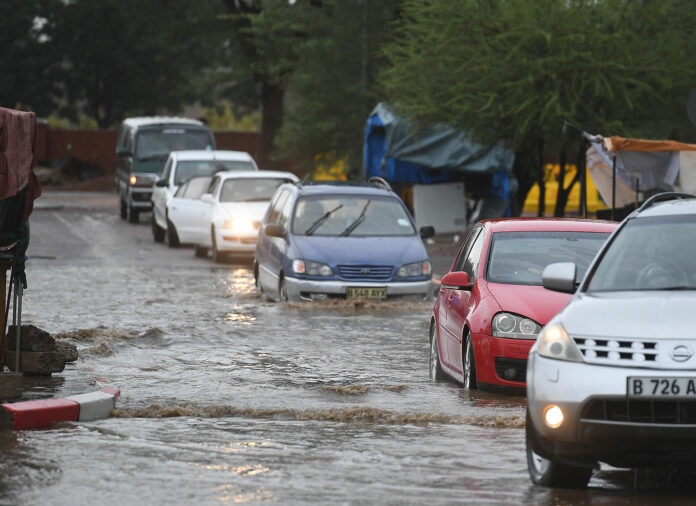
The question on most lips of Batswana is does Botswana have proper mitigation strategies to reduce the impact and risk of extreme weather events? This comes as the number of disasters has increased by a factor of five. Over the last decade, Southern Africa has been struck by several extreme weather events which left a trail of destruction in their wake. While Botswana has been fortunate enough to dodge the bullet and avoid being in the crosshairs of disasters such as Cyclone Idai and KZN floods, weather scientists caution that the vortex pull that extreme weather is exerting in neighbouring countries is likely to spill into Botswana, very soon.
The scale of the KZN flood disaster is far reaching. The floods left over 400 people dead and disrupted the lives of people in unimaginable ways. The impact will last long after the dust settles. But the number of people who have been killed and are still missing from the floods in South Africa has forced some people to question whether Botswana has proper mitigation strategies to reduce the impacts and risks of hazards through proactive measures taken before an emergency or disaster occurs.
The purpose of the National Disaster Relief Fund (NDRF) in Botswana is to provide financial assistance to natural disaster victims by meeting the cost of reconstruction and repairs to their shelters and as such other costs related to disaster relief as the minister may approve. However, Botswana got off to a bad start in the management of the NDRF. In 2009, the Office of the President of Botswana diverted close to P12.4 million which was in the accounts of the NDRF from its intended use to the formation of the Directorate of Intelligence and Security Services (DISS), sometime before the inauguration of the former President Lieutenant General Seretse Khama Ian Khama. The money was drawn in two tranches; P13 million to buy equipment, houses and for training purposes. Shortly after the P13 million was exhausted a second trench of P3 million was drawn. The money was never fully accounted for.
This is not the only time that the National disaster fund was embezzled. In 2016, the Auditor General, Pulane Letebele alleged that the National Disaster Relief Fund housed at the Office of the President had inappropriately used disaster funds to build houses in Tonota and satellite villages as well as procurement of equipment such as boat trailer, boat shelter, boat covers, camping beds and sleeping bags. In a brief comment, she noted that this “would be inappropriate for funding from the fund” as provision of houses for the destitute falls under the country wide destitute housing programme under the ministry of Local Government and Rural Development.
According to the Southern African Development Community (SADC), some of the key challenges facing the bloc include “Institutional frameworks for Disaster Risk Reduction at the regional, national and, in some cases, local/community level, which are often under‐funded and not coordinated; lack of comprehensive and constantly updated risk assessments and analysis; and weak information and knowledge management systems”.
A study entitled “International Disaster Response Law (IDRL) in Botswana” authored by University of Botswana Humanitarian Law lecturer, Elizabeth Macharia-Mokobi a few years ago noted Botswana may be at risk should a major disaster strike.
The report which sought to enquire on legal preparedness for facilitating and regulating international disaster assistance in Botswana noted that Botswana has no legal instrument that addresses disaster response.
“Existing legislation is fragmentary and while it may be used to assist in disaster situations, this may take valuable time and resources and be burdensome on government and international actors offering assistance,” reads part of her report.
Furthermore, the report highlighted that Botswana has not acceded to or domesticated most major treaties in Disaster Risk Management; has no National Disaster Risk Management legislation; has no legislation governing the facilitation and regulation of international disaster assistance and has no law that manages the international disaster assistance as in funds, food and qualified human resources.
A commentator who spoke to The Telegraph indicated that there is need for Botswana to be proactive with regards to monitoring disasters. “Botswana is prone to periodic droughts and floods that hamper socio-economic growth. What is more troubling is the fact that the existing multiplicity of laws relating to disaster risk reduction is fragmentary and burdensome,” says Ronald Dintle.
He also said that the floods which ravaged Gweta and Nata in 2008 show the importance of always making sure that the disaster relief fund is not tampered with at any point in time.
“I am grateful that disasters of such magnitude as the KZN floods have not come our way yet. Whilst I accept that no country is immune to disasters of hydro-meteorological origin, Botswana’s low coping capacity could cost us thousands of lives in the event of a disaster. We must place more emphasis on preparedness, mitigation, response, rehabilitation and recovery,” he said.
One thing that the Covid-19 pandemic has probably taught the whole world is the necessity of always having a disaster fund in case of emergencies. The idea behind the Botswana government setting up the Covid-19 Relief Fund was noble. However, the misuse of the same Fund which was meant to support vulnerable households and businesses that suffered losses due to Covid-19 had an overall negative impact. Hopefully, the political lords have learnt a lesson and will handle the National Disaster Relief Fund with utmost caution.

