

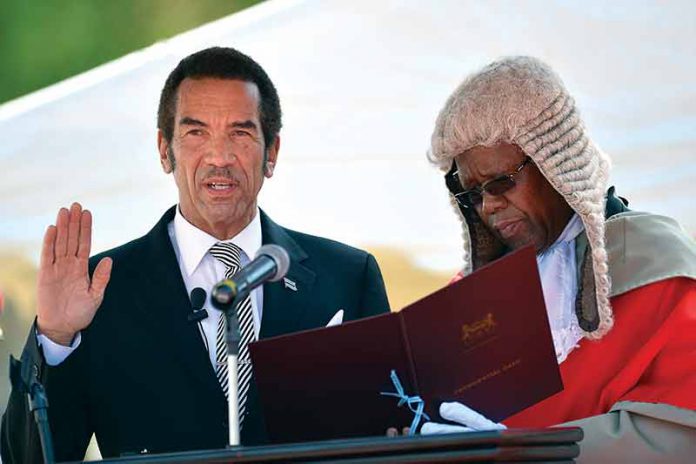
In his inauguration speech, Khama quoted Mogae’s last State of the Nation Address in which the former president stated that he had not allowed political expediency and the pursuit of populism to cloud his judgment and service to the nation as the road to political expediency and populism could be lined with cheering crowds.
Mogae had in the same breath warned that harsh punishment waited a nation that spent unwisely in pursuit of immediate gratification rather than sustainable development. Khama acknowledged the wise statement and pledged to identify himself with the former President, urging him to freely call on him at anytime to render advice on any issue of national importance and promising to do the same in return.
The question then arises whether once on the pedestal as the country’s president, Khama honored some of his noble pledges? It certainly does not appear he did. It has become apparent that Khama has allowed political expediency to cloud his judgment by throwing money at most of the economic problems that the country is faced with. Most of the projects he has initiated during his tenure as president are proving unsustainable and do not yield the desired results. Coordination and implementation of most of the projects is haphazard while the president wants to be seen to always be at the driver’s seat, undermining the authority of those seized with their implementation
When the country faced its first ever biggest civil servants strike in 2011, Khama refused to engage his predecessors for wise counsel despite the negative economic impact the strike had on the country. He further refused to engage striking workers’ unions, opting to hold kgotla meetings at which he declared that the workers could go on strike for as long as they wished.
Khama is also reported to have snubbed intervention by his predecessors in a bid to chart an end to the strike. This is despite the pledge he had made to Mogae urging him to call on him at anytime to render advice.
Elders of the Botswana Democratic Party (BDP), including former presidents are reported to have tried in vain to engage Khama during the strike. Instead the public media reported that Khama was busy holdings kgotlka meetings when it was clear that the impact of the strike on the economy had become unbearable. As if that was not enough, when his party faced an imminent split after the tumultuous Botswana Democratic Party (BDP) Kanye congress, at which his cronies lost all the elective positions, Khama snubbed the party elders who called on him to smoke the peace pipe and avoid a potential split.
It was under his watch that the BDP suffered its first ever split that led to the formation of the Botswana Movement for Democracy (BMD) that later joined forces with the Botswana National Front (BNF) and Botswana Peoples Party (BPP) to form the Umbrella for Democratic Change UDC); a party that nearly toppled the BDP’s uninterrupted rule since independence in 1966.
The handling of these two particular issues pointed clearly to a change of leadership despite Khama’s pledge that change of leadership would not entail radical changes in the way the country and the ruling party has been setting out its objectives as agreed for the benefit of the entire nation across the political divide. He maintained that his party had a manifesto that he subscribed to as well as the national development plan that he was also party to. However, the new administration adopted a change in style and special emphasis on a number of national issues. It was Khama’s assertion that this should not cause alarm or uncertainty. After all, changes had to be seen in the context of the fact that no two people were the same despite aspiring for similar overall objectives.
It was also during Khama presidency that Botswana adopted its roof top diplomacy that was not in sync with the position of the Southern African Development Community (SADC) and the African Union (AU) on a lot of issues ranging from the political crisis in Zimbabwe and the International Criminal Court’s indictment of Sudan’s President Al Bashir. Botswana pronounced its stand to arrest and hand over Bashir to the ICC if he dared set foot in the country.
During the Zimbabwe political crisis, Botswana adopted a lone position declaring never to share the stage with Robert Mugabe after the latter refused to accept an election defeat. Although Botswana finally toned down and accepted a coalition government in Zimbabwe, relations between the two neighboring states were already strained.
Often times when SADC and AU took a position on a particular issue, Botswana would have long pronounced its stance that was not in consonance with the consensus. When other heads of state attended international meetings, Khama opted to delegate such functions to his deputy.
He did not even attend the United Nations (UN) summits opting instead to attend conservation meetings. This tendency has denied Botswana an opportunity to be heard at the international stage because its head of state was occupied elsewhere.
It was under Khama’s rule that poverty levels and unemployment soared to uncontrollable highs despite his pledge for improved economic diversification. Although he promised special emphasis on employment creation and poverty alleviation, programmes for the youth, health, housing and the fight against crime, not much has been so far achieved.
It is unlikely that much will be achieved in the remaining months of Khama’s presidency despite his acknowledgement that Botswana is no longer seen as the only beacon of success in Africa. Khama has however correctly acknowledged that a growing number of countries on the African continent had become stable, democratic and increasingly attractive for investors, tourists and like spirited people.
It was also during his presidency that he implemented the alcohol levy that has led to the dwindling profits of Sechaba Holdings Limited, the parent company for Kgalagadi Breweries and Botswana Breweries.
Despite his four Ds of Democracy, Development, Dignity and Discipline roadmap, Botswana is quickly losing the democratic credentials that it had been renowned for.
Tourist arrival figures are reportedly on the decline since Khama’s ascension to the presidency. Khama also comes across as the only president who has never held a local press conference in which the media has been afforded the platform to interrogate his economic policies as well as his political agenda.
His disdain for the private press is unrivalled. Khama has never held a press conference save for interviews with a few select media houses which in all fairness failed to hold him to account for the many ills that the country is grappling with.
Although professing to be a democrat and believing in democratic ideals, it is under his watch that the judiciary is facing its worst crisis ever following the suspension of four High Court judges for allegedly receiving housing allowances while occupying institutional houses.
Corruption is also reportedly rearing its ugly head under his watch. Some of his cronies have been linked to serious acts of corruption but have not been taken to task and are still holding office despite the chilling allegations.

