

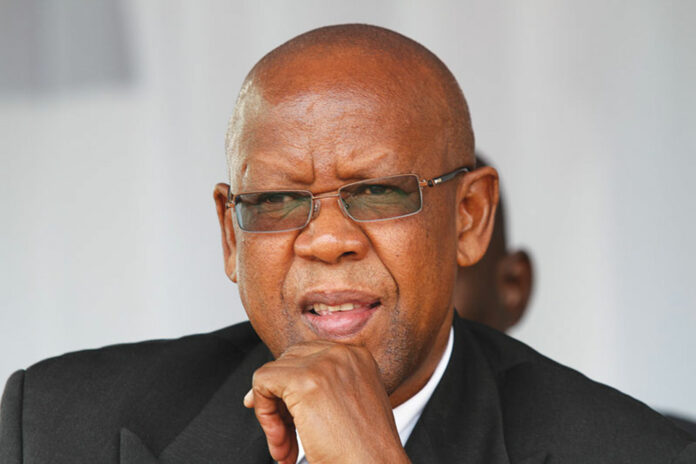
In a highly unusual development in the judiciary, a judge wants President Mokgweetsi Masisi and the Judicial Services Commission (JSC) to reverse (“set aside”) its decision to appoint a professional colleague of his as Court of Appeal judge and appoint him to that position instead.
The first judge is Justice Tshepo Motswagole who works at the Gaborone High Court. Upon completing his LLB at the University of Botswana, Motswagole began his legal career as a magistrate. While he would later go into private practice, he later returned to the civil service to work as Deputy Government Attorney. Soon thereafter, he obtained an LLM from the University of Witwatersrand and in 2010, was appointed High Court judge. In the period of time that he was in private practice, Motswagole dabbled in opposition politics, becoming Gaborone Deputy Mayor. The mayor was Paul Rantao, who went on to become the first Gaborone West MP on a Botswana National Front ticket.
The second judge is Justice Goemekgabo Tebogo-Maruping who has been working Judge President at the Industrial Court for the past 20 years. He wrote in his LinkedIn profile while, he was still at the Industrial Court: “I lead a team of Judges and court personnel/support staff, including Registrars and Law internees (Local and International), hear labour disputes generally, research and write judgments.” Tebogo-Maruping holds an LLM in commercial and corporate law from the London School of Economics and an LLB from the University of Swaziland. His career started at the Attorney General Chambers in 1984 when he was appointed State Counsel.
This year, a position for judge opened up at the highest court in the land – the Court of Appeal – and both men applied to fill it. From reading the “intention of notice to sue” written by Motswagole’s lawyers, Monthe Marumo & Co., it is unclear how many judges applied. However, there is revelation that Motswagole and Tebogo-Maruping were the only ones who ended up being shortlisted. Applications to the bench are evaluated by the Judicial Services Commission (JSC) which is made up of the Chief Justice, Judge President of the Court of Appeal, Chairperson of the Public Service Commission, Attorney General and “a person of integrity and experience who is not a legal practitioner.” Following such evaluation, the JSC makes recommendations to the president, who is the appointing authority.
The JSC evaluation happened sometime in “July/August” and recommended Tebogo-Maruping over Motswagole. Such recommendation was then passed on to President Masisi who appointed Tebogo-Maruping to the CoA effective October 1. Upon conviction that he was better qualified for the position, Motswagole wants Masisi to reverse Tebogo-Maruping’s appointment and appoint him instead.
Motswagole’s lawyers single out the CoA President, a JSC member, for having “unjustifiably disqualified our client and recommended the other candidate who did not even meet the minimum and basic requirements for the office.” Perhaps the most startling part of the Notice of Intention to Sue is the part where the lawyers reveal reasons that were given for disqualifying Motswagole.
“The ‘evaluation’ carried out against our client was not based on objective facts. Our client was insulted, belittled and labelled obstinate, bad-tempered, an anti-death penalty activist, a violator of the constitution and an anarchist who caused confusion and initiated a petition against the Chief Justice and delayed judgements. The foregoing allegations were made with full knowledge that the same were not true,”
In order to repair such harm, they are demanding that their client should be declared “the only qualified candidate of the two shortlisted candidates, and is accordingly deemed duly recommended for advancement, elevation and promotion to the office of Justice of Appeal.” In service of the latter, they want the JSC to make such recommendation to President Masisi.
Motswagole’s fight is much broader and targets long-established processes through which judges are appointed to the CoA.
In the Notice of Intention to Sue, his lawyers argue that the appointment of High Court judges to the “more prestigious” positions of Chief Justice, Justices of Appeal and CoA President are “arbitrary and discriminatory.” Their diagnosis of the problem is that there is no “clear written policy on career development path” and that such gap “has opened the door to habitual and wanton disregard for statutory prescription on seniority” as outlined in both the High Court Act and the Court of Appeal Act and also compromises judicial independence and impartiality. On the basis of the foregoing, Monthe Marumo & Co. argue that “hardworking”, “diligent” and “credible” judges are “devalued and there is a reasonable suspicion that they are being victimised for their decisional independence in order to pressure them into capitulation and betrayal of oath of office in consideration of monetary advantage.”
The empanelling of the CoA with High Court judges is also described as “arbitrary and discriminatory.” The reason given for such accusation is that this assignment is given to “certain judges” at the exclusion of their equally competent colleagues. In another part of the Notice of Intention to Sue, this practice is likened to “nepotism and patronage” by the appointing authorities. Monthe, Marumo & Co argue that this practice, which Motswagole “has been a victim of”, is “tantamount to unlawful suspension.” They further argue that the CoA President has transformed “this illegal practice” into a rule of procedure.
The lawyers describe as “secretive” a practice through which vacant positions at the CoA are filled and to that end, comparing it unfavourably with the transparency used at the High Court. They argue that “failure to advertise objective eligibility criteria and selection method filling up vacant offices” has resulted in “arbitrary secretive appointments based on patronage and favouritism and thereby lacking in legality and consequently, a court so constituted is not a court ‘established or recognised by law’ within the meaning of Section 10(1) as read with Section 127(10) of the Constitution.”
Justice Motswagole wants wholesale reversal of the injustices that he is complaining about. He wants the Administration of Justice to adopt “a revolving roster that is accommodative of seniority, availability, and equality of opportunity” for all High Court judges; a declaration that the current practice by the Chief Justice and CoA President violates his rights to equality; a declaration that such conduct offends principles of the rule of law, protection under the law, equal opportunity, non-discrimination as well as fairness and transparency as prescribed in the Constitution, the Court of Appeal Act, the High Court Act as well as the Public Service Act and its regulations; and a declaration that the judiciary is legally bound to advertise positions at the CoA.
He wants the JSC to be directed that within 30 days, it should have put in place, “a reliable system of judicial appointments that covers the publication of vacancies, prior objective eligibility criteria, the proportionate weighing of each factor, transparent selection method, and the justificatory process for, and publication of each decision, consistent with the rule of law, the independence and impartiality of the judiciary.” He also wants the JSC to consult with judges and submit to President Masisi, comprehensive statutory and administrative reforms and recommendations that enhance the separation of powers, the rule of law and judicial independence. The entire process should be conducted within 60 days.
The lawyers warn that if such demands are not met within 30 days, effective October 14, 2022, then they will launch a case at the High Court against Masisi, Chief Justice, CoA President, Attorney General and Tebogo-Maruping.

