

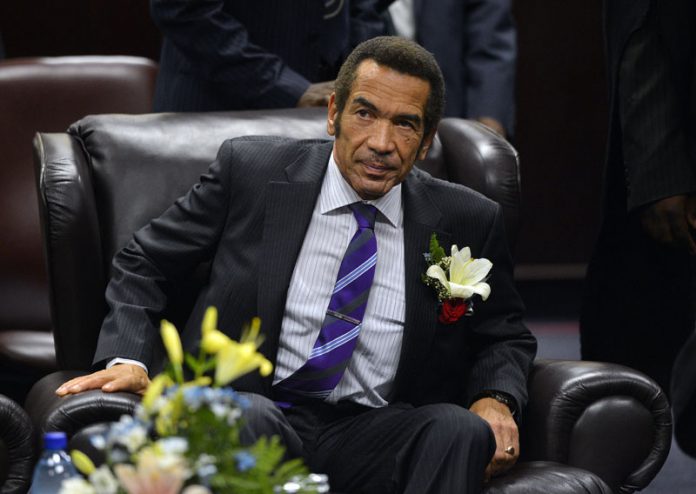
A growing number of Batswana are having the same bad dream. In it, President Ian Khama is turning the judiciary into his lap-dog: Judges who do not fit into his plan are being purged and those he can bend to his will are being whipped into line. This may not be pure fantasy; something similar may actually be happening. Khama wasted no time in asserting his power on the judiciary. Among the first items in his “IN” tray was a list of names recommended to the bench by the Judicial Services Commission (JSC). The new President threw the list into his trash can.
This signalled a break with the tradition that was followed by his predecessors. Khama was sending a message. Indications are that the JSC was listening and a few months later it sneaked judicial appointments procedural reforms through the back door to give Khama the power to choose judges. Under the new system, the President’s powers were extended beyond being an appointing authority. He now had a hand in choosing who should be appointed to the bench.
Under the old system, the President only had the power to appoint judges but had no discretionary powers to choose who he liked. The JSC would interview candidates and recommend names to the President for appointment as per Section 96(2) of the Botswana Constitution.
Under the reformed system, the JSC interviews candidates and then gives President Khama a list of names to choose from. The new system was first used in the appointments of Justice Tshepo Motswagole and Justice Ookeditse Tshosa as full time judges and Justice Michael Leburu and Justice Kholisani Solo as acting judges.
With the JSC playing ball, Khama’s train was on a roll and a few squeals on the sideline could not stop it. The power to appoint High Court and Court of Appeal judges is one of the great prizes of any Presidency, and Khama assumed office at a propitious moment. In 2009 Unity Dow stepped down as High Court judge, creating a vacancy on the bench. A year later Chief Justice Julian Nganunu stepped down and Justice Maruping Dibotelo was appointed to the post, creating a vacancy on the bench. Six months thereafter Justice Tebutt stepped down after serving 16 years in the Court of Appeal, the last nine as President of the court. Justice Kirby was appointed Judge President. This came at a time when plans to establish a permanent Court of Appeal were in motion. Justice Isaac Lesetedi and Justice Stephen Gaongalelwe were appointed to the Court of Appeal, creating more vacancies on the bench. President Khama later appointed Justice Elijah Legwaila as the fourth permanent member of the Court of Appeal after trade unions challenged his appointment to the Industrial Court after he had turned 70.
During his term, President Khama has appointed all permanent members of the Court of Appeal and 11 of the 22 High Court Judges, the highest number of appointment by a single sitting President so far. The number is expected to increase before the end of his term, with Justice Phumaphi due to retire in December and Justice Walia in 16 months. This gives Khama unrivalled power to impact various legal, political, and policy debates and determinations through his judicial appointments. At the Court of Appeal level judges’ decisions become the precedent and provide persuasive authority for other courts. Even at the High Court, the Justices’ decisions set an enduring precedent ÔÇô one that is not often subsequently reversed. Because High Court judges are tenured for life, the President can leave a lasting impact on Botswana and its laws long after his Presidency has ended. Lawyers argue that, consequently, it is critical to be informed about the President’s motivation and understand the types of individuals he will likely appoint to the bench. President Khama however told the High Court recently that he is not obliged to disclose his reasons. Khama watchers have resorted to simply joining the dots, and a sinister outline has emerged. That the President has a grand plan to create a judiciary that bends to his will. The conspiracy theory sees Khama retiring under the protection of a friendly Court of Appeal, bench and Chief Justice. There is however a small problem: the High Court succession plan is unlikely to deliver a friendly Chief Justice. With justice Dibotelo due to retire before the end of Khama’s tenure, the next is inline is Justice Phumaphi who is past his retirement age and will step down in December. Next in line is Justice Walia who has indicated that he is not interested in the top post because he will be retiring in about16 months. This leaves Khama with Justice Key Dingake who is widely believed to be a maverick with an anti-establishment streak.
This has stoked speculation that that the recent decision to suspend four High Court judges was fancy footwork by the Office of the President and Administration of Justice to get rid of Justice Dingake. Insiders say President Ian Khama’s decision to suspend Justice Dingake, Justice Modiri Letsididi, Justice Mercy Garekwe and Justice Ranier Busang after they were accused undermining Chief Justice Maruping Dibotelo and bringing the judiciary into disrepute is part of a large and calculated plan to have Dingake sacked.
While President Khama is believed to be marshalling the ascendency of an executive minded bench, Justice Key Dingake on the other hand never passes up an opportunity to speak out against executive minded judges and has even hinted support for a more transparent appointment of judges.
In his paper: “The Role of the judiciary and the legal profession in protecting the rights of vulnerable groups in Botswana”Dingake does not hide his disdain for executive minded judges. In a tribute to the late Justice Moatlhodi Marumo justice Dingake said, “Marumo was of the view that if the powerful in society abuse their powers without restraint, it is essentially because of the dominant influence of timorous souls and those who Lord Atkin, in the celebrated case of Liversidge v Anderson, said were more executive minded than the executive.”
Justice Dingake even hinted that he was opposed to President Khama’s decision to declare former University of Botswana Professor Kenneth Good a prohibited immigrant stating: “Not long after joining the bench, he presided over the first phase of Professor Good v The Attorney General case. Professor Good had been declared a prohibited immigrant by the President of the Republic.
He approached the court challenging the presidential directive. Marumo J (as he then was) issued an interim order halting the deportation. The rest as they say is for future historians to grapple with ÔÇô but whatever historians’ final verdict will be, I am certain that history will absolve him.”
Earlier this year, while speaking during a workshop organised for judges and magistrates by the Southern Africa Litigation Centre, Justice Dingake warned that “executive mindedness undermines the peoples’ confidence in the independence of the judiciary.” Justice Dingake reiterated his position last month at a workshop organised by the International Commission of Jurists in Pretoria, South Africa. President Khama has appointed a tribunal to investigate whether Justice Dingake, Justice Letsididi, Justice Garekwe and Justice Busang “ought to be removed from the office of judge of the High Court for misbehaviour.” The tribunal is tasked with investigating whether the letter calling for the impeachment of the Chief justice was written by the quartet and whether this amounts to misbehaviour within the meaning of Section 97 and if so whether they ought to be removed from office. The plan, however may backfire because the petition at the centre of the investigation was signed by 12 judges. Should the tribunal decide against the four judges, then the decision will have to be extended to the rest of the 12 judges, plunging the judiciary into a crisis. In a bid to get around the problem, the Office of the President has been calling in some of the judges who have signed the petition and promising them indemnity if they withdraw their signatures.

