

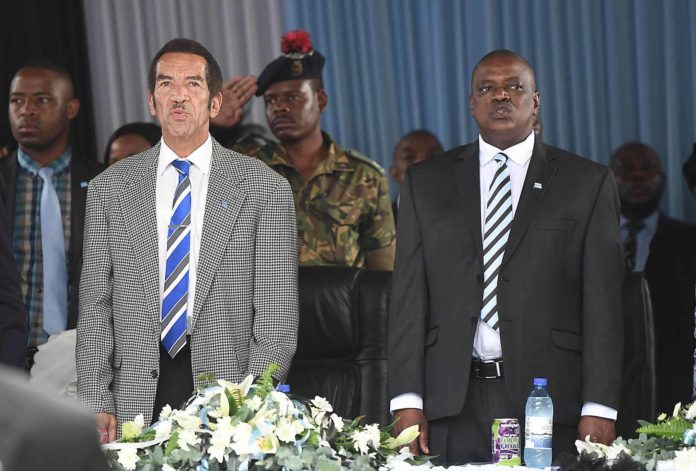
When two men who grew up in Botswana’s only presidential factory and would themselves become presidents don’t see eye to eye, the most natural question to ask is the one we asked former president Ian Khama: Both of you grew up in Extension 5 and would have interacted while you were still young; on the whole, what sort of relationship did you have as children and in your youth? While brief, his response is worth more than a thousand words: “There was no relationship in our youth.”
The other half of “our” is President Mokgweetsi Masisi. Khama is the son of founding president, Sir Seretse Khama and Masisi that of Edison Masisi, who was one of Sir Seretse’s ministers in the founding cabinet. Both Ian Khama and Mokgweetsi Masisi grew up in Extension 5, an enclave of Botswana’s first capitalist overachievers and political royalty, which is smack bang in the middle of Gaborone, the capital city. Extension 5’s centerpiece is the State House, the official presidential residence and arrayed around it are ministerial residences. So, Khama grew up in State House and Masisi at one of the ministerial residences not far from the latter.
All this happened at a time that Gaborone had very few residents – and Extension 5 had even fewer. Thus far, all five Botswana presidents have very deep Extension 5 roots: Sir Seretse and his successor, Sir Ketumile Masire, founded it and as one of the first university graduates in independent Botswana, Festus Mogae was among the earliest residents.Born in 1954, Khama is nine years older than President Mokgweetsi Masisi. It is understandable why the former would skate over the childhood part of the question we posed because it is unlikely that people with that age difference would have shared that developmental phase.
At a time that the teenage Khama was beginning to discover the world, donning bell-bottom trousers and style-walking, Masisi would have been a pupil at Thornhill Primary School, tottering about in a pair of black Student Prince shoes.If the former had a relationship with anyone in the Masisi household, it would have been the latter’s elder brother – Tshelang – but more of that latter. However, when Khama was 27, Masisi was 18 and it is not unusual for people with that age difference to do what today’s urban youth call “chilling” together.
Theoretically, that both men have been teetotalers their entire lives (Khama because of aversion to alcohol, Masisi because of the hole that alcohol consumption burns in one’s pocket) should also have brought them together. Khama is from the Bangwato royal family and was installed as kgosi in 1979. Sir Seretse performed the ceremonial garbing of a new kgosi with a lion skin coat, the animal choice being a peculiarity in a cultural main that uses a leopard skin-coat for such adornment. Addressing a kgotla meeting in Serowe in 2018, Masisi revealed that he attended the installation ceremony. As the Bangwato tribal capital, Serowe was settled in 1901 by Khama’s great-grandfather, Kgosi Khama III, after a brief stay in Palapye.
In adult life, Khama would go into the army while Masisi became a teacher and later UN worker. Khama was the first to go into politics (in 1998) as Vice President and would serve in the same parliament as Tshelang Masisi, who was Francistown West MP. Masisi would follow much later and only after an unsuccessful run for the Moshupa parliamentary seat. Khama immediately made him assistant minister at the Office of the President – which some people connected to their common Extension 5 history that goes back to their formative years.
Masisi became vice president after serving for only five years – a rarity in modern times. A couple of primary reasons have been given for that promotion but the secondary one is, once more, linked to a common Extension 5 past.There was expectation by some that even after Khama stepped down, Masisi would keep him onside and serve as some kind of regent-president for Khama’s younger brother, Tshekedi. However, on the very day that the presidential change of guard happened, Masisi appointed Slumber Tsogwane as his vice president, effectively pushing Tshekedi to the back of the line. Shortly thereafter, the animosity between Masisi and Khama, which had apparently been playing itself out in private, overspilled onto the public arena. The inflection point was when Khama left the Botswana Democratic Party, which his father co-founded, to form the Botswana Patriotic Front.
Two years later, the animosity shows no signs of abating and of late, Khama has publicly claimed that Masisi wants to assassinate him. Ironically, the head of the Directorate of Intelligence services and Security, Peter Magosi, has also alleged an assassination plot against Masisi. To be absolutely clear, Magosi never named names but in a newspaper interview, Khama has addressed speculation that he was behind such plot.
The situation described is one that would raise the question: Both of you grew up in Extension 5 and would have interacted while you were still young; on the whole, what sort of relationship did you have as children and in your youth? Khama’s response helps illuminate – if not confirm – an article that appeared in the Botswana Guardian years ago when he was still Vice President. The article alleged that Khama’s leadership style rankled with the parliamentary party and became an agenda item at a caucus meeting – which is held when parliament is sitting.
Tshelang Masisi was reported to have told Khama that he had changed from what he was during his childhood when he (Khama) would play with Masisi and other boys from around the neighbourhood. To that, Khama was reported to have said that “The Honourable Member is mistaken” because he (Khama) had “grown up in boarding schools” and not Extension 5. To Midweek Sun and in addressing a different issue, Khama said that having spent most of his childhood at boarding schools (in Zimbabwe and Swaziland) was the reason his handle on Setswana was infirm.
A little over a year ago, Masisi dropped Tshekedi Khama from cabinet and Sunday Standard made a historical-trivia observation that the development marked the first time in more than a century that a Khama has not been part of the national executive leadership. The Khamas rose to prominence in the late 1800s when Khama III became an influential political figure. BPF spokesman, Justice Motlhabani, understood the article to be implicating the family for undue political dominance. He countered by asserting that going back to 1966 to date, each Botswana parliament has had a Masisi as an MP – which is true.

