

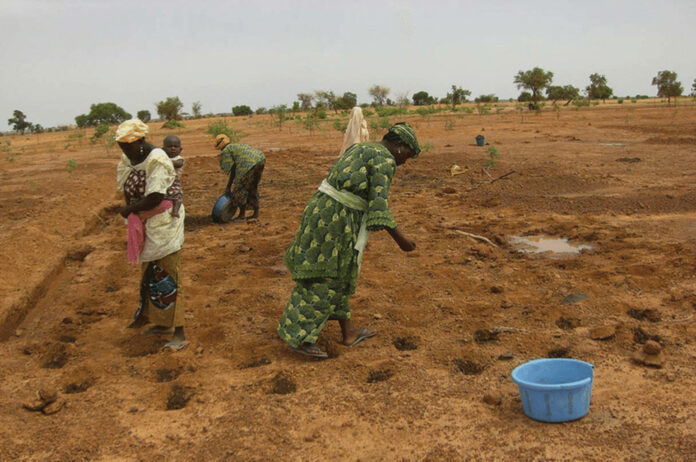
Land degradation is a problem which could result in ripple effects being felt across various sectors in Botswana. Land degradation – a process in which the value of the biophysical environment is affected by a combination of human-induced processes acting upon the land – is stressing Botswana’s arable lands and pastures which are critical for food production, livelihoods, and the production and provision of other ecosystem goods and services.
Wherever land degradation occurs it often results in the reduction of biological potential or the carrying capacity of land to unsustainable levels. The effects of land degradation in Botswana became clear over the past few years as evidenced by communities experiencing crop failure, hunger, and failure of soil to retain moisture. Although there is no new data available to assess the extent of land degradation, some studies found out that 91,000 km2 or 15.5% of Botswana is affected by land degradation or desertification. It is also estimated that the annual cost of land degradation in Botswana is between P3billion and P3.5billion.
An Environmentalist who spoke this publication explained that land degradation has catastrophic effects on human health including threats of food insecurity which ultimately leads to malnutrition. She also notes that land degradation causes water borne diseases due to poor hygiene and a lack of clean water; as well as air borne pollutants which increase respiratory diseases.
“Apart from causing damage to the ecosystem and affecting food production, land degradation can cause malnutrition from reduced food and water supplies, respiratory diseases caused by atmospheric dust from wind erosion and other air pollutants as well as the spread of infectious diseases as populations migrate,” says Tuelo Dibeko.
In Botswana, land degradation has accelerated over the last few decades and combined pressures of agricultural and livestock production, urbanisation, deforestation and droughts has resulted in land losing its productive capacity – to some degree. Regionally the situation does not look good either because the African continent is the only continent where deforestation and forest conversion to agricultural land is on the rise.
A fresh report which explores the cross-sectoral linkages of land-water-energy (LWE) systems that can be used to leverage progress towards achieving land degradation neutrality (LDN) highlights that Botswana should embrace commitments to better manage and restore land resource. The report entitled “Regional Thematic Report for Southern Africa Leveraging the Land, Water and Energy Nexus in SADC” which was published for the United Nations Convention to Combat Desertification (UNCCD) states that Botswana and southern African countries are going to experience strong pressures on land and land-based resources, exacerbated by various physical and social stressors. The report also urged Botswana to integrate water management into land restoration commitments. “Botswana, DRC and Madagascar should consider the integration of water management and conflicting water needs into land restoration commitments,” reads part of the report.
According to the United Nations Convention to Combat Desertification (UNCCD), over 120 countries have engaged with the land degradation neutrality (LDN) Target Setting Programme and considerable progress has been made since the 2030 Agenda was adopted in 2015. The Land Degradation Neutrality Target Setting Programme (LDN TSP) assists countries in making the LDN concept a reality by 2030, by providing practical tools and guidance for the establishment of voluntary LDN targets, accelerating the implementation of transformative programmes and projects, with positive changes.
Botswana has already jumped on the bandwagon. The Ministry of Environment, Natural Resources Conservation and Tourism (MENT) has made concerted efforts to domesticate and implement United Nations Convection to Combat Desertification Convention (UNCCD) which aims to protect and restore our land and ensure a safer, just, and more sustainable future. Furthermore, the ministry of environment through the Department of Forestry and Range Resources (DFRR) embarked on a project to restore degraded land and soil in order to achieve land degradation neutrality (LDN).
Land Degradation Neutrality (LDN) is defined by the Parties to the United Nations Framework Convention on Climate Change (UNFCCC) as: “A state whereby the amount and quality of land resources, necessary to support ecosystem functions and services and enhance food security, remains stable or increases within specified temporal and spatial scales and ecosystems.”
Although Botswana has not had any substantial investments in sustainable land management, the decision to embark on land degradation neutrality is important on many levels chief of which is the fact that the United Nations (UN) reaffirmed that LDN has the potential to act as an accelerator of Sustainable Development Goals.
The minister of Environment, Natural Resources Conservation and Tourism, Philda Kereng has on several occasions pointed out that land degradation is a major cause of the declining agricultural and rangeland productivity in Botswana.
“If not controlled it will lead to the deterioration of biodiversity and food security in the country,” she said back then.
Sustainable Development Goal (SDG) 15, Life on Land, is defined by the United Nations (UN) as halting and reversing land degradation, halting biodiversity loss, combating desertification and sustainably managing forests. SDG 15.3 states that “by 2030, combat desertification, restore degraded land and soil, including land affected by desertification, drought and floods, and strive to achieve a land degradation-neutral world.” This target is a great prospect for Botswana to curb the budding threats of land degradation and to reap numerous socio-economic benefits.

