

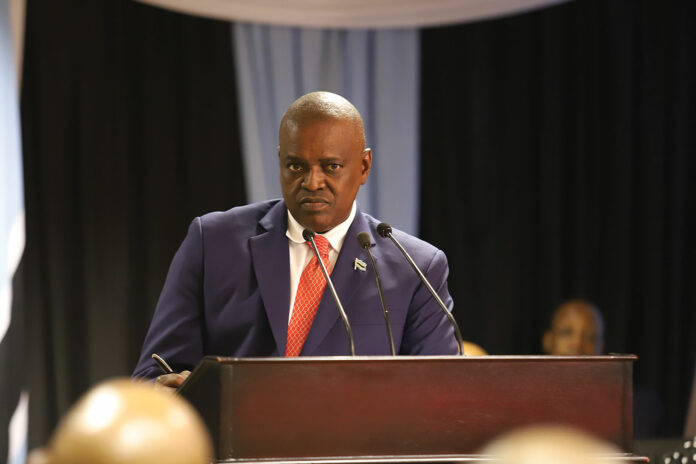
Russia’s president Vladimir Putin’s envoy is reported to have abruptly canceled a high stakes meeting with Botswana’s President Mokgweetsi Masisi in a move that marks the lowest point in the strained relationship between the two countries.
Botswana and South Africa are currently caught up in a battle of narratives by Russia and the European Union (EU) over the invasion of Ukraine.
EU High Representative for Foreign Affairs and Security Policy Josep Borrell who visited Botswana and South Africa recently to drum up support against Russia’s invasion of Ukraine has classified Botswana as “ a like-minded partner of the EU” – a document passed to the Sunday Standard has revealed. Russia on the other hand has classified Botswana as “ unfriendly”, a document passed to the Sunday Standard has suggested.
Unconfirmed reports have further revealed that Russia’s Foreign Minister Sergey Lavrov has dropped Botswana from his scheduled tour of African countries to canvass support for the invasion of Ukraine.
The development marks a new blow to already strained Botswana- Russia relations that have been in a downward spiral for months since Putin’s invasion of Ukraine.
Media reports indicate that Lavrov’s canceled the visit to Botswana which was part of Russia’s efforts to boost international support for Putin’s war effort in Ukraine. Lavrov was expected to visit Eswatini, Botswana and Angola after South Africa.
A document by EU’s Josep Borrell appraising EU members about his recent visit to Botswana and South Africa further revealed that that the two Southern African neighbours hold conflicting view on Russia’s invasion of Ukraine.
The Russian embassy in Gaborone and Botswana’s Ministry of Foreign Affairs as well as the Botswana Government spokesperson did not respond toSunday Standard enquiries.
In his report, Borrell had this to say about Botswana:”This landlocked country in Southern Africa with some 2.5 million inhabitants is a like-minded partner of the EU. In my meeting with Foreign Minister Kwape…… We also discussed multilateral issues with both partners and above all Russia’s war against Ukraine. And here, there are significant differences between Botswana and South Africa. While Botswana voted in favor of the UN resolutions in March and in October condemning the Russian aggression and the illegal annexation of Ukrainian territories and while Botswana has engaged with Russia asking to end this invasion, South Africa abstained in both cases.
Russia’s alleged decision to cancell its diplomatic engagement with Botswana does not come as a surprise. Ahead of last year’s UN resolution vote to suspend Russia from the Human Rights Council in which Botswana abstained, Russia circulated a note that read in part: “It is worth mentioning that not only support for such an initiative, but also an equidistant position in the vote (abstention or non-participation) will be considered as an unfriendly gesture.”
While Botswana could afford to antagonise Russia, it couldn’t do so with the United States, the main export market for its diamonds and one of its main donors. Russia’s suspension from the Human Rights Council came at the instance of the US, which also quietly exerted pressure on mostly Third World countries to do its bidding. The US voted “yes” and Botswana’s abstention was effectively also a “yes.”
Botswana-Russia relationship goes back to 1970 when the embassy of the Soviet Union and the High Commission of Botswana in London exchanged notes. In 1976, Russia opened an embassy in Gaborone while Botswana covers Russia from its embassy in Sweden and also an honorary consulate in Moscow. The relationship between the two countries has grown over decades – Norilsk Nickel, which mined nickel in Francistown, is a Russian company. However, the trade and economic cooperation between them is dwarfed many, many times over by that between Botswana and the US, which also extends to other areas. Botswana was one of the main beneficiaries of the he U.S. President’s Emergency Plan for AIDS Relief (PEPFAR), the largest commitment by any nation to address a single disease in history.
While it played the standard diplomatic game with the Human Rights Council, Botswana was more forthright in condemning Russia (via a UN General Assembly vote) after it invaded Ukraine. At this point, it is unclear how and when Russia will punish the “unfriendly gesture” of Botswana and other countries but it has made that much very clear.
The second part of Russia’s statement reads: “The position of each country will be taken into account both in the development of bilateral relations and in the work on the issues important for it within the framework of the U.N.”

