

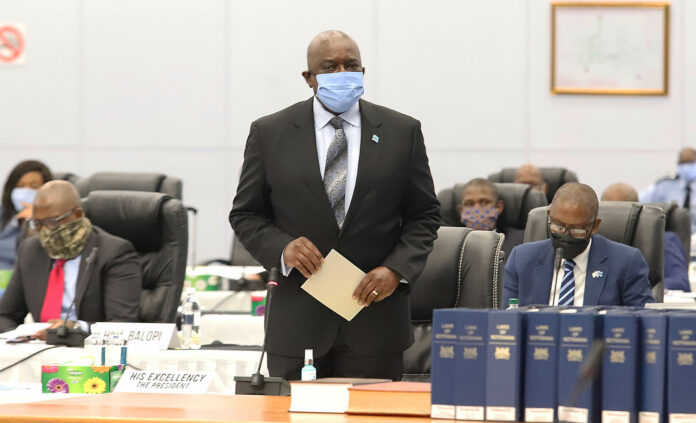
Officially, President Mokgweetsi Masisi visited Serowe a fortnight ago to comfort a traumatised family. The family is that of the Minister of Local Government and Rural Development, Kgotla Autlwetse, which suffered arson at the hands of some local residents who paid an unsocial visit in the wee hours of the morning. A vehicle belonging to the minister’s wife burnt to ashes while a rapid response team put out a fire that started in the kitchen and was spreading to the rest of the house.
In departing from the official purpose and veering off into the realm of self-indulgence, the president committed a series of faux pas that had the effect of undermining the dignity of the office he holds. Then again, the composition of the welcoming party was designed in such manner as to heighten the chances of such faux pas occurring. Oddly for a visit of stated purpose, some in the welcoming party were decked out in full Botswana Democratic Party attire. The latter was clear indication that in addition to the comforting, partisan politics would also be thrown in as well. The latter happened when the president attacked both the Leader of the Opposition, Dumelang Saleshando, and his father, Gilson Saleshando.
He complained about Dumelang being in the habit of insulting him during parliamentary debates, then made a shocking statement – that Dumelang takes after the father, who served a stint as Selebi Phikwe MP between 1994 and 1999. Masisi invited his audience – which included everybody with access to the Facebook pages that his speech was livestreamed on, to verify this claim by looking up back issues of the Hansard, the parliamentary record of proceedings. The most offensive part was not the accusation itself but the Setswana that the president used: “O goditse yo a mo tsetseng.” The English translation [“He takes after the father”] seems innocent enough but in reality, the cultural context of “tsetseng” is not. The word means “sired”, is ordinarily used to refer to animals but becomes an insult when used on people.
It seems unlikely that despite his rivalry with Saleshando, Masisi would knowingly use insulting language to refer to his father. What is certain is that the president habitually uses Setswana that he apparently doesn’t understand. The latter may have to do with the fact that he grew up in Botswana’s first suburb and went to elite private schools (Thornhill Primary School and Maru-a-Pula School) where indigenous culture is not only shunned but actively discouraged as well.
Once before, the president has, in the same sentence, described himself as both a lelope and lelatswathipa, which are two completely different things. A lelope is a member of the Kgosi’s advisory council while a lelatswathipa (literally “knifelicker”) is a bootlicker. While Masisi mistaken conflation of these terms can be attributed to broader mistaken use by the general public, his position imposes greater responsibility with regard to linguistic competence. “Lelope” has been corrupted in much the same way that one too many young people who don’t listen to the Dipina le Maboko programme on Radio Botswana have, via a popular hip hop song, corrupted “Ke letsitsiropi ke legwaragwara” in Ponatshego Mokane’s poem to “Ke letsitsiropi ke legwatagwata.”
As all politicians, Masisi feels the need to demonstrate familiarity with the ways and language of ordinary folk. A member of the Bakgatla-wa-ga-Mmanaana tribe, he expressed solidarity with his Bangwato audience in Serowe by alluding to fictive tribal cousinship between the two tribes. There is actually no such kinship between Bangwato and Bakgatla-ba-ga-Mmanaana, who broke away from Bakgatla-ba-ga-Kgafela and are now an independent tribe. However, there is such kinship between Bangwato and Bakgatla-ba-ga-Kgafela. When they broke away from Bakgatla-ba-ga-Kgafela, Bakgatla-ba-ga-Mmanaana came to Botswana and interacted with Bangwato. However, the two tribes never established fictive cousinship. In claiming cousinship with Bangwato, Masisi was identifying himself with a Kgatla clan that he actually doesn’t belong to.
One admits of possibility that the president intentionally used the offensive word about Saleshando’s father because there is an example of him using offensive language purposefully. Deploying a mocking verbal mannerism (“nywee”) that is typically used in exaggerated form to describe bratty conduct, Masisi complained at a kgotla meeting that some “elderly” people begged for material goods from him. He gave the hypothetical example of an elder asking for a fence wire roll with “Nywee, tautona ke kopa terata.”
Masisi was hauled over the coals in the just-ended session of parliament when the Minister for Presidential Affairs, Governance and Public Administration, Kabo Morwaeng, cautioned opposition MPs for using insulting language on him – the president. Speaker after speaker reminded Morwaeng that the president himself routinely uses insulting language on ordinary folk. The Serowe and “nywee” were given as examples. Francistown South MP, Wynter Mmolotsi, even asked Morwaeng whether he was really serious or was just mocking someone known to use insulting language himself.
There can be no doubt that the president has put himself in an extremely difficult position. As president he has to set an example for the rest of the nation but as MPs credibly argued in parliament, he is failing to do that. There may be a solution: he should try not to use too much Setswana, especially the classic type, off-the-cuff. Granted, he can use some classic Setswana words like “serubi” and “pula ya masusubele” (which he may have memorised to dazzle his listeners) but he hasn’t developed comfort level with the language. Given his socio-economic and professional background, English (and not Setswana) is his principal conversational language. Save for normal slips of the tongue, the president never puts his foot in the mouth when he speaks English. This clearly shows which language he is more comfortable with, especially in public speaking.
It is good that Masisi speaks fluent Setswana but to contrive comfort with classic Setswana is getting him into trouble. People in his position have whole armies of speechwriters who can translate the English version into Setswana and all he would have to do is repeat what is on the page. The “nywee” example shows that he would do well to stop riffing in Setswana. The term is properly rendered as “nywee-nywee” but he didn’t say the second half, suggesting that he caught himself a split second too late.

