

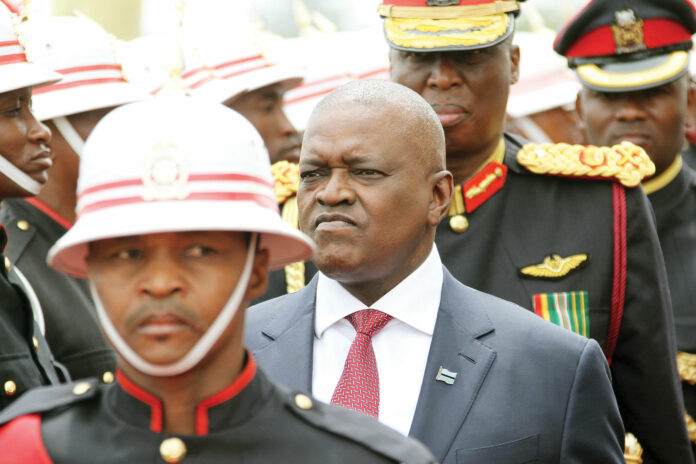
President Mokgweetsi Masisi’s international messianic halo was last week smashed by a German democracy and human rights watchdog, suggesting that his international political honeymoon is officially over.
The Bertelsmann Stiftung’s Transformation Index which was published last week stated that “President Masisi seems to be as intolerant of his opponents as former President Khama.”
For the first time since he ascended to the presidency, an international democracy and human rights watchdog broke away from the popular portrait of Masisi as the potential saviour of Botswana’s democracy as instead recast him as a villain.
The Bertelsmann Stiftung’s Transformation Index 2021 stated that, “although public expectations were quite high when President Masisi succeeded Ian Khama in March 2018, it did not take long for Masisi to display an intolerance of his opponents and private media. Masisi’s intolerance first came to the fore when Pelonomi Venson-Moitoi declared her intent to challenge him for the position of party president, which was to be decided at a party congress in April 2019. Venson-Moitoi was immediately vilified and harassed and prevented from campaigning freely.”
The phrase “Masisi’s intolerance” comes up more than a dozen times in the ten page report on Botswana. This is a break from previous reports by international democracy and human rights watchdogs which portrayed Masisi as the knight in shining armour who will liberate Botswana after 10 years of Khama’s dictatorship.
The United States Department of State 2019 Botswana human rights report concluded that President Mokgweetsi Masisi had so far performed better than his predecessor Lt Gen Ian Khama on press freedom, transparency, human rights and civil liberties.
The report drew a tacit comparison between Khama and Masisi on “press freedom” and “civil liberties.”
States the report: “In a break from his predecessor, President Masisi initiated a productive relationship with media. He continued to hold press conferences and has repeatedly assured journalists of his respect for their role in a healthy democracy.”
In another tacit comparison, the report again mentions Khama and Masisi in the same sentence when discussing civil liberties. “While some civil society representatives criticized DISS under the previous Khama administration, claiming it did not receive sufficient independent oversight and posed a potential threat to civil liberties, observers generally welcomed the 2018 replacement of the DISS director under President Masisi.”
This was the popular narrative presented by a number of international human rights reports, until last weeks report by the Bertelsmann Stiftung’s Transformation Index which states, “Botswana is not known for outright media censorship, intrusions or blackouts. However, the country’s reputation in this critical area deteriorated under the presidency of Ian Khama – a situation that has continued under President Mokgweetsi Masisi, who had pledged to defend good governance, but whose record in office has pointed to the contrary.”
The report further states: “The opposition has experienced its fair share of President Masisi’s intolerance, especially in the build-up to the October 2019 elections. Opposition politicians accused President Masisi of using state agencies, such as the Botswana Unified Revenue Service (BURS) and the Directorate on Intelligence Services (DIS), to harass his opponents, especially the leader of the UDC, Duma Boko. In turn, UDC Vice President Dumelang Saleshando accused the BURS and the DISS of playing a critical role in influencing the results of the October 2019 elections, which called the freeness and fairness of the elections into doubt.”
The report further stated that, “what is encouraging is that there has not been any evident disregard for the rule of law by the executive, even under President Khama who is considered in some quarters as the worst president in the country’s history. President Masisi reiterated his pledge to protect the rule of law during his inauguration following the October 2019 elections. However, just like Ian Khama, President Masisi has demonstrated an intolerance toward opposition and his commitment to the rule of law is doubtful.”
The German human rights and democracy watchdog warned that the feud between Masisi and Khama may destabilise the country and its institutions.
“The public dispute between President Masisi and Ian Khama, which emerged in 2018 soon after Masisi succeeded Khama, eventually led to Khama being pushed out of the ruling party in May 2019,” said the BTI country report, which added that, “The public dispute between Masisi and Khama could lead to instability.”
It notes that Khama accused Masisi of being intolerant of opposition. Other key members of the party, who had criticized or opposed Masisi, were also purged. State media decided not to provide airtime to former President Ian Khama, a decision that was criticized by the opposition.
The report says the public spat between President Masisi and former President Ian Khama did not develop into open conflict, but it led to concerns that the country would be divided between north and south.
“In all areas, the leadership qualities of Botswana’s fifth president, Mokgweetsi Masisi, who succeeded Ian Khama in April 2018, and those of other key actors will continue to be of the utmost importance,” states the report.

