

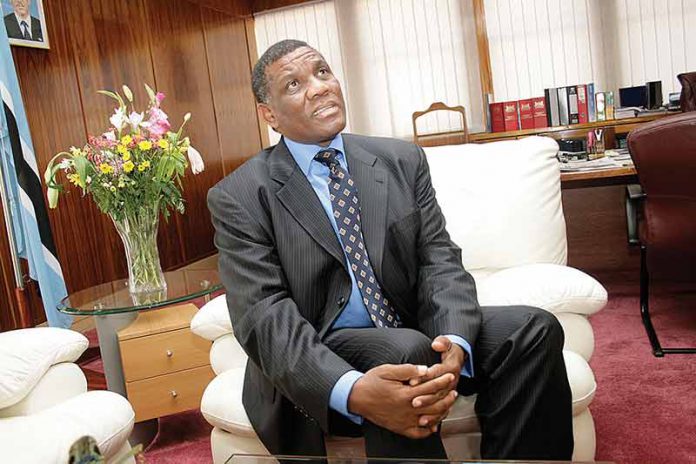
A little over three months out of a coveted government ministerial position Ndelu Seretse says he feels like he is back to his teens.
Rather than bewail the loss of all the power trappings, he says he is relishing every moment of it.
Freedom at last, he seems to be saying.
“It feels like a heavy yoke has just been lifted off my shoulders,” he chimes.
Before we start the interview proper, he excitedly regales a story of how he cut his teeth in politics as a socialist Botswana National Front youth activist in the seventies.
This was notwithstanding the fact that his father, Lenyeletse Seretse was a senior minister in a BDP government. His mother is a sister to Sir Seretse Khama, the founding President of both Botswana and the ruling Botswana Democratic Party.
“My BNF membership was never an issue with my father. On a number of occasions my dad told me he knew that Kenneth Koma would one day chase me out of his BNF. His statement proved prescient. I only left the BNF after Koma asked me on more than one occasion how I had lost my way into the BNF. I knew then that I was in a wrong crowd.”
The enthralling anecdote belies the mammoth task at hand.
Ndelu Seretse wants to become National Chairman of the ruling Botswana Democratic Party.
As the interview drags on he admits that it will not be an easy shoo-in.
Having spent almost all his time in parliament as a senior cabinet minister, until only a few months ago, he implicitly concedes that he does not enter the race for chairmanship with a clean pair of hands.
And then there is the name baggage which he really could do without.
As a Seretse, he is close blood relation to President Ian Khama.
This provides a further difficulty to convince many that he can successfully deliver a clean break with the past that is craved by the party rank and file.
As if those were not big enough hurdles, two other close relations of his – Tebelelo Seretse and Tshekedi Khama have also availed themselves to contest the same position of BDP Chairman. This has aroused public whispers of dynastic intentions on the Khamas. And such intentions arouse resentful public disapproval.
The blood relation adds to the already unsavory mix an unwelcome drama each of the contestants could really do without.
And Ndelu Seretse is abnormally conscious of it all. He is at pains to dispel it off: “I wish people could judge Tebelelo, Ndelu and Tshekedi as individuals and forget the names attached. The quality is not in the name. People should judge us as individuals ÔÇô based on our capabilities, capacities and what each one of us has to offer. I really wish people could for a second forget about our surnames.”
Across the party spectrum there is a deep-seated consensus that the BDP faces the biggest existential problems since it was established over fifty years ago.
Not much consensus however exists on how to overcome those difficulties.
There is also the problem of a buoyant and increasingly ambitious opposition.
While the BDP needs to be steadied, there is also an equally pressing need to deliver some destabilising blow on the buoyant opposition Umbrella for Democratic Change.
Does Ndelu Seretse think he is the right man for the job?
A cerebral policy honcho who believes in the potency of systems, Ndelu Seretse says before everything else is done to resuscitate the BDP, the party has to work hard at putting strong structures and systems in place. With such systems in place it would be easy for the party to go back to its members and reconnect with them knowing who they are and where they.
He says at the moment systems have so much collapsed to an extent that they are almost non-existent.
He complains about a Constitution that he describes outdated and somewhat stale.
His vision is that of a BDP that is more decentralized, with the party leadership sharing power with members.
It worries him that under the present setup, members are nothing much more spectators.
And it is beginning to show.
To push his argument further he says he has recently been visiting an elections related website that hosts manifestoes for all political parties that contested Botswana’s last year’s General election.
What has emerged from that website has been an eye opener. It has also left him horrified: More and more people are visiting the UDC manifesto than they are visiting that of the BDP. And for him it is not difficult to discern the reasons.
“People want change. And they look at UDC as an agent of change. As the BDP we need to show that we too are an agent of change. Of course people want better lives for themselves. But can we achieve it if we continue with the current distance between party and the executive?” he asks rhetorically.
For him the distance between party and the executive has become too uncomfortable.
Ordinary members feel alienated from power and the decision making process. They view themselves as nothing much more than a voting fodder.
He reckons that the party should start debating ideas that ultimately give direction to the party.
The diagnosis goes on and on until he shakes his head in despair, literally putting his forehead on the table as if in debilitating pain: “Some of us really are to blame for it. I was in government but never in party leadership. As a government we did very well for this country. But we left the party behind. In the end we had a government that was very strong and a party that is very weak. That has to change. Elections are contested not by governments but by parties and only strong parties can win elections and put their governments into power,”
Among the ills he narrates ÔÇô and there are many – is that it is time to create a party that is stronger than government.
The debate of party versus government has been raging for some time.
At one time it pitted the then BDP Secretary General, Kentse Rammidi against President Ian Khama.
Rammidi lost the debate and left the party in despair. Like many disgruntled BDP members, Rammidi joined the opposition ranks. As it turns out, Rammidi’s position has since turned up new converts.
Ndelu Seretse is immensely passionate about a party that is stronger than government.
Predictably, he talks about it with the zeal of a new convert, which in all fairness he really is.
“I have come to realize what a big mistake it has been to have a strong government and a weak party. It is a big flaw. I accept that I was part of that mistake. Look, I know how nice it is to be a minister, but I didn’t care when I lost all those ministerial benefits. What happened is that my attention immediately shifted to the party and I could not help but realize how far behind we had forgotten the party as a government. More than ever before we now need a strong BDP,” he says with a thinly veiled sadness which stems from a realization that unless it reforms and reinvents itself, the BDP, like many African political parties that stayed in power for too long before losing it too will also die. It is this perilous prospect that rankles many inside the BDP. Having spent all its existence in power, many of the BDP followers cannot even begin to imagine their party out of power. Ndelu Seretse is one of them.
Under his new found matrix it should be the party that advises government on what policies to adopt and not the other way round.
He is particularly scathing that the BDP does not have a vibrant policy forum whose ideas should be filtering into the overall policy discourse of government.
“The Party should have a say in government. That is currently not happening.”
The upfront demeanour that Ndelu Seretse’s exudes today is a sea change to a laidback intellectual subtlety that was so much his defining character while in government.
The sense of urgency in his attitude in a way also reflects a sense of urgency with which he says the BDP has to take a fresh look at itself and start marketing itself as an agent of change.
Where did it all go wrong for the BDP?
To answer this question, Ndelu Seretse chooses to juxtapose the leadership styles of all the four presidents that have led both the party and country thus far. It is a way to show that people’s expectations on their leaders have been changing: Sir Seretse Khama was humble leader who carried people along, Sir Ketumile Masire was an ordinary and easy going man with whom everyone could relate, Festus Mogae was a thinker who allowed innovation gave everybody room to express themselves, Ian Khama is a hands-on leader who keeps everybody on their toes. He wants and expects reports from everybody working for him, he says before taking a gasp of air, followed by a strong punch line.
“You see, the current President is a naturally powerful person. A growing number of the people think that his power and popularity went beyond those of party and government. To some this has bred resentment,” he says deliberately not proffering a solution how to tamper the president’s personal power and popularity for the benefit of both party and government.
Any attempts at trying to drive the interview towards what effects official corruption might have had on the party have a stultifying effect on the conversation.
“There are certain things that have to be said but which I cannot say because time is not right.”
Has President Khama condoned corruption especially at his beloved security agency levels?
“I was a minister and also at one point a political head of all the country’s security branches. So there are certain things that I cannot say. In any case my interest is not in personalities but in institutions. Broadly I think our foundations are outdated. We need a shift in the way we are doing things,” is all that he can say on the sensitive issue. He is aware the answer is not satisfactory, but cannot, for obvious reason go much further without attracting negative labels to himself.
The neglect of the middle class is something he feels has to be addressed if the party slide is to be reversed.
“The party needs to interact more with the middle class. If you want to help poor people you must have a strong middle class. At the moment the middle class feels left out. I think they need to be empowered.”
Ndelu Seretse is overly aware that many will think he has become exceedingly radical since leaving government.
His current posture will however not come as a total surprise to those who had previously known him during his days as BNF youth activist.

