

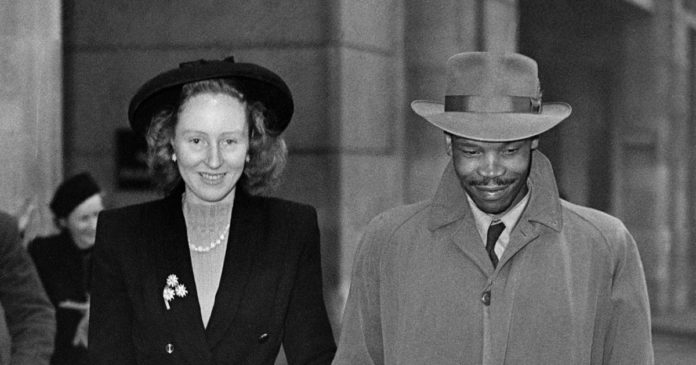
Let’s suppose, for argument’s sake, that then Crown Prince Seretse Khama had not gone to a certain London social outing in June 1947. He would likely not have met Ruth Williams and upon completing his studies at Oxford University, would have returned straight home and married a young Mongwato woman selected for him by his paternal uncle and regent, Kgosi Tshekedi Khama. In Tshekedi Khama: The Master Whose Dogs Barked At, Gasebalwe Seretse identifies that would-be bride as Gaolese Molefinyane, the eldest daughter of Morotsi Molefinyane.
“Gaolese, being the daughter of a headman and also being an educated woman, was deemed to be fitting the bill of a future queen,” Seretse writes in a book that, at some points, offers rare insight into the less admirable side of the character of a Ngwato kgosi who caused a firestorm both here at home and abroad by marrying a white woman.
Had Khama married Gaolese, would his profile have been high enough for him to be headhunted by colonial settlers, some European others Afrikaner, to lead a mildly Africanised version of the Tuli Block Democratic Party which had been formed for the specific purpose of protecting white commercial interests? The answer that a Motswana scholar, Professor Monageng Mogalakwe, would give is a vehement “NO!”
“Yes, Seretse Khama was a celebrity and a legend in his lifetime,” says Mogalakwe, a former University of Botswana lecturer who now works as an international consultant. “This was not because of this much talked about architecture and vision for Botswana – which is important – but more importantly, because of his marriage to a white woman.”
He credits “this singular event, more than anything else, and the chain reaction that it caused” as the source for the celebrity and legend that Botswana’s founding president enjoyed “both in the then Bechuanaland and even internationally, especially in Britain, and the United States, where he was even featured in Ebony magazine.”
Some would disagree with Mogalakwe’s analysis regarding his choice of spouse as being the source of his popularity but there can be no denying that Khama’s life story is largely defined by his love affair with a white woman. In 1948, Seretse married Williams with neither the knowledge nor approval of Tshekedi and the royal family as tradition demands. As a direct result of apartheid South Africa, Britain, then a colonial power ruling Bechuanaland Protectorate, banished Seretse from Bechuanaland. Inter-racial marriage was an issue bigger than it is now but that this particular marriage involved a future king. It caused a diplomatic row and made front-page news across the globe.
Confused about “king” and “chieftain”, the August 14, 1952 issue of Jet featured Khama and his wife, the future Lady Khama, on the cover page with the title: “How a King lives in Exile” and teased a side bar with “Seretse Khama and Wife, Ruth: Exiled African Chieftain Now Lives in Suburban Luxury.” Jet was the first black American publication and would be renamed Ebony. In an Ebony issue in which the couple made the cover once more, Khama explained “Why I Gave up My Crown for Love.” Virtually all other international publications, some with a profile much higher than that of Jet/Ebony also dedicated prime editorial acreage to the Seretse/Ruth love story. Decades later, there would be books and a Hollywood movie about what the London’s Daily Mail has described as “one of the greatest love stories of the 20th century.” To date, this obsession – if that is what it is, continues and another major media project that focuses on it could be in the works as of this writing.
Mogalakwe contends that it was this choice of spouse that “enabled Seretse to eclipse his paternal uncle, Tshekedi, who was hitherto, a celebrity and legend in his own right, especially because of his run-ins with colonial state officials, especially Sir Charles Rey.” The latter was Resident Commissioner and is infamous for destabilising Kwena bogosi (inherited traditional leadership) by deposing a Bakwena kgosikgolo and banishing him from Kweneng.
As regards Khama’s legacy, Mogalakwe reiterates a viewpoint held by some in Botswana that the contributions of other founding fathers (notably Sir Marquette Ketumile Joni Masire) are not adequately acknowledged. Borrowing the language of construction engineering, Mogalakwe says that while he agrees that Khama was a visionary and architect of present-day Botswana, “it is equally important to note that most architects work closely with structural engineers if they are to build a strong building.” Top of his structural-engineer list is Masire who was Khama’s Vice President and Minister of Finance and Development Planning for 15 years and following his death in 1980, president for the next 18 years. In himself giving acknowledgement he feels is all too often stinted on, Mogalakwe says that Masire was, for 33 years, “the helmsman or steward of Botswana economic transformation.” The latter point raises an interesting and related question: had Botswana remained poor or had its national economy been badly managed, would Khama have been hailed as a transformative figure?
The other structural engineer that Mogalakwe mentions is Gaositwe Chiepe, Khama’s schoolmate at Tigerkloof and Botswana’s first female cabinet minister. Noting how many things have been named after Khama (army headquarters in Mogoditshane, an international airport north of Gaborone, a highway, and a secondary school in Gaborone – somebody else adds military “Khamaflage” in a mean joke), Mogalakwe says that the government could at least name something after Chiepe, a Serowe-born educator who was the first Motswana to obtain an MA in education. He proposes the Serowe College of Education for such honour.
For years now, the opposition has been clamouring for the review of the original constitution not least because it super-concentrates near-monarchical powers in the presidency. The president appoints the Chief Justice – head of the second arm of government – and the National Assembly, the third arm of government, is all but a department under the Office of the President. Mogalakwe points the finger of blame unwaveringly at Khama.
“Seretse studied law and unlike people like Masire, clearly understood the implications of the concentration of executive powers in the hands of one man, the president, who he then was. Thus people who talk about constitutional review must understand that it was Seretse Khama who got us here in the first place,” he says.
At a personal level, Mogalakwe endured an ordeal that prompted him to question Khama’s liberal credentials. The year was 1978 and some members of the Botswana National Front youth wing, among them Mogalakwe, had been invited to and were to attend that year’s edition of the World Federation of Democratic Youth Festival in Havana, Cuba. This was at the height of the Cold War and a few short (17) years after the Bay of Pigs incident in which the US tried but failed to invade Cuba through an inlet on the country’s southern coast. A year before, Russia had secretly installed nuclear-armed Soviet missiles on Cuba, just 90 miles from US shores, which were later discovered.
Mogalakwe says that on the eve of the BNF’s delegation departure for Cuba, the state confiscated the passports of all delegates and somebody started a rumour that the delegates were actually on a nefarious mission.
“Contrary to the nonsense that was said about us undergoing military training, the truth of the matter was that Seretse was arm-twisted by the Americans, who wanted to isolate Cuba in a war that continues today. US wanted the festival to fail and Botswana was one of the countries used to try to sabotage it.”
As regards allegations of military training – whose net result would have been a coup that toppled Sir Seretse, Mogalakwe says that if those who made the allegations believed such national security threat existed at all, “appropriate action would have been taken against us.” Between 1978 and 1981, he couldn’t leave Botswana because he had no passport. He observes that Khama was ironically doing to him what the British had done to him (Khama) in the 1950s by punitively and unfairly restricting his movements within the borders of a geo-political entity.
The overarching point that Mogalakwe makes is that while it is important to honour Khama, it is as important to give a balanced account of his life and legacy by highlighting both his achievements and failures. A parade of speakers at rival Sir Seretse Khama centenary celebrations in both Gaborone and Serowe confined themselves to achievements.
“You can’t expect members of the Botswana Democratic Party to say anything like this at a public forum,” Mogalakwe says.

