

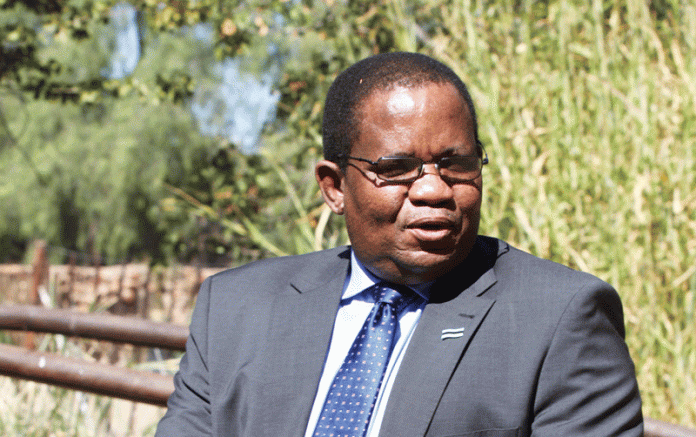
When Dan Mahupela chose to leave Debswana for BCL, his mining engineering colleagues thought he was out of his mind. Not only was he leaving behind promising career prospects at the blue chip Debswana, there also were ugly fears that BCL did not have a future. For many years the Selibe Phikwe based mine had been going through a constant decline.
The impacts of a defective tax structure under which BCL was required to pay an excessive forty percent tax were undermining all efforts at growth. As if that was not enough, the mine also had to grapple with depressed international commodity prices. All these factors had over the years conspired to cause a slump from which recovery seemed nowhere near. A string of credit lifeboats and rescue packages had come and gone. And still BCL would not turnaround. And then there was the real danger that the known resource was reaching the end of its life. To anyone who cared to check, it was immediately clear that the end of BCL would spell a final death knell for the whole of Selibe Phikwe as a town. To say it was all gloom and glum is an understatement. It was the worst of times. A date of closure had been set. As a result investors were taking flight in anticipation.
With no new arrivals setting in even the most infernal of optimists would have their spirits broken. Mahupela’s brief as Resource Planning Manager at BCL ÔÇô the first the mine ever had was to find new resources. Just as he was still settling into establishing parameters of what was needed to find new resources that could save BCL from closure, things got worse. The then General Manager, Monty Mphathi left the company.
Mahupela was drafted into the hot seat of captaining a tight BCL ship to calmer waters. He says talk of impending Selibe Phikwe demise intensified and continued to loom large with its smell hanging in the air. From the government side, reference to such closure became a kind of an obligatory ritual line for every speech writer. It was mentioned by every government official ÔÇô from a ward councilor right up to the highest level of a State President. “When I left Debswana for BCL I had wanted to come and see this Selibe Phikwe closing down which everyone had been talking about for years but which for me seemed not to be happening.”
As it turned out it was to be on Mahupela’s strategic insights that the mandate of rescuing BCL and with it Selibe Phikwe ultimately fell. And from the look of things Mahupela has been relishing every moment of it. He says one morning the then Ministers responsible for minerals, PHK Kedikilwe called them into a room and asked them a few harrowingly difficult questions: Selibe Phikwe is going to close down. I don’t want it to close down. What are you guys going to do about it? Are you guys going to allow this town to die? As the meeting drew to an end after Mahupela asked the minster to allow him and his team a few months to think about it. Two months down the line, Mahupela approached Kedikilwe with a crudely wrought rescue strategy plan.
It was still work in progress. Like a little boy with a new toy, the veteran politician with an exuberant flare for language was exhilarated. He told Mahupela and the BCL team that he was “sufficiently enthused.” “I did not know what enthused meant,” Mahupela said this week, sending everyone into stitches. When one looks back at the level of misery, distraction and frustration that the talk of Selibe Phikwe closure has caused over the years, it is hard to establish why it had to take Kedikilwe, now Vice President and due to retire in three months ÔÇô to send the May Day message to BCL executives about the impending closure before action could be taken. When we sit down for an interview over lunch at Phokoje, Mahupela gazes at a distance and adds almost aimlessly that it was all a miracle. “It all started right here at Phokoje Lodge.
We crudely drafted the strategy and enlisted an expert to put it together. We called it Polaris II, in reference to a North Star. We presented it to the Board, then to the minister and then to cabinet. The rest is history.” He says the restructuring of BCL is now complete. The company has paid back all its P3.8 billion debt back to government ÔÇô P1 billion in cash and P2.8 billion in equity. And with the departure of the Russian Norilsk, BCL is now wholly owned by Botswana Government. Efforts to find new resources and put them into the existing production stream have started to pay off. Mahupela has his sights into transforming BCL into a multi-resource mining company, more like Anglo American, with a footprint reaching beyond Botswana borders. And in that regard, talks are already at an advanced stage to buy a mine in South Africa. There is no longer more talk of Selibe Phikwe closing. Where there was once gloom and glum, there is now excitement, hope and a vision for the future. Currently BCL employs 4500 people. With a new steel plant the construction of which was launched by Kedikilwe during the week a further 1000 people will be added.
Polaris II will itself deliver a further 5000 jobs in the next two years. “This place will be a city in a few years. We need a proper shopping mall. I am told two are on their way.” With Selibe Phikwe death no longer an issue, SPEDU, a parastatal that was hastily setup by government with a mandate to create industries to possibly alleviate the closure of the town beyond BCL now finds itself with a much easier mandate to fulfill chief of which is no longer to avert the death of a town but rather to attract investors that will take advantage of the mushrooming downstream opportunities brought about by the ballooning BCL. “We are now looking at chrome and manganese.
Selibe Phikwe is going to produce the first petrol made from coal. I think the company is going to be called BCL Energy,” says Mahupela as he bursts into his trademark happy-go-lucky laughter, clearly enjoying himself as he looks back as if to confirm that his wild gamble to leave Debswana for BCL has more than paid off; not just by taking his career to altogether new heights but also by saving and ensuring the future of an entire town.

