

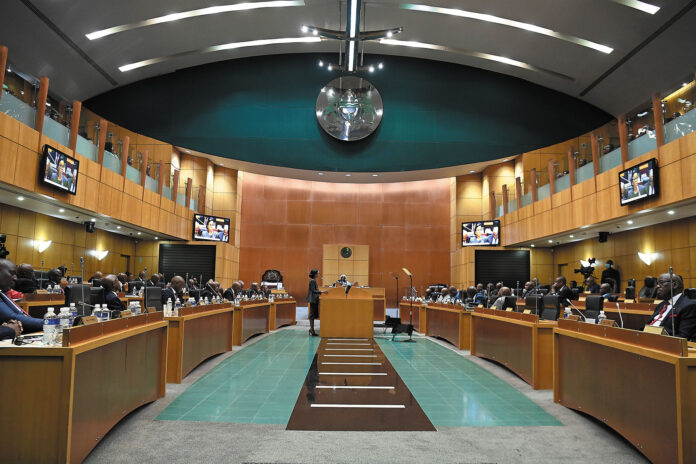
Minister of Finance, Peggy Serame, has addressed concerns regarding the state of the country’s public finances, particularly the sharp decline in the Government Investment Account (GIA). The statement, delivered on Monday, aimed to clarify the financial situation and dispel what she called “circulating misinformation”.
Serame began her address by providing a historical context to the current financial situation, referencing the 2008/2009 global financial crisis as a significant turning point. During this period, she told parliament, Botswana’s economy was severely impacted, leading the government to deplete fiscal savings and seek substantial budget support from institutions like the African Development Bank (AfDB), which provided USD 1.5 billion (P20.31 billion) to help stabilize the economy.
Then came the outbreak of COVID-19, and the country once again faced an economic crisis.
“The pandemic necessitated an urgent and extensive response from the government, which included measures to save lives, stimulate the economy, and stabilize financial conditions. These interventions, however, came at a cost. The government had to dip into its accumulated fiscal savings and secure budget support loans from multiple international financial institutions, including the World Bank, AfDB, OPEC Fund, and the Japan International Cooperation Agency (JICA).”
Against this backdrop, she said, the GIA experienced a downward trajectory, mirroring the broader economic challenges. She said he account, which represents the government’s savings held at the Bank of Botswana, saw a significant decline from P30.5 billion in 2008 to P13.6 billion in 2010, following the global financial crisis. “The impact of COVID-19 was equally severe, with the GIA plummeting from P23.9 billion in 2018 to a mere P2.8 billion by December 2020. Although the GIA saw a temporary recovery in 2021, increasing to P12.1 billion by December 2023 due to the global recovery in the diamond market and the resumption of economic activity, this improvement was short-lived. By April 2024, the GIA had dropped to P5.1 billion, and by the end of May 2024, it stood at P4.1 billion, a significant decline from P19.1 billion in May 2023.”
Serame said this marked reduction impairs the government’s ability to finance the budget and provide adequate buffers against unforeseen events and shocks in the future.
She explained the GIA is not merely a simple savings account but also represents the government’s share of the Pula Fund portion of the foreign exchange reserves. “The value of the GIA is influenced by three main factors: the balance of government revenue, spending, and financing operations; changes in the Pula-Special Drawing Rights (SDR) exchange rate; and unrealized gains in the market value of Pula Fund assets.”
She said revenue collections have been lower than expected, with actual total revenue and grants amounting to P18.2 billion as of June 2024, compared to the anticipated P23.4 billion. This shortfall, combined with increased government spending, has contributed to the GIA’s decline.
Serame made reference to several factors that have contributed to the changes in the GIA levels since 2020. Chief among these, she said, is the weak performance of the diamond market, which was significantly impacted by the COVID-19 pandemic. She said in the first half of 2024, diamond sales amounted to USD 1,949 million, a stark decrease from USD 2,428 million in 2023, representing a 46.1 percent decline.
“Additionally, government spending increased substantially as the government implemented various economic response measures during the pandemic. These included support for workers, stabilization of businesses, and the establishment of the COVID-19 Pandemic Relief Fund with a capitalization of P2 billion. These interventions, while necessary, further reduced the available buffers in the GIA.”
Serame told parliament that currently, the GIA remains low due to the government’s commitment to increased spending aimed at stimulating economic growth and supporting recovery. “Key expenditures have included P5.75 billion for personal emoluments, P1.5 billion for the Botswana Public Officers Pension Fund (BPOPF) pension augmentation, and P1.5 billion for tariff subsidies to the Botswana Power Corporation, among others.”
She emphasized that the economic landscape has changed significantly since the 2024/2025 Budget Speech was delivered in February 2024. Economic growth decelerated to 2.7 percent in 2023, lower than the anticipated 3.2 percent, primarily due to weaker-than-expected performance in the diamond industry. “The challenges in the diamond market, including competition from lab-grown diamonds, low demand from key markets, rising production costs, and disruptions caused by the Russian-Ukraine conflict, have continued into the second half of 2024.
The Minister however expressed confidence that the domestic economy is expected to rebound in 2025, in line with global economic recovery and a resurgence in the diamond market. “The government remains committed to its fiscal consolidation program and to rebuilding the GIA to sustainable levels.”

