

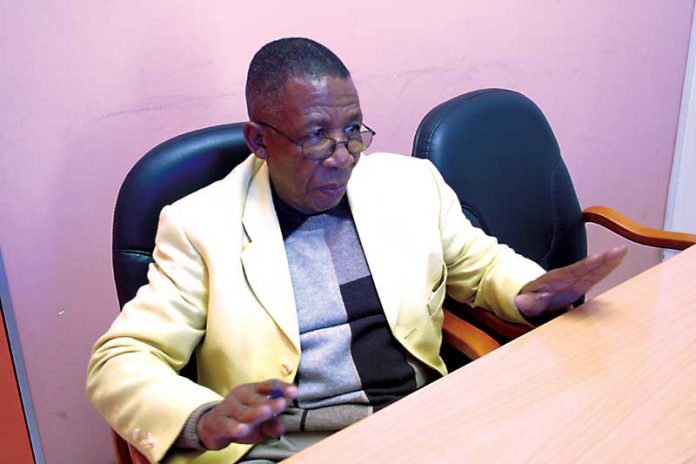
From the safe distance of more than ten years, Nat Serache, former Unkomto we Sizwe freedom fighter who cheated death when his Gaborone hideout was bombed by apartheid commandoes and now South African envoy in Botswana, recalls his years in the shadows ÔÇô writes MERAPELO LETEBELE
They say one man’s terrorist is another man’s hero and Nathaniel Serache looks like neither. He looks too much like a retired civil servant or perhaps a businessman. He is shorter than me and his timing impeccable. At 62, he is now First Secretary for Political Affairs at the South African High Commission. I surmise that being on time is a habit he carried over from his days as a dangerous insurgent when timing and precision were of paramount importance. When Nat Serache was younger, his idea of fighting apartheid was less menacing. He thought becoming a journalist would do the trick because he would expose the injustices of the apartheid regime’s racial policies and bring it crumbling to its knees. After all, didn’t some wise man say the pen was mightier than the sword, or in the case the bombs and guns? It must have been easy to recant this hyperbole and pick up an AK47 and a political name tag; communist dissident.
When he first came to Botswana on April 23, 1977, the brutality of the apartheid apparatus was so intense that he had to run and literally go underground. On the other hand, and on the same footing, the rise of black South Africans pining for independence was just as forceful, and unbeknownst to any of his lot, freedom was another 17 years away. “I simply walked across the border and jumped the fence, avoiding road blocks and detection,” this is how Nat Serache began his life as a rebel and eventually an apartheid hero 31 years ago. He spent eight of those years as a shady schemer camouflaged as a run-of-them i l l Gaborone resident. Serache had a few good reasons to run. He had two dangerous capital charges hanging
over his head and a third one looming. South African security forces had found offensive literature in his home during a surprise raid and were afraid that he would spread dangerous communist ideas around to the agitated African communities. He was later found guilty under the infamous “Suppression of Communism Act.”
While on bail for having Marx, Lenin and Nkurumah on his underground bookshelf, Serache was arrested for planning to distribute pamphlets commemorating the Sharpeville Massacre. “I was arrested at the Free State where I had attended a meeting with Steve Biko and Tenjiwe Mtintso, who is currently the South African ambassador to Cuba. They intercepted the literature and I was detained. I shouldn’t have been given bail on the second charge but since I was already on bail pending a court appearance for the other earlier charge, my lawyer successfully applied for a different bail condition so that I could attend court for the first charge,” he said, his narrative a bit confusing at first. While getting ready to travel to Bloemfontein to answer for the second charge, Nat learnt that there was a third political offence he was apparently being wanted for.
“I would have never left court if I had gone to Bloemfontein because they were waiting for me. My underground cell decided that I had to leave the country to avoid exposing our network. We spread the story that I would be going to the Bloemfontein court to derail them,” he said. While the security forces waylaid him in Bloemfontein, he went in the opposite direction to Mafikeng. He was dropped off in Matlhase in Lehurutshe, a place they considered as a “liberated zone,” where he saw his mother for the last time. In other words, his exile was hastily arranged. “On the day when I was supposed to be in court, I was somewhere near the Botswana border and I listened to the news when they reported that I had failed to appear in court and that I was armed and dangerous. They said if anybody saw me, they shouldn’t try to apprehend me but instead should call the security forces. We laughed that one off and that same afternoon, I jumped the border into Botswana near Setlhareseleele, and marched towards Pitsane where some comrades were waiting for me.”
Over the next years, Nat Serache was involved in one of the most dangerous jobs that any man could have. He was part of the team based in Botswana that received recruits, trained and secretly mobilized and
ploughed them back into South Africa so that they would “multiply.” He said, actually, this is how the ANC grew in South Africa “Botswana authorities knew I was here but out of concern and respect for the laws of the country, I camouflaged as a non-aligned member of the refugees community. I secretly
went for training in Angola and came back to do quiet underground work from here,” he said. So convincing was Serache’s “nonaligned” act that he even took up employment with the Ministry of Agriculture in the government enclave. With his journalism background, he ended up co-editing the ministry’s publication for farmers, AgriNews. He was a freelance correspondent for the British Broadcasting Corporation. In one of his missions, he said, he found out that the South African Defence Force on the Namibian side were recruiting Basarwa on the Botswana side to work as trackers to find
SWAPO operatives. “I found out that the soldiers gave these people tobacco and meat and taught them
how to shoot and kill Namibian freedom fighters (SWAPO dissidents). This story came to the surface when a lot of guns were found abandoned in the bush. We found out that the Basarwa threw the guns away when the ammunition got finished,” he said.
The eight years Serache spent in Botswana were punctuated by long and difficult lessons on determination, betrayal and brutality. In its most rudimentary form, his mission was simple yet dangerous. He was
among the men and women who received new recruits from South Africa and schooled them in Marxism before sending them further to Angola for guerilla training. Even then, sometimes things became
messy and chaotic. One time one of the units he and others trained was infiltrated by the enemy, the apartheid regime. Black South Africans just like them. He particularly remembers the time when a young and bright “comrade” rose quickly through the ranks of one of the units because he was simply brilliant.
When the time came for the young commander to lead the troops back to South Africa through a route in Kgatleng, he simply disappeared.
“We were shocked to see him on TV, showing Americans how to assemble and disassemble AK47 rifles during the “Denton Commission.” We were relieved to find out that he was a government agent. At least we knew who our betrayer was. The others came back and we knew that we had successfully avoided an ambush on that day,” he said. The events that led to the sudden end of Serache’s stay in Botswana were exactly the sort of thing he had been evading for eight years and he can never say that it came without
warning. Having come from a reconnoitering mission along the Phitshane-Molopo border on a February afternoon, he and his colleagues noticed an unusually heavy traffic of white men coming into Botswana.
They knew that they were SADF, so they hurried back to Gaborone to alert others and help them shift positions while some got ready to defend themselves. Some women and children were moved to Dukwi Refugee Camp on the night train. Serache and his comrade retired to their rented house in Ginger
location in Gaborone. They must have taken too much comfort in the little decoy they devised so that anyone trying to harm them would think that they were sleeping in the first bedroom. Having forgotten to take care of themselves, Serache and his comrade got a nasty surprise.
At about 12:10, on the morning of February 13 1985, a huge blast went through their kitchen and flung out the deep freezer and put it on top of the neighbour’s roof. The fridge, that was full of game meat was cut in
half and thrown to the street. As it turned out, someone had planted an extremely powerful explosive between the kitchen and the “decoy” bedroom. “I was knocked unconscious. When I finally came round, it was drizzling a little bit and when I looked up, I saw stars. I said, ‘Aii, they’ve got me.’ When I suddenly became conscious, I felt the debris crushing me. There were people milling around. The first thought
that came to my mind was that someone was pinning me down, so I elbowed hard at the person until I broke my elbow. Actually, that was a part of the concrete wall on top of me,” he said. “When I looked at where my comrade had been, I saw his bed on fire and I thought he was dead. Apparently, the impact of the
explosion had thrown him outside the house and on to the street.”
“I wanted to resist to be taken into the ambulance but I was too weak. My comrade, “Moropa” Moadira, reported me dead to the police and I also said he was dead. You can imagine how we felt when we saw each other at Marina. We just laughed at each other. After getting medical attention I was taken to the police station in protective custody. Thabo Mbeki came to see me there and made arrangements for me to be evacuated to Lusaka. I was later taken to the Soviet Union to receive further medical care and ended up
in Cuba as well.”
The SABC reported him dead along with eight others, though they had been whisked to Dukwi that same night. Serache says his former editor, a white man, Alistair Sparks was turned away when he tried to visit him at Princess Marina Hospital. “I guess they thought he had been sent to finish me off. I also had to answer questions from the police, who were wondering why Thabo Mbeki, then the Director for International Affairs, was calling me comrade, though I had repeatedly denied that I was linked to any political party in South Africa,” he said, laughing out, not too loud, his shoulders shaking violently.
Looking back at all that, Serache can do very little except express gratitude to Botswana for the role it played during the liberation struggle.
“I know who betrayed me, at least by name. He was one of the youngsters we trained. He was already a spy when he came to us. He is a soldier in the South African Defence Force. You know some of these people
are my bosses because they have always worked for government and as you can imagine, they have progressed well, “ he said. When the 80 year old struggle against apartheid was finally over and Nat Serache first went back to South Africa, he used to dream about meeting the person who planted the bomb and invite them over for a braai to celebrate his failure. But the man applied for amnesty. In fact, two men claimed credit for the bomb, one is called Van De Venter and he can’t remember the other chap. Years later, he is back in Botswana, this time he doesn’t have to hide his true identity. And to top it all, he is a distinguished diplomat. Recalling the struggle is part of his reality now and he has kind words for Botswana and its citizens.
“Botswana sacrificed for our struggle. If I were in their position, I don’t know if I could have gone as far as they gone. Every government has a duty to protect its citizens, and receiving us posed a risk for Botswana.
Botswana government knew what we were doing, and it was illegal but they chose to look the other way. They knew we were waging a liberation war. Honestly, they did their best. We couldn’t have done it without them,” he said.
READ SERACHE OWN COMMEMORATIVE WRITE UP NEXT WEEK

