

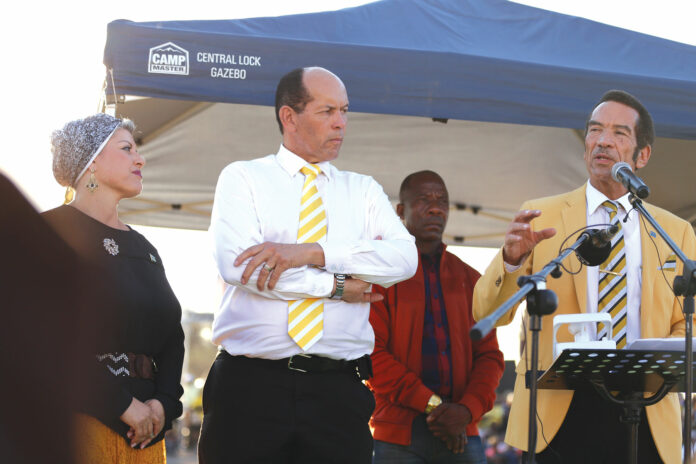
When then Vice President Ian Khama ran for the Serowe North seat in 1998, there were allegations in the press about his opposition opponent being followed around by military intelligence operatives. This shadowing reportedly happened even when the opponent visited small villages neighbouring Serowe. What was inside that episode was, at best, illumination about Khama’s approach to electoral democracy and at worst, a foreshadowing of a future that was just 21 years away. Khama trounced his opponent with a huge margin, a feat he would repeat not once or twice but thrice.
When he stepped down, his younger brother, Tshekedi, inherited that seat by winning election (2008) after election (2009) after election (2014) after election (2019). The explanation for the mathematical discrepancy is that the first was a bye-election that was occasioned by Khama’s ascension to the presidency and happened a year before the general election. As president, Khama led the Botswana Democratic Party (BDP) to victory twice – in 2009 and 2014. Soon after stepping down in 2018, he fell out with his successor, President Mo0kgweetsi Masisi, and left the party the following year to found his own – the Botswana Patriotic Front (BPF). In the year that Khama stepped down, the BDP held its primary elections and Tshekedi was facing an uphill battle in Serowe North. While he represents a Serowe constituency, Tshekedi is essentially a Gaborone person and as MP, never spent a lot of time in Serowe. Some constituents were greatly displeased about this and wanted to vote him out. Khama went to bat for Tshekedi in a big way by not only campaigning for him but by also bringing along outgoing Maun West MP, Kgosi Tawana II.
Involving Tawana in Tshekedi’s campaign was a tactical move. Khama is kgosikgolo (supreme traditional leader) of Bangwato and Tawana, who is a cousin of his, is kgosikgolo of the Batawana. The plan was to concentrate as much royal prestige as possible in a struggling campaign. Khama knew this would work wonders with an electorate enamoured of royalty. More importantly, Khama didn’t want a Khama in the nucleus of the Bangwato royal family to lose an election. Tshekedi won the BDP primary election but, as was expected, would later decamp to the BPF. Once more, Khama’s support carried Tshekedi and that of two other BPF candidates in Serowe constituencies, to both the finish line and winner’s podium. Much has been made of the fact that a new party (and one formed a few months before the general election) won three seats. However, there is a downside that is hardly ever talked about: the BPF lost in many more constituencies.
Naturally, Khama could not have expected his party to win but he hitched his wagon to an opposition collective – the Umbrella for Democratic Change – that he expected to win. A UDC win would have been a Khama win. When UDC lost, so had Khama. For the first time in history, a Khama had lost an election. The aftermath of the 2019 general election illuminated what was only a dark outline back in 1998 and it is interesting to observe the stark similarities between Khama and a man he is said to detest: Donald Trump. As a first world economy, America analyses its politics comprehensively and if you follow this analysis as relates to Trump, you will find striking similarities with a particular local political actor.
Trump’s idea of a fair election is one in which the outcome favours or will favour him or the candidates he supports. When he lost the very first primary election in Iowa to Ted Cruz in 2015, Trump called the Chairman of the Iowa Republican Party and tried to get him to disavow the results because the winner had “cheated.” When every poll said that Hillary Clinton would win the presidential race the following year, Trump pre-emptively said that the outcome would be rigged against him. He won but made similar claim in 2020 when he did actually lose to Joe Biden. After losing the 2019 election as a UDC-aligned party, Khama claimed that the BDP had rigged the outcome in its favour. It is always useful to remember that until Khama made that claim, no opposition leader had alleged rigging.
A day after the results were announced, Khama said that he would get Boko to protest the results. After laying low for a week, Boko came out to allege rigging. Then would start the saga that began with him addressing a press conference in Johannesburg about rigging that happened not in South Africa but Botswana and end with hype about the ill-fated People’s Court. The latter was a quasi-judicial forum that would have litigated the electoral fraud but was postponed over and over again until plans for it were shelved. The People’s Court was Khama’s idea and he actually made advance payment to a Gaborone CBD hotel to host it. It is possible that the BDP, which has traditionally rigged the process in its favour, did actually up the ante in 2019 by cheating at the ballot box.
However, both Khama and the opposition leaders that he recruited were never able to assemble a convincing case. What was even more tragic is that they compromised their ability to make credible claims of vote-rigging in the event that happens in the future. The setting for Khama’s latest Trumpian antics is the BPF itself. Having fled the short arm of the law to a country that Botswana has an extradition treaty with, Khama is keen on making Tshekedi party president. Tshekedi is also in South Africa after an unpleasant encounter with law enforcement. The physical presence of the Khama brothers has created a power vacuum that Guma Moyo, former Tati East MP and assistant minister under Khama, wasted no time in filling. Moyo also wants to be BPF president and every indication is that he will trounce whoever runs against him.
If the latter scenario does indeed pan out, a member of the Khama political dynasty would have directly lost an election for the first time since 1966. As part of effort to protect one of the oldest political brands in Southern Africa and the oldest in Botswana, the patriarch of that dynasty is determined to forestall that eventuality. As Trump did in 2016 and 2020, Khama is raising doubts about the fairness of an election that hasn’t happened. As part of a double-pronged strategy, Khama has also mobilised the support of BPF MPs and councillors in his quest to get the election cancelled. The reason is obvious: he knows that Tshekedi is going to lose and can’t bear the thought of a Khama losing an election. Former Palapye MP, Moiseraele Goya has also been named as a potential presidential candidate.
If he does indeed contest, it would be for purposes of shielding a Khama against the humiliation of losing an election. Big picture: since 1875, the Khamas have had pride of place around the flame of power. Masisi elbowed them out but for what it is worth, the fire that the BDP built back in 1965 is dying out. If Tshekedi can become BPF president, he would also become part of a party, which for now at least, has the most realistic chance of clearing the heap of ashes that the BDP will leave behind and build a bonfire. Tshekedi would have pride of place that bonfire. He certainly has to win the election for BPF president. If he can’t, then the election wouldn’t be fair. Alternatively, someone has to bear the humiliation of losing on his behalf.

