

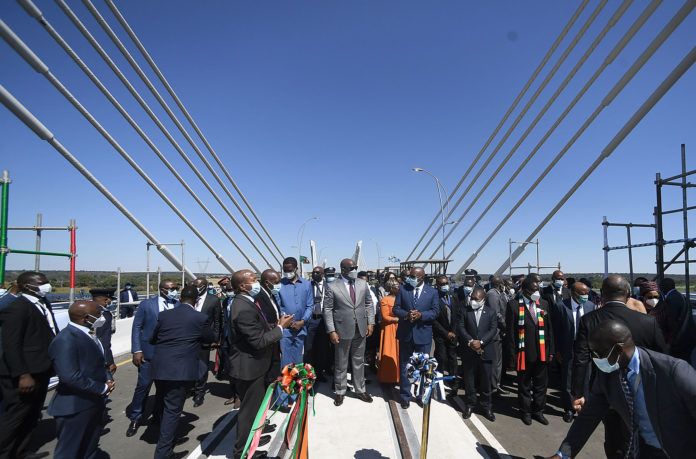
Behind the pomp and fanfare that surrounded the recent opening of Kazungula Bridge lies a sad story of local entrepreneurs who find themselves saddled with debts running into millions and little prospects of success in their dispute with the contractor.
In a classic case of David versus Goliath, entrepreneurs Titose Thipe and Fanuel Amos of Lead Masters Holdings have locked horns with South Korean multinational Daewoo Engineering & Construction, a global construction monolith whose project map includes oil and gas, power and nuclear plants, transportation, harbours and dams across the globe.
Their ordeal dates back to February 2015, when Daewoo, the main contractor of Kazungula Bridge, awarded Lead Masters Holdings a P36 million tender for the design and construction of accommodation, laboratories and site offices on both the Botswana and Zambian sides. Things took a turn for the worst eight months later when Daewoo terminated the contract, citing Lead Masters Holdings’ failure to complete works on time.
Lead Masters Holdings headed for court and was in October 2016 granted a default judgement against Daewoo after the latter failed to defend an application for a garnishee order in lieu of P18 531,170,07; inclusive of outstanding payments for services rendered, interest and collection commission.
Daewoo later filed an urgent application seeking a rescission and stay of execution of the default judgement; arguing that it was not properly served with the summons as their offices were situated on the Zambian side of Kazungula border. In passing judgment, Justice Nyamadzabo found that Daewoo’s ambivalence in stating its principal place of business was a smoke screen intended to mask its receipt of service of summons. He struck out Daewoo’s founding and confirmatory affidavits, saying they ought to fall as they were fatally defective.
“Serious prejudice will be visited upon Lead Masters Holdings by a nonchalant observance of the rules of the court,” said Nyamadzabo J.
He further ruled that Daewoo’s application for rescission would find no joy as the multinational had failed to reasonably explain its default and demonstrate that’s its application was not meant to delay Lead Master Holdings’ claim. He therefore dismissed Daewoo’s application and ordered the multinational to pay the costs of suit.

Daewoo went on to appeal the default judgment and garnishee order, roping in corporate law firm Osei-Ofei Swabi & Co, who instructed Advocate Andrew Redding SC. The multi-national prayed for the default judgement passed in 2016 to be rescinded and set aside; arguing that it was not in wilful default as its application was bonafide and not brought for purposes of delay. Daewoo also pointed out that the senior engineers involved in the Kazungula bridge project were unfamiliar with the English language and Botswana jurisprudence as they were of South Korean descent.
JURISDICTION
Key to Daewoo’s appeal was its unyielding position that its contract with the governments of Botswana and Zambia for construction of Kazungula Bridge was governed by the laws of England and Wales. The multi-national faulted the Registrar of the High Court for erroneously applying the laws of Botswana in awarding Lead Masters Holdings a default judgment in the P18 million dispute.
“In any case, the Registrar would most likely not have been in a position to apply the Laws of England and Wales,” argued Daewoo in papers filed in court.
Osei-Ofei Swabi & Co and Advocate Redding SC also pointed out that the courts of Botswana did not have jurisdiction over the matter as the contract between Daewoo and Lead Masters Holdings had a dispute resolution clause that compels them to resolve all disputes through negotiation, failing which they should proceed to the International Chamber of Commerce in Singapore.
According to Section 26.1, the contract between Daewoo and Lead Master Holdings shall be governed by the laws of England and any disputes settled by mutual agreement. Upon failure to settle by mutual agreement, the matter shall be exclusively referred for mediation by three arbitrators sitting at the International Chamber of Commerce in Singapore. Sunday Standard investigations have revealed that Lead Master Holdings will have to pay each arbitrator $1 million to hear the case, despite the fact that they are owed P18 million. Daewoo further accused Lead Masters Holdings of substantially inconveniencing it by instituting legal proceedings with the courts of Botswana even though it was aware of the dispute resolution clause at all material times.
COUNTER CLAIM
The multinational then turned its guns on Lead Masters Holdings, accusing it of failing to deliver the project on time and within budget even after receiving an advance payment of P3.6 million and a subsequent P1.5 million for partial work done after termination of contract. Further, Daewoo pointed out that at the request of Lead Masters Holdings, it directly paid the sub-contractor’s suppliers and workers over P20 million prior to terminating the contract. The multinational drove the nail into the coffin by submitting a counter claim of P43 million for additional costs incurred after taking over the project; as well as P1.4 million in unrecoverable rental occasioned by Lead Masters Holdings’ failure to complete construction of engineers’ accommodation and offices.
Daewoo has also tabled yet to be calculated claims for lost interest on amounts payable by the governments of Botswana and Zambia on account of delays in completion of subcontract works. Another claim is for liquidated damages, which arise from Lead Masters Holdings failure to comply with its contractual obligations. The liquidated damages are calculated at 0.1 percent of the contract price for every day that passed beyond the prescribed time for project completion. Daewoo argued that Lead Masters Holdings misconduct resulted in the costs of the subcontract escalating from P36 million to P70 million.
“Had Lead Masters Holdings conducted itself with integrity, these applications would not have been necessary. We have suffered substantial inconvenience and expense in dealing with this matter. The court should mark its displeasure with appropriate award of costs on a punitive scale,” argued Daewoo in its closing arguments.
When passing judgment, Court of Appeal Judge Ian Kirby referred the matter to the lower courts.

