

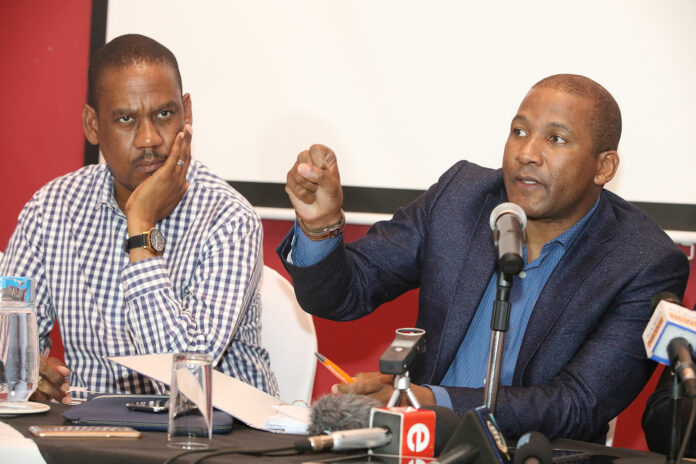
In a moment that he ponders his own culpability in the emergence of a deeply troublesome political situation, a Shakespearean character is led to remark to a friend: “The fault, dear Brutus, is not in our stars but in ourselves.” Cassius, a Roman nobleman, uses “stars” in the context of their astrological purpose. With regard to the political circumstances of our own time and place, “stars” can be given a different and more contemporary meaning – political stars in the Umbrella for Democratic Change. One is UDC president, Duma Boko, and the other his deputy, Dumelang Saleshando.
UDC is a loose coalition of three parties: Boko’s Botswana National Front, Saleshando’s Botswana Congress Party and the Botswana People’s Party, which is led by Motlatsi Molapisi. BPP is the parent to one and grandparent to the other: BNF broke away from the BPP in the late 1960s and BCP itself broke away from the BNF in 1999. Little more than a woefully underperforming provincial party, BPP is only a symbolic partner in the UDC project but its participation in this political project is important for purposes of presenting a united front. As a result of the latter, UDC’s decision-making apparatus is almost exclusively BNF and BCP.
At this point in time, the leaders of the two parties literally don’t see eye to eye. That enmity has set off administrative and political dysfunction that threatens the mere survival of the UDC. All too often, fingers of blame are firmly pointed at the two men but are they really to blame?
In properly-functioning systems of electoral democracy, the real power lies not in the leadership but followers, who also vote in elections. However, UDC’s power structure is constructed in a quite abnormal manner because its membership is open to political parties and not individuals. Going back decades, Botswana’s opposition has continually shot itself in the foot by its persistent failure to coalesce into a united whole – which accounts for some of the voter apathy in the country. The UDC project inspires a lot of confidence because it offers realistic possibility of defeating the political monarchy that the Botswana Democratic Party has become. In that regard, most voters identify with the UDC and not to its constituent members. It is actually quite common to hear opposition sympathisers, who are not affiliated with the BNF, BCP or BPP, identify as UDC (“Nna ke mo–UDC”) when the reality is that only parties and not individuals can be UDC members. While you can vote for UDC in an election, you can’t be a member of the party.
One of the duties and privileges of party membership is setting a party back on course when it goes off. The UDC has done more than go off course, it is lost in the political wilderness. The global and one real measure of political support (number of seats in the national assembly) shows that BCP (not the BNF) is the majority party in this coalition. That notwithstanding, BNF retains UDC presidency and Saleshando has had to settle for parliamentary leadership – which has led to two diametrically opposed centres of power because the two men are not marching in lockstep. Not too long ago when the BNF and BCP started butting heads, the latter’s spokesperson, Professor Mpho Pheko, said that Boko hadn’t attended a single UDC National Executive Committee meeting for over 10 months and has been managing party affairs by issuing unilateral decrees. In relation to such decrees, Pheko generally complained about lack of inner-party democracy in the UDC.
Oddly, the priority of one too many UDC sympathisers is not dealing with the issues that Pheko complained but keeping all parties within UDC in order to defeat the BDP. This unfortunate stance overlooks the fact that a UDC government will need intra-party cohesion to govern, not numerical strength. The latter is what you need to win an election and the former (intra-party cohesion) is what a winning party needs to govern effectively. Nothing suggests UDC sympathisers are anticipating a situation in which, in line with Pheko’s statement, a President Boko takes critical decisions without informing cabinet – which would spell doom for such government. People don’t want leadership change for its own sake but want to see effective leadership that can respond to the challenges that Botswana currently faces. That notwithstanding, the UDC-or-nothing mindset will lead to putting a hugely disintegrated party in power with the expectation that it should provide effective leadership.
Then again, there is nothing that UDC sympathisers can do about the current problem in the UDC because not being members, there are no formal structures that link them to the decision-making apparatus. If a BNF, BCP or BPP member is displeased about a particular issue, s/he can officialise his/her grievances through party structures – like the cell, branch, constituency or region committees. On the other hand, if a UDC sympathiser is displeased about a particular issue, s/he can’t officialise their grievances through party structures. Such person would have to belong to one of the three UDC parties. However, as stated, individual parties are shunned for the UDC collective.
Not belonging to constituent members is problematic in one other respect. BNF, BCP and BPP members can vote in party elections to choose committees and candidates for general and bye-elections. They necessarily have to participate in party politics at these levels because otherwise their participation in general elections equates to what Batswana call the matladibudule phenomenon – avoiding all the hard work that goes into food preparation but showing up at mealtime with a big smile, big spoon and an even bigger appetite. Those who shun any one of the parties that make up UDC in favour of UDC, deny themselves the opportunity to choose people they would like to see in leadership positions. Oddly, people insist in retaining their right to criticise the quality of leadership even when they pass up opportunity to elect leaders.
Ultimately, the fault is not in UDC’s stars but in political enthusiasts who hold a fantastical view about what UDC is and what should motivate the constitution of a coalition movement.

