

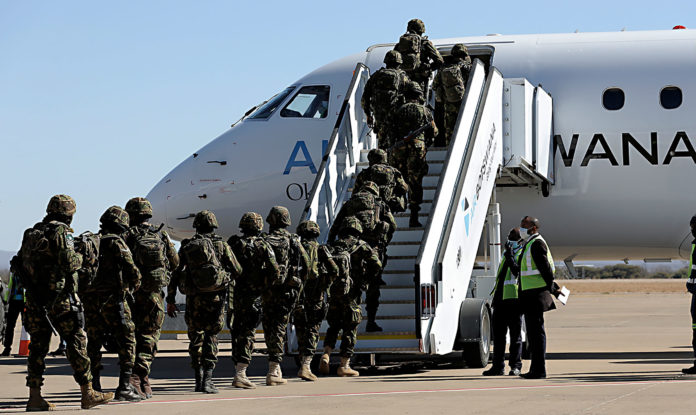
In seeking to understand civil strife in one part of a SADC country, Sunday Standard asked last month via a headline: Is BDF protecting Mozambican civilians – or the largest foreign investment project in Africa? While complex in one respect, the answer to this question has become patently clear.
As The Voice reported recently, the Botswana Defence Force soldiers in Cabo Delgado province “spend most of their day idling about with nothing to do.” Some are said to be whiling away time by basically “chilling” on the sandy beaches of an area that was popular with tourists before an ISIS franchise attacked it.
The oddity here is that the Botswana’s soldiers were deployed to Mozambique to deal with an urgent national security threat. On that basis, they should have joined the battle against ISIS insurgents hours after landing in Cabo Delgado. That did not happen: only the Rwandan and Mozambican troops are practically fighting ISIS – on TV because reporters from major television networks like Al Jazeera, BBC, CNN and Sky News have reported from the frontlines. The resulting media reports mention Rwanda and Mozambique only.
Batswana have a saying for situations where the host plain ignores a visitor: “moeng-o-etetse-mang?”, which roughly translates as “Visitor, whom are you here for?” This about sums up the situation BDF soldiers find themselves saddled with in Mozambique.
However, while the “moeng-o-etetse-mang?” soldiers may not be on the frontlines, their mere presence (as that of others SADC troops) is a deterrence because ISIS knows about it. In that respect, BDF is indirectly and passively protecting Mozambicans civilians.
To be clear though, the insurgency in Cabo Delgado is at least four years old. SADC has always known about the insurgency but made no effort to quell it. The west (namely the United States and France) knew about the insurgency but never sought to make the issue front and centre of international security discussions. The insurgency became an issue after ISIS combatants overran a multi-billion-dollar gas project that is being undertaken by a French company, Total. The latter is being touted as the largest ever foreign investment project in Africa. Only after Total was forced to abandon the project did the agenda-setting western media start reporting consistently about ISIS running amok in Cabo Delgado and the consequent humanitarian crisis.
That an ISIS franchise terrorised Mozambicans for four years and SADC did nothing but scrambled into action a few short months after the same ISIS overruns Total’s installations should be helpful in answering the question of why BDF is in Cabo Delgado. There is a follow-up question: why isn’t BDF actually fighting? The answer is a quite simple one: as the rest of SADC, Botswana was not part of a deal that France (which country Total comes from) made with Mozambique and Rwanda.
According to Deutsche Welle, a German media outlet, France had wanted to send its own troops but Mozambique balked at such suggestion. In the end and as a result of the latter, President Emmanuel Macron of France essentially contracted Rwandan troops for what Charles Matseke and Koffi Kouakou have described as “a state mercenary role for France and Total to secure the multibillion-dollar oil and gas project.” Both are based in South Africa and offered their insights in a piece they co-wrote for Sunday Times.
This deal began taking shape on April 28 this year when Mozambican President Felipe Nyusi visited President Paul Kagame in Rwanda. On May 18, both presidents attended a summit on the Financing of African Economies in France where they met Macron. Nine days later, Macron visited Rwanda to “repair” relations between the two countries after decades of Rwandan accusations that France was complicit in the 1994 genocide. It certainly is in the interest of both countries to normalize diplomatic relations but some would see this visit (and the flurry of diplomatic activity around it) as too much of a coincidence.
In another part of the world, a part much closer to Cabo Delgado, SADC leaders (among them Nyusi himself) were planning the deployment of the Force Intervention Brigade under the auspices of the SADC regional security framework. Nyusi appears to have been pulling wool over the eyes of his SADC counterparts – who included our very own President Mokgweetsi Masisi, who at the time was chairing SADC’s defence and security arm.
BDF would probably be involved in combat duty if Mozambique had not dealt with Rwanda/France and SADC separately. In simpler terms, there is now a situation in Mozambique where two armies, which are supposedly have the same objective, have to quell a national security threat but are not coordinating their battle plans.
After the takeover of the Palma town by ISIS, SADC despatched a technical task team to draw up a battle plan. The team proposed a four-phase rollout. Phase 1 entailed the deployment of intelligence assets (land, air and maritime) and personnel in support of the Mozambican army in order to gain in-depth understanding of ISIS. Phase 2 entailed immediate deployment of special forces and naval assets to conduct targetted operations and elimination of maritime crime in the area of operation respectively. Phase 3 entailed pacification operations and Phase 4 withdrawal.
Conversely, Rwanda and Mozambique had and followed a completely different plan. Obviously two armies (one favoured by the host) with different battle plans couldn’t work together.
Darren Olivier, a conflict research consultant, reveals that upon arrival in Mozambique on July 10, Rwandan troops went into the battlefield having done very little orientation, intelligence-gathering or any sort of on-the-ground preparation.
“It appears likely that Mozambique requested such rapid action from Rwanda in order to change the facts on the ground and clear out the zone around Total’s gas project, so as to remove the need for SADC forces to deploy into those same areas,” proposes Olivier in an analytical piece he wrote for The African Centre for the Constructive Resolution of Disputes, a conflict management non-governmental institution headquartered in Durban, South Africa.
Truth be told, Mozambique never really wanted SADC troops in Cabo Delgado. It was reluctant to accept a SADC intervention mission, delaying the mission announcement in two SADC summits – then delaying the signing of the Status of Forces Agreement which the troops needed to deploy. Olivier’s theory is that the latter may have been done intentionally “in order to allow for rapid deployment of over 1000 Rwandan and police personnel to the area long before substantial SADC Mission in Mozambique could deploy.”
It is unclear whether France participated in the planning of Rwanda’s intervention mission but the financial role it is playing has been confirmed by various sources, including Mozambican media. Total itself has denied reports that it is sponsoring the Rwandan operation. Whatever the case, soon after flushing out ISIS, the Rwanda troops created a 50 kilometre-long safety zone for the gas project and will retain control of the towns of Mocimboa da Praia and Palma – which are vital for the Total Energies project.
Officially, the operations of the Rwandan troops, which leave next month, have been a resounding success. That is being disputed by security analysts who point out that ISIS, whose fighters mostly disappeared into the forest, has mostly retained its strength in both numbers and equipment and that the Rwandan force is too small to hold all the territory it cleared of insurgents.
In the final analysis, the solution to the Cabo Delgado problem is not through what the barrel of the gun can discharge in rapid succession. The province has a horrendous economic exclusion problem which ISIS is exploiting and which those intervening in Cabo Delgado (both regional and international) are not seeking to resolve. The Southern African People’s Solidarity Network has lamented “the absence of a SADC-guaranteed framework for diplomatic engagement to seek political-economic and ecological solutions.” Resultantly, the Network has called on the regional bloc to resolve “deep-rooted underlying conditions of underdevelopment that lie behind the insurgency.” It has also lambasted the US-led “war on terror” and European military adventures “in areas rich with fossil fuels.”

