
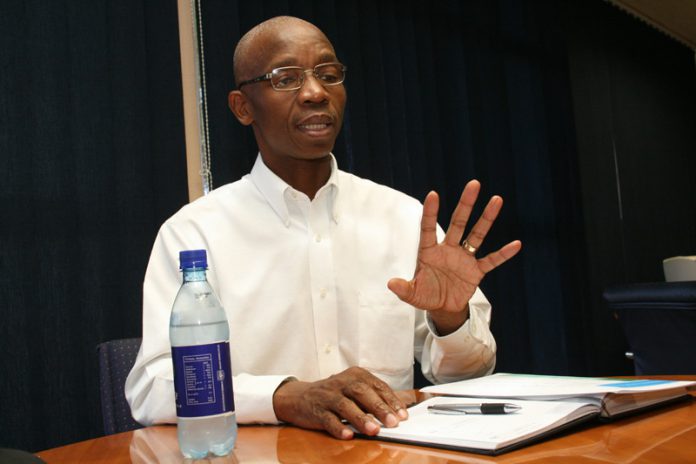
Hloni Matsela is a cheerful host. The Managing Director of Kgalagadi Breweries Limited would always welcome analysts and financial journalists to the Coca Cola boardroom to discuss group results with a smile.
Hardly surprising! The performance of Sechaba Brewery Holdings, an investment company with interests in Botswana’s two big brewers, Kgalagadi Breweries Limited (KBL) and Botswana Breweries Limited (BBL) was the envy of the industry.
Matsela and his predecessor, Lon Mtongana, saw the company cross the 1 billion mark revenue milestone. The company was the toast of the industry as shareholders rubbed their hands gleefully, knowing that their money was sweating a fortune.
That was then. These days, Matsela’s smile is as rare as soaring KBL profits, and yesteryear’s man of the moment risks being written off as the man who presided over the collapse of KBL.
“As you can see, the results are not complimentary,” says Matsela, pointing to a power point presentation.
When he talks about the non complimentary results, he means that the company fortunes are on free fall.
This is bad news for the more than 1000 company workforce who could see their jobs going down with the company profits. Aspiring investors who were hoping to benefit from the KBL corporate social responsibility project, Kick-Start, may also see their dreams going up in smoke.
KBL is the same company that financed democracy towards 2009 general election by bankrolling political parties to the tune of P2 million.
The alcohol levy that came with political changes in 2008 has burnt a big hole in the KBL pockets.
KBL alcoholic beverages volume declined by 34. 5 percent and Sechaba had the worst of it as the group’s turnover fell by 15 percent from P1.4 billion to P1.1 billion.
This is huge margin on the top line decline and a major concern to shareholders who want value from their investment.
The irony of the 30 percent levy is that since it was introduced, consumers of alcoholic products went for cheaper fixes.
To KBL, this defeats the whole purpose of the alcohol tax.
“Since the levy, consumers have moved from lower alcohol content (products) to the higher ones,” reveals Matsela.
“Outside our portfolio, we saw people move to wines; which defeats the purpose of the levy.”
At the same time, KBL is concerned that the levy favours imports to the detriment of local brewers.
The levy is collected on point of entry of imports into Botswana and charged on Cost, Insurance and Freight (CIF) of imports while it is charged on ex-factory selling price for KBL and BBL.
On the other hand, the levy is imposed on marketing, sales and distribution costs as well as profit margin for KBL and BBL while in the case of comparable competitor imports, the levy is charged only on the cost to the importer.
“The resultant quantum of the levy is thus significantly lower in the case of imported products,” complains Sechaba.
“The levy favours the imports. It has been one and half years since the competitors have been having a field day,” says the concerned Matsela.
The future of KBL, a hundred of jobs and tens of business dreams depend on President Lt Gen Ian Khama rethinking his strategy to fight alcohol abuse in Botswana.
There are currently behind the scenes negotiation between KBL and government to address the problem.
There, however, is a small problem: President Khama has invested a lot of passion in the campaign against alcohol abuse. There are even fears that the line between his persona and the campaign has been blurred and he takes attacks against the campaign as an attack on his person.
Member of Parliament for Gaborone West South, Botsalo Ntuane, who has since defected to the breakaway Botswana Movement for Democracy (BMD) was forced to apologise to the president after he openly criticised the alcohol levy. As one of the conditions not to break away from the BDP, the splinter BMD demanded that Khama re-think the alcohol levy. The stakes could never be higher.
If Khama backs down from the levy, Ntuane would be vindicated and the BMD may gain political mileage while the president would be nursing an injured ego.
For now, the president seems to have painted himself into a corner. Resolute as only a former head of the army can be, it is unlikely that he will climb down from his campaign without a face saver. The doomed negotiations are not helped by movements at the government enclave. Government officers keep on switching roles, especially at the Ministry of Trade and Industry.
This means the talks always have to begin afresh.
The levy has been with the industry for one and half years now. During the time, it has emerged that it was all a tragedy of good intentions. Although it came from the right place, it missed the point.
“We have come to the conclusion that the levy favours imports basing on our calculations,” says Matsela.
“There is a lot of discussion with responsible officials in government, especially Ministry of Trade and Industry (MTI),” reveals Matsela.
It remains to be seen whether government will bend on its decisions and Matsela does not want to be optimistic nor pessimistic.
It is only the figures that may convince government since the alcohol industry contributes to employment creation, tax to treasury although its contribution to GDP declined from 3 to under 2 percent over the years.
“I do not know,” Matsela tells Sunday Standard when asked if he thinks government would bend on the levy.
“That is a subject of discussion. We continue with the discussions and empower them (government) with facts. That is all we can do as good corporate citizens.”
However, the alcohol tax seems to be missing its objectives as the folks who were targeted decided to move to cheaper wines for a quick fix.
Despite arguments that the levy is not a single variable to KBL cost, taking into consideration the recession on the other hand, its contribution is massive.
Matsela says a 26 percent decline in clear beer is a cause for concern compared to the two percent increase on the soft drinks division.
“To me it is chalk and cheese.”
He says because of the recession, they might have grown by 5-6 percent for the soft drinks.
Matsela feels for the shareholders whom he says are in unison on their concerns over the financial results. “They expect us to continue lobbying government.”
On the other hand, traditional beer brewer BBL will fall into the same trap when the regulations come into place.
“The proposed traditional beer regulations are expected to have a further impact on BBL sales in the coming months,” reveals the CEO.
A survey conducted by BBL to gather information that would assist in determining the impact of the proposed traditional beer regulations on Chibuku retailers nationwide has revealed that the regulations will affect women mostly.
The traditional beer will be regulated under the steep Liquor Act as opposed to the Local Government/Township Act.
The 30 percent alcohol levy was introduced in the fall of 2008 as part of President Khama’s blue print to instill discipline on Botswana roads.
Before turmoil in the ruling BDP, Khama had threatened to increase the levy again. But it became a demand for the Barata Phati faction that the levy be scrapped as it encroached on civil liberties.

