

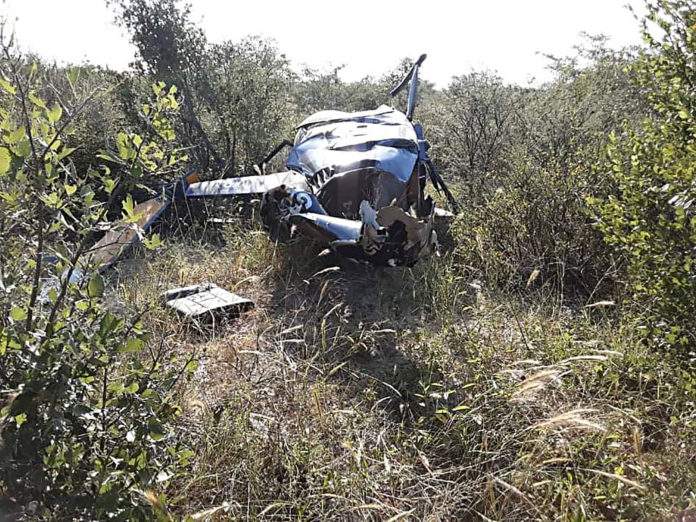
Information about how a Robinson R44 helicopter crashed a little over a week ago, claiming a young life continues to trickle out and from what Sunday Standard has learnt from aviation industry insiders, a fuller, more believable picture is beginning to emerge.
The young life is that of Sarona Motlhagodi whose fans knew by her stage name, Sasa Klaas. She was the daughter of the Minister of Nationality, Immigration and Gender Affairs, Annah Mokgethi. A spokesman of the family, Francis van der Westhuizen, who is Mokgethi’s brother and was Minister of Local Government and Rural Development until 2019, has revealed that the helicopter was being piloted by a Gaborone businessman called Leonard Matenje. The crash happened in the evening of March 5 near Sojwe. The nature of the relationship between Sasa Klaas and Matenje has been the subject of much speculation and by one account, Matenje, who recently qualified as a pilot, let Sasa Klaas pilot the helicopter, leading to the tragic accident that claimed her life.
Through very credible sources, Sunday Standard has established that the helicopter, a Robinson R44, took off from Matsieng airstrip (officially called Matsieng Aerodrome) at 1800 hours on Friday and set for Matenje’s farm (called Xumabee Game Ranch) in the Kalahari Desert. While it is standard procedure to be cleared by air traffic control (ATC) upon take-off, the pilot didn’t do that and there are divergent views with regard to this. One is that he was flying in uncontrolled airspace – being where ATC service is not deemed necessary. Helicopters fly at a low altitude and in Botswana, they are so few of them. The other is that each aircraft is supposed to get clearance from the ATC. This is one of the issues that an ongoing investigation will clarify.
The flying time from Matsieng to Matenje’s farm is between 50 and 55 minutes. While coveted for its other strengths – like power, a Robinson R44 is not fast – which explains why its scheduled flying time between that relatively short distance was that long. The general time frame of “around 7 p.m.” has been mentioned for when the crash occurred. More helpful is the information that Google provides about when sun set around the general area where the crash occurred: 1842 p.m., Central African Time.
Flying at a low altitude was a double-edged sword. The sun rises earlier and sets later at higher altitude. Had the pilot flown at a higher altitude, he would have been able to see the sun past 1842 p.m. but would have descended into disorienting darkness when he descended to a lower altitude in preparation for landing. In itself, this disorientation (technically called “spatial disorientation in flight”) has been known to cause aviation accidents. Flying at this altitude and at a time that it was getting dark, was the reason the helicopter hit a tree with its tail and spun around wildly. With the pilot’s ability to control the chopper impaired, tragedy was the result.
At least to those familiar with flying and on the basis of photographic evidence alone, the question of why Sasa Klaas died and Matenje survived is very easy to answer: greater impact from the crash happened on the passenger’s side. The plot elements of the social media account that he jumped out before the chopper crashed don’t dovetail because he would most likely have broken his limbs had he done so. Given that he was flying low, he would also not have had enough time to exit the cockpit.
Another version that has been retailed is that he let Sasa Klaas fly the chopper. A pilot with decade’s long experience says that is highly unlikely because, despite appearances, a chopper is actually much more difficult to manipulate than fixed-wing aircraft. One of the reasons is that the cyclic stick used to control it is very sensitive to even very small movements.
“You control the stick by gently turning the hand at the wrist; if you are moving the whole arm, then you are over-controlling the helicopter and it may spin out of control,” this pilot says.
Naturally, moving the whole arm is something that would come naturally a non-pilot temporarily taking over the controls during a joyride.
Another danger that the pilot cites is spatial disorientation in flight – its opposite is spatial orientation, being the ability to maintain body orientation and posture in relation to the surrounding environment (physical space) at rest and during motion. The flight environment is unfamiliar to the human body and can create sensory conflicts and illusions that make spatial orientation difficult, thus leading to spatial disorientation. This problem could get more acute at night when there are no visual references – like a visible horizon. Spatial disorientation can make aircraft look like it is flying sideways when it is not – prompting the pilot to right the problem by actually flying sideways.
This impairment was identified as one of the possible causes of a 2017 accident involving a Botswana Police service chopper. Part of the accident report reads: “The crew entered a state of spatial disorientation and in the process collided with the terrain. Lack of knowledge of the terrain, possible fatigue and apprehension could have led to spatial disorientation and as such cannot be ruled out as contributory factors in this occurrence.” Spatial disorientation happens to everyone, as the human body’s response to an abnormal environment, and is all the more reason why handing over the controls to a green horn would be a grave mistake.
“I don’t think he did that but if indeed he did, o tla a bo a le sebete,” says a source, meaning – by the Setswana, that Matenje would be uncommonly reckless.
An investigation is underway and one of the things that those carrying it out would be interested in is the pilot’s level of competence. From what we learn, Matenje recently acquired a South African pilot’s licence. South Africa will assume greater role in this matter than Botswana because in addition to having issued the licence, it also registered the Robinson R44 that Matenje was flying. In terms of International Civil Aviation Organization rules and despite the fact that the accident happened here, legally Botswana has no jurisdiction over the investigation. If Matenje is found to be culpable and his licence has to be taken away, such decision will be made by South African authorities who issued it in the first place.

