

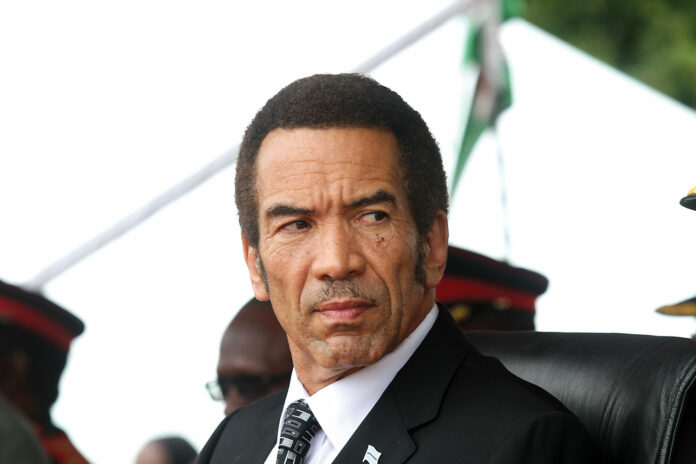
In upholding a High Court judgement, the Court of Appeal (CoA) has slammed the Directorate of Intelligence Services for having failed to prove that former president Ian Khama is a national security threat as it alleged. In one particularly stinging paragraph in the judgement, Justice Lakvinder Walia accuses the spy agency of abusing its power. “In my view, bringing those offences under the guise of threat to national security is not only disingenuous but gross abuse of power by DIS officers. There is nothing in the papers before us to show how or why the possession by [Khama] of the arms and ammunition, even though in substantial quantities, presents a threat to the security of the nation,” reads a 30-page judgement of a five-judge panel which, however, bears the signature of only three judges.
The other judges are Justices Tebogo Tau (Court President), Isaac Lesetedi, Leatile Dambe and Mercy Garekwe. The last two didn’t append their signatures to the 30-page judgement which was delivered last Friday. The dispute between Khama and DIS arose out of the latter’s possession of arms and ammunition which, outside court, have been referred to as “weapons of war.” Through court papers filed by Jet Steven Mafuta, DIS obtained a search-and-seizure warrant for properties either belonging to or occupied by Khama, former DIS head Isaac Kgosi and a DIS agent called Sehunelo Khunou. The warrant listed an assortment of 28 types of guns that it believed were concealed in such properties. The search was to be conducted in terms of the Intelligence and Security Service Act.
However, DIS made a grave mistake and realised that too late. Upon calling at State House 4, Khama’s official residence on Extension 5 which was a hand-me-down from the late Sir Ketumile Masire, they encountered Khama’s lawyers. During what the judgement describes as “a lengthy debate at the residence”, the lawyers pointed out to the DIS agents that State House 4 didn’t appear in the warrant. Resultantly, Mafuta went back to the High Court with an application that essentially corrected the mistake that he had made earlier. His explanation was that “during the execution of the warrant, it was discovered that Khama’s official residence being Plot 260/261 Extension 5, Gaborone, also known as State House 4, had erroneously been left out of the search warrant and consequently, a search of the said property could not be conducted. “ Mafuta second affidavit also stated that while Khama met DIS officers at State House 4, he denied them permission to search the premises. While the former president confirmed that there were arms and ammunition in the residence that were kept in a safe, he also told the agents that he didn’t have the key.
The person who had the keys would be back in two days, he revealed. Following this discussion, the agents gave Khama a deadline of November 8, 2021 to have surrendered the weaponry. On that very day, Khama essentially fled into South Africa where he has been staying ever since. The second application failed, whereupon another that came before Justice Ranier Busang was filed. Once more, DIS was unsuccessful with the judge stating in his judgement that the statement relating to why State House 4 was left out in the initial application were not sound.
“The statement does not say how the error occurred and what caused it given that [Khama] is, for the most part, resident at State House 4. In my judgement, a bald and unsubstantiated statement would not suffice for purposes of explaining the omission,” said Busang’s judgement, adding that “utmost good faith, honesty and full disclosure of the circumstances underpinning an application are of the essence” and that if a second warrant was to be issued, “full and honest disclosure should be proffered.” It was this judgement that DIS appealed but the five-judge panel that the matter came before poked holes in the state’s case.
The judgement says that whereas Khama had struck a deal with DIS for its agents to collect the weaponry, the agency didn’t keep its end of the bargain. “Instead, in a telephone call on November 3, 2021, [DIS] instructed [Khama] to deliver the arms and ammunition at the former’s offices at Sebele and following exchanges of correspondence between [DIS] and [Khama’s] attorneys, Khama was instructed to deliver the arms by no later than 12 noon on November 8,” the judgement says. With DIS not having refuted what Khama stated in his affidavit, the CoA found that the former has “inadvertently or by design, sought to place the blame “wrongly” on Khama. While the former president invoked his constitutional rights to privacy, security and liberty, Walia says that was not even necessary as the appeal had to be determined “on the very narrow issues” of non-disclosure and DIS powers. The Court determined that DIS had withheld (failed to disclose) some vital information from Busang.
Following an interpretation of the Intelligence and Security Service Act, the Court determined that DIS had actually stepped on the mandate of a different arm of force – the Botswana Police Services. “… none of the offences forming the basis of the application for the warrant are offences prescribed in the Act. They are offences under the Penal Code and the Arms and Ammunition Act,” says the judgement before making the point about DIS having abused its power and Khama not being a national security threat. A few paragraphs later, the judgement faults DIS for “usurping the role of proper crime prevention force, such as the police.” The latter echoes sentiments earlier expressed by the suspended Director-General of the Directorate on Corruption and Economic Crime, Tymon Katlholo when he appeared before the parliamentary Public Accounts Committee in May this year.
Katlholo charged that DIS was continually stepping on his department’s mandate. While this particular issue has been brought to finality, some other issues remain unresolved. While received wisdom says that Khama fled to South Africa to avoid arrest, he has maintained that he did so to thwart an assassination attempt. The latter means that the end of the matter doesn’t automatically mean that he will be coming back home.

