

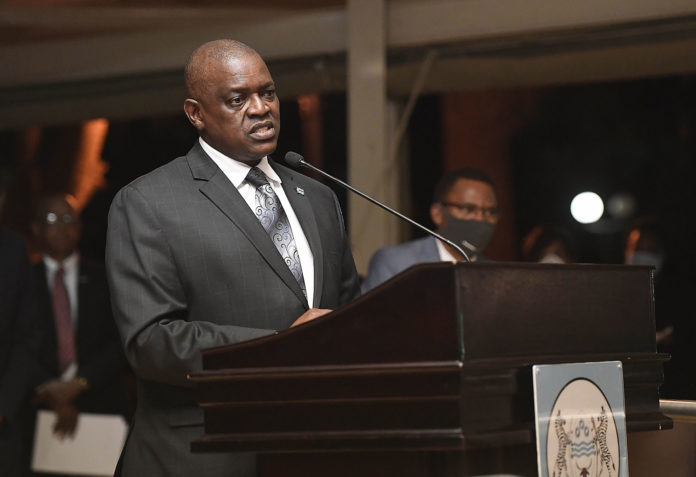
An estimated 46 of the 55 African countries have signed on to China’s ambitious Belt and Road Initiative (BRI) as of January 2020. . The last country to sign was Botswana, on 7th January 2020 when the Chinese foreign minister visited the county. Coincidently, this year marks the 46th anniversary of the establishment of diplomatic relations between China and Botswana.
While the world is bouncing from the impact of COVID-19, China has been working overtime to achieve its ambitious infrastructure development targets. The BRI was proposed by Chinese President Xi Jinping in 2013 as a public good for participating countries connecting Asia with Africa and Europe via land and maritime networks. It seeks to link six corridors with the purpose of improving regional integration, increasing inter-regional connectivity and stimulating economic growth. The BRI focuses developing large infrastructure projects such as transportation and logistics, energy and power generation, and light-scale industrial development. African countries with huge infrastructure deficits can potentially benefit from the opportunity offered by the BRI to address their infrastructure gap.
The BRI however comes with some challenges such as debt trap, unhealthy competition from large scale manufacturing companies in China, creating jobs for Chinese citizens in foreign countries instead of locals, relocating pollution-infested companies from China to unsuspecting developing countries such as Botswana. Furthermore, there are many examples of projects, even before the BRI, that have turned into ‘white elephants’ – too large, too expensive, not viable or simply not well planned, and out of proportion with their value or usefulness. Despite being a remarkable political and socio-economic accomplishment, participating small developing countries such as Botswana needs to put in place a carefully balance and robust domestic policy framework to protect its interest due to the power imbalance protect local businesses and citizens. There are two ways in which Botswana can avoid making avoidable strategic mistakes and position itself to maximize benefits instead of losing out from the BRI.
Avoiding “The Debt trap”
There exist evidence to show that debt trap diplomacy is factual. Brahma Chellaney describes how China leverages excessive debt for infrastructure projects in vulnerable resource-rich countries for its BRI. Beijing has long denied claims that investments in BRI, risk saddling recipients with so much debt that they have little option but to hand over controlling stakes in assets and/or agree to granting China excessively long leases. Policy commentators and experts across the political spectrum have criticized Chinese aid and investment practices in Africa and Asia with Zambia and Sri Lanka being classic cases. For instance, former secretary of state of the US Hilary Clinton, has warned that China is embarking on “new colonialism” in Africa.” Reference is often made of Kenya’s Chinese funded Mombasa-Nairobi Standard Gauge Railway. The railway was a marquee project for the BRI but has since proven a financial drain on the Kenyan economy; subsequently becoming a white elephant. If Kenya defaults on payments, China might be able to receive revenue from the Port of Mombasa as collateral, although the Chinese government has said it does not intend to do this.
Nevertheless, there are counter-arguments that the debt-trap diplomacy criticism of the BRI is often misunderstood. Proponents of this narrative contends that the “debt trap” argument has been one-dimensional and overlooks the amount of African debt that China has forgiven, as well as its willingness to renegotiate lending terms. In this sense, African countries such as Botswana can benefit from the BRI provided their leaders exercise prudent decision-making and press Chinese companies for more favorable lending terms and to responsibly invest strategic infrastructure projects that will drive local and national economic growth.
Learning from others
The BRI started as a vision to connect countries in China’s neighbourhood, but now has a global outlook. Asian countries have more experience in dealing with Chinese-supported infrastructure projects. Botswana and other African countries can learn from these Asian countries. For example, Cambodia and Myanmar have adopted a strategic approach to the BRI. Myanmar, has developed a stringent screening process for proposed BRI projects. Each proposal is examined by a high-level expert committee, led by high ranking experienced government officials, who are responsible for making sure that approved projects fit into Myanmar’s own development plans. The government has also created another layer of oversight as a ‘project bank’ to screen all potential Chinese funded infrastructure projects (BRI or otherwise) to select only those deemed viable and profitable for local development. Cambodia’s approach adopts conservative debt management strategy. Thus, the country borrows only under specific conditions (e.g. only to finance productive infrastructure, and only at very concessional rates).
A contextualized conservative debt management approach that fits African realities could potentially help African countries avoid a proliferation of ‘white elephant’ projects that break the bank. It should be underscored that some African countries are becoming wiser in renegotiating loan terms with China. For example, Tanzania’s President John Magufuli’s indefinite suspension last year of a port project agreed by his predecessor, which granted China a 99-year lease for the facility is clear case.
What Botswana should do
There are benefits in joining the BRI. Of course, like any other large-scale initiative, there are risks. If these risks are properly managed, they will not hamper the progress of national infrastructural upgrading and strategic economic growth. The government led by President Masisi and the citizens need to demand greater transparency in negotiations and more returns on local BRI investments while also maintaining control of strategic assets.
About authors
Chazha Ludo Macheng holds Master’s degree in International Business from Wuhan University, China. She researches international trade and sustainable development in Africa. She has published expert pieces with China-Africa Project (China), China-Africa Magazine, Daily Maverick (South Africa), African Portal, Sunday and Development Reimagined. She worked as Research and Policy Analyst at Development Reimagined, Beijing, China and has served as an intern at the Parliament of Botswana.
Dr. Michael Addaney is a lecturer at the Department of Planning and Sustainability of the University of Energy and Natural Resources, Sunyani, Ghana.

