

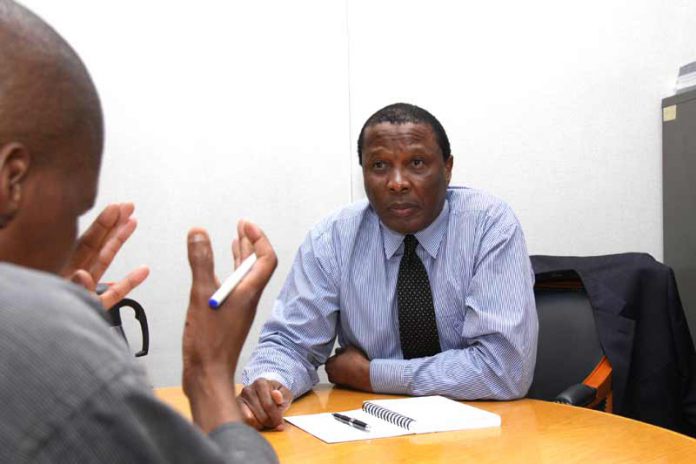
Andrew Sesinyi, the novelist, former journalist and diplomat whose pacesetter novel Love on the Rocks was one of my prescribed English books at junior secondary school, changed our appointment thrice before we finally sat down for a 40 minutes or so interview at his office.
Before the actual interview about the status of broadcasting in Botswana, I ask him about his stint at the Union of National Radio and Television Organizations of Africa (URTNA) in Dakar Senegal.
With a spark in his eyes, Sesinyi waxes lyrical about his role at the now Union of Broadcasters explaining how, as Secretary General, he inherited an organization whose major fund raising was the purchase of sporting rights at a discount with a minus in the bank.
Sesinyi says that propelled him to travel across Africa alone to raise money from the most defaulting member countries. He managed to raise and put aside money to buy rights for the 2004 Olympics, he says. “The Olympics proved to be a huge public relations exercise. Olympics don’t sell as football. It meant taking austerity measures,” he adds.
For instance Sesinyi says as the SG, he took the most unpopular decision to put the entire staff, himself, on half salary. “You could pay staff for a month and go for three months without pay. I cut the entitlements of the SG. The position attracted huge benefits. I postponed plans to purchase a new Mercedes for the SG, removed the travelling from first class to business class and moved out of a mansion to an apartment whose rental was one fifth of what the mansion cost,” he says.
Sesinyi says after the realization that the position of SG was too expensive following a SWOT analysis of the URTNA he proposed that the nucleus of the organization be run by an executive director maintained by the organization at a lower salary than that of the SG with fewer entitlements.
Sesinyi says he resisted the urge to implement the nucleus when he was asked to. “You needed a different person to implement the scheme,” he says.
We shift focus from his role at URTNA. We talk about what inspired his career as a broadcast journalist. The name Batho Molema comes first but he acknowledges the late news reader Kgosietsile Mmamapilo’s “sheer talent in news reading”. “The best broadcaster still alive is my neighbour Batho Molema. He has absolutely no idea how I hold him in high esteem. Molema is a successful man in his own right. He was a pioneer,” Sesinyi says.
What could be the reasons for the government’s seemingly unrelenting control of the electronic media? I also ask him to take stock of the status of broadcasting in Botswana.
The former Director of Information says there could be two reasons why the government does not want to free the airwaves. On the one hand, he says, it could be that the government of the day wants to use the electronic media to concentrate on development programmes. On the other hand, he suspects the government probably fears that if it distanced itself from these critically important facilities it might have a sort of loss of direction.
“It’s terribly inconvenient and uneconomic to run broadcasting as a government department. There must be good reasons why the government wants to run it as a government department. The truth is you have greater control when you allow a discernable degree of independence to broadcasting units (radio and television). You then leave it to designated people to do the talent search. Most importantly, you make it clear that they [designated people] must recover the costs of running these institutions,” he argues.
The current scenario, he observes, is such that employees at these government institutions are not bothered whether or not the institutions attract advertising as they are assured of salaries from the government. There is no need to excel, nobody cares to mentor others.
“To activate talent, you must relate talent to a reward system. Making the electronic media free from government control gives it a semblance of autonomy,” he says. The former director offers like many others before him, that broadcasting must be run not as a government department but a parastatal. The beauty of it, he says, is that it will depend less and less on government to recover costs.
Sesinyi argues that any form of direct ownership by government takes away the essential transparency that ought to make the institutions look democratic
The former journalist says government is denying itself the benefits of a huge credit that comes with showing they are not interfering with the day to day editorial business of the public media. “We have for example the SABC which has less stigma than ourselves but it is government controlled. We are at a stage where we should also know that the public is fairly sophisticated and so unless we project a more transparent image of both radio and television, news that come out of these media will always be regarded as propaganda,” warns Sesinyi.
It is as he talks about this propaganda that I ask him to share his thoughts on the role of the National Broadcasting Board over the government owned media in particular. Was the ruling over the government media favouring the Botswana Democratic Party at the height of the infighting within the party on the eve of the 2009 general elections a healthy one?
Sesinyi becomes evasive and beamingly proffers a “No comment”.
All the same, he denies that during his tenure as director of Broadcasting Services anyone ever leaned on him to suppress alternative views and spin the government propaganda.
“When I ran the Round Table show there was no interference on my show. As the former director I never experienced any interference from anyone although I was called a puppet. Everyone called me the chief censor of news. I didn’t blame them because I was 100 percent owned by the government,” he says.

