

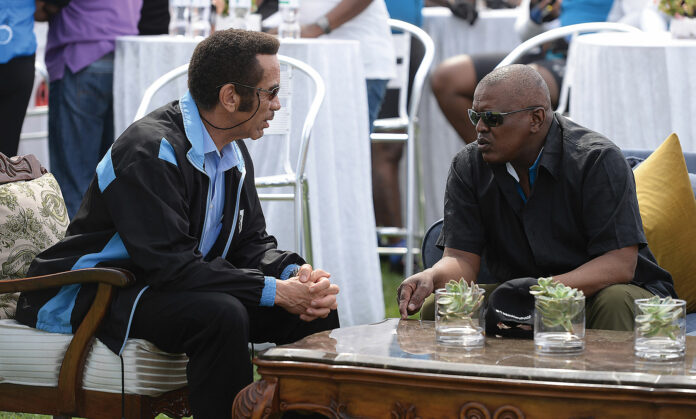
The bitter feud between former President Ian Khama and President Mokgweetsi Masisi has touched off a new controversy.
The Fraser Institute attributes it to investors losing confidence in the country’s mining investment attractiveness index.
In the latest Fraser Institute’s Annual Survey of Mining Companies for 2021, Botswana saw a significant decline as investors expressed increased concerns over the country’s political stability.
Botswana lost its ranking as the top African jurisdiction in terms of policy, ranking 31st in 2021, compared with 15th in 2020.
Botswana is also no longer the highest ranked jurisdiction in Africa on policy, ranking 31th (of 84) this year after ranking 15th (of 77) in 2020.
The report reveals that, “Botswana’s significant decrease in its PPI score—a 22 percent drop—reflects increased concerns over the uncertainty concerning protected areas (+r63 points), its political stability (+38 points), its labour regulations/employment conditions (+38 points), and its taxation regime (+38 points).”
The respondents indicated the above policy factors together with political stability deterred investment.
Compared with the 2020 survey ‘Investment Attractiveness Index, Botswana’s scores dropped significantly, from 81.48 in 2020 to 48.61 in 2021
The survey, which is sent to more than 2 000 exploration development and other mining-related companies around the world, aims to assess how mineral endowments and public policy factors, such as taxation and regulatory uncertainty, affect exploration investment.
According to the Institute, the Policy Perception Index, or PPI, provides a comprehensive assessment of the attractiveness of mining policies in a jurisdiction, and can serve as a report card to governments on how attractive their policies are from the point of view of an exploration manager.
“In previous survey years, we have referred to this index as the Policy Potential Index,” the Institute says.
The institute further explained that the Policy Perception Index is a composite index that captures the opinions of managers and executives on the effects of policies in jurisdictions with which they are familiar.
All survey policy questions (i.e., uncertainty concerning the administration, interpretation, and enforcement of existing regulations; environmental regulations; regulatory duplication and inconsistencies) are included in its calculation.
Other policy questions included in the calculation are taxation; uncertainty concerning disputed land claims and protected areas; infrastructure; socioeconomic agreements; political stability; labour issues; geological database; and security.
Our sister publication Sunday Standard recently reported that the Bertelsmann Stiftung’s Transformation Index (BTI) 2022 has also highlighted that the continued dispute between Masisi and Hama could destabilise the country and its institutions.
The BTI assesses the transformation towards democracy and a market economy as well as the quality of governance.
“The public dispute between President Masisi and Ian Khama, which emerged in 2018 soon after Masisi succeeded Khama, eventually led to Khama being pushed out of the ruling party in May 2019,” said the BTI country report, which added that, “The public dispute between Masisi and Khama could lead to instability.”
It notes that Khama accused Masisi of being intolerant of opposition. Other key members of the party, who had criticized or opposed Masisi, were also purged. State media decided not to provide airtime to former President Ian Khama – a decision that was criticized by the opposition.
The report says the public spat between President Masisi and former President Ian Khama did not develop into open conflict, but it led to concerns that the country would be divided between north and south.
“In all areas, the leadership qualities of Botswana’s fifth president, Mokgweetsi Masisi, who succeeded Ian Khama in April 2018, and those of other key actors will continue to be of the utmost importance,” the report says.

