

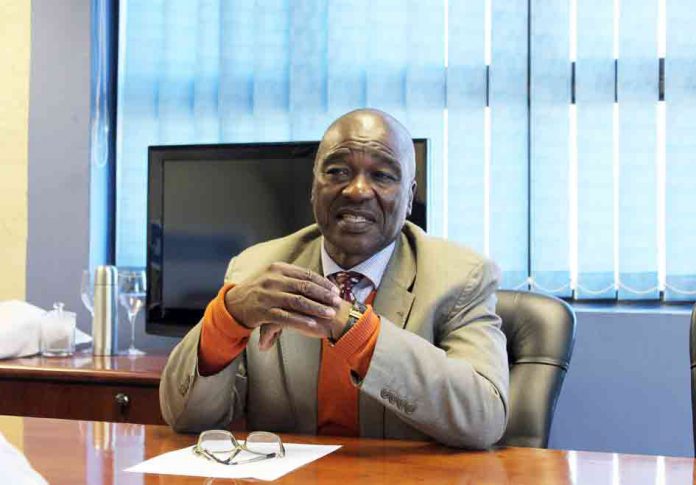
If you were to ask Abel Modungwa what type of graduate he wants to see emerge from Botswana’s education and training system, the answer would be along the lines of, a globally competitive individual with a set of skills that can either land them a good job anywhere in the world, or be used to self-employ.
The new emphasis is on what one can do.
“It is not about completing so many years (of study); it is about what skills and competencies one has acquired,” he quips.
He is explaining the National Credit and Qualifications Framework, often shortened to NCQF. Part of the mandate of the organisation that Modungwa leads, Botswana Qualifications Authority (BQA), is to provide for and maintain the NCQF. This is the superstructure that will ultimately bind together the nation’s entire education system; from early childhood through to PhD level. Through the NCQF’s quality assurance mechanism, it is intended to ensure that the quality of Botswana’s education system compares well to other systems in the region ÔÇô and even internationally.
“As we develop the system, we have to bear in mind that the ultimate is to develop a knowledge-based society; that we should produce learners who will be able to work locally and internationally,” Modungwa states. “There is a deliberate move that the NCQF should be aligned to the SADC qualifications framework because we want to give learners or potential employees the opportunity for mobility across the region.”
This flows from the National Human Resource Development Strategy, which underscores the need to transform Botswana into a knowledge-based society that produces global workers. The framework in place, therefore, is seen as the mechanism to deliver that type of human resource.
“One of the key benefits of this framework is that it brings the nation into a common understanding of what its education system is all about. It brings comparability both locally and regionally,” he says. “This framework is such that the national qualifications get to be registered in the system, and are defined in terms of what is called level descriptors, which state knowledge, competencies and skills expected to be imparted at each level. A level is defined in terms of standards required for the sub-system under which it falls, whether General Education, Technical and Vocational Education and Training, or Higher Education . The standards are generally and technically described as outcomes; so we talk of an outcomes-based system. It is outcomes-based because the standards state what the learner should be able to do when he or she has completed a diploma or a degree.”
Established by an Act of Parliament in 2013, BQA took over the quality assurance functions that were previously performed by the old Botswana Training Authority (BOTA) and Tertiary Education Council (TEC). The organisation is currently transitioning two quality assurance systems ÔÇô the vocational training system that was under the remit of BOTA, on the one hand, and the higher education system that was the responsibility of TEC, on the other ÔÇô that had different approaches to learning programmes accreditation.
The transition is a product of the BQA Regulations that were gazetted late in 2016. As required by the Act and the regulations, the Authority is mandated to register and accredit all education and training providers (ETPs), both private and public.
The 12-month transition period is meant to emerge with a single regime in which education and training providers (ETPs) only offer programmes that have been accredited. This is a departure from the old system under TEC in which ÔÇô during the accreditation process ÔÇô learning programmes could be given the status of either approved, provisionally accredited, fully accredited, or deferred accreditation. In all the three cases, the programme was allowed to run. The programmes that were registered, approved, or accredited under the old regulations are allowed to run during the transition period, and learners enrolled in such programmes will be allowed to complete their studies with recognised qualifications.
A thread that runs through the entire maze is quality, as well as seeing to it that the ETPs provide learning programmes that are relevant to the needs of learners, industry and employers.
Related to this aspect is ensuring that there is no mismatch between qualifications and what the market requires. It’s what Modungwa calls, “avoiding a situation where jobs are on the left and the qualifications are on the right”. He emphasises the importance of ascertaining that learners acquire qualifications that add value to their lives, thus putting them in a good position to either be employable or become entrepreneurs.
In sectors where there are professional registration and regulatory bodies, these have to be brought on board as partners in the accreditation process of learning programmes that are specific to their professions. For instance, a memorandum of understanding was entered into with the Botswana Health Practitioners Council (BHPC) in May for learning programmes in the health field. Modungwa states that BQA will soon enter into a similar arrangement with the Engineers Registration Board (ERB) to be part of accreditation of engineering programmes, while consultations are ongoing with other professional bodies for the same purpose.
Prior to accreditation of a learning programme, the input of the relevant professional body is sought. If satisfied that the programme meets the human resource needs of the country, as well as satisfying the required quality assurance and professional standards, it is accredited against a qualification that would already be registered on the NCQF.
“After accreditation,” Modungwa states, “you now monitor to ensure that they (ETPs) maintain the standards. This is critical because you might accredit someone today, and in a year’s time they would have dropped the standard. So you constantly need to check.”
It is a high stakes environment. With government’s generous sponsorship of tertiary education, the higher the student enrolment, the bigger the profits. Modungwa often finds himself being blamed by some ETPs that he blocked them from getting students.
“It’s not our mandate to allocate students (to ETPs),” he says. “That is the responsibility of the Ministry of Tertiary Education, Research, Science and Technology. But they would only allocate learners to a given ETP on the basis of its accreditation status. That’s where we come in. The ministry asks us for a list of accredited ETPs and programmes, and then decides how to place learners based on the identified priority areas. Our business is quality assurance of the education and training system, as well as monitoring for continued compliance to protect enrolled learners.”
He underscores that in the business of skills development, quality comes first.
The other touchy area has been the new fees that were also gazetted late last year. The view is that the fees are too expensive and prohibitive for most people who may want to enter the education and training business. Modungwa explains that the fees are meant as a cost-sharing measure, and a departure from the old subsidy approach.
He has heard the argument that the fees will close out average citizens, and ensure that only those with healthy bank balance continue to share the cake amongst themselves. He states that the fees are currently being reviewed and due consultations will be carried out.
Seven months into the transition period, Modungwa says all affected ETPs have been sensitised to move with speed to meet the December deadline. While conceding that challenges are to be expected, he insists that the key thing is for institutions to submit their applications for registration and accreditation, especially the public ETPs, which previously were exempted from the accreditation.
“They must throw the ball to us,” he says. “We do not accept that anybody should reach December without having submitted applications for their ETP. We don’t want to participate in any conversation that suggests that someone may not be ready by December; that they may not have registered and accredited. Our view is that anybody who has not accredited by December is non- compliant and risks action being taken against them in terms of the law; whether private or public ETP, it doesn’t matter.”
The system does not only confine itself to high education. It also provides for registration and accreditation of basic education providers as well ÔÇô early childhood, primary, and secondary. This is one area where work is ongoing for a transition plan before registration and accreditation can begin.
“It’s a much bigger system than the other two (TVET and Higher Education) systems in terms of the number of schools. There are about 1500 primary and secondary schools. We don’t even know how many early childhood institutions are. We still have to ascertain that,” he says. “We would rather be realistic, and say we need a year or two to profile and understand them. With the other two, we had the advantage that we were already dealing with them under the old BOTA and TEC.”
With his contract coming to an end in December, Modungwa indicates that he has already communicated his intention to retire to his principals. He has had a unique opportunity to be the founding CEO of two training regulators, having established BOTA in 2001, and later setting up BQA.
“We started from zero, but now BQA is largely established,” he says. “We now have the law, we have regulations, and we have ETPs that are starting to be registered under this system. But even more so, we have educated Batswana about this system, particularly the learners. So, I am leaving a very happy man.”

