

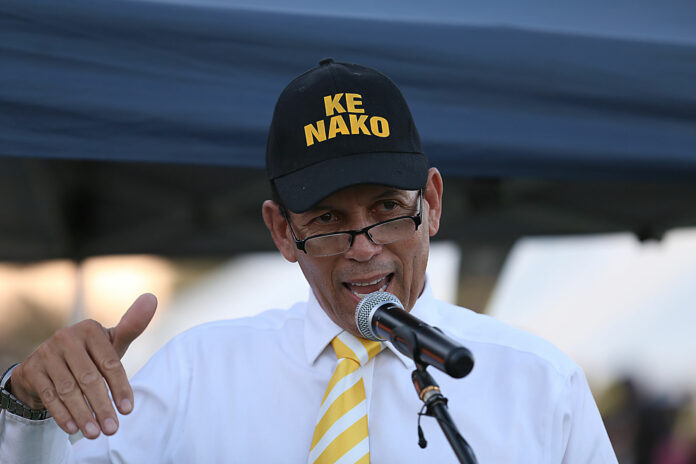
Tshekedi Khama can absent himself from parliament until February next year and won’t suffer any consequences. However, if he doesn’t attend next year’s winter session, he will definitely be out of a job as Serowe North MP. Interestingly, a fellow comrade of his, who also left the ruling Botswana Democratic Party for the Botswana Patriotic Front, also went AWOL in the last parliament and didn’t suffer any consequences.
Last month, Tshekedi and his family joined his elder brother and former president, General Ian Khama, in South Africa. Tshekedi’s twin brother, Anthony Khama, did likewise, also taking his family with him. Khama fled in November last year as the Directorate of Intelligence Services and Security (DISS) closed in on him in a criminal investigation. Tshekedi, his wife Thea and Anthony were arrested by DISS late last month and spent a night at a DISS jail in the outskirts of Gaborone. This arrest was in connection with operations of Seleka Springs, the controversial family business that the twin brothers have managed for decades. Following this arrest, the brothers crossed into South Africa, Anthony and family first and Tshekedi following shortly thereafter, using the Pioneer border gate in Lobatse.
Anybody else would lose their job if they went AWOL for months on end but the standing orders (the rules of parliament) are overly accommodating to MPs. According to the standing orders, an MP can only lose his/her seat if s/he absents him/herself from parliament for three consecutive meetings. A parliamentary year has three meetings: the first begins in late October when the president gives the state-of-the-nation address and normally lasts eight weeks; the second, which is the longest, begins in February when the finance minister gives the budget speech and lasts about 13 weeks; and the last, which is also the shortest takes place between July and August, lasting six weeks.
Tshekedi attended part of the current meeting of parliament, which is coming to a close. In terms of the standing order in question, he can miss both the upcoming winter and end-of-year meetings. However, if he doesn’t attend the budget meeting in February next year, he would have absented himself for three consecutive meetings and would thus lose his seat. The seat would be declared vacant and a bye-election would be held to fill it.
Guma Moyo, a man with whom Tshekedi is low-key battling for control of the BPF, also did the same thing in the last parliament. Mid-way through a meeting of parliament, Moyo fled the country citing fears for his life. By his account, he had received credible intelligence that there was a plot to kill him.
Standing orders impose workplace requirements on MPs only when parliament is in session and give the Speaker supervisory authority over them. As the administrative head of the National Assembly, the Clerk of the National Assembly maintains something akin to an attendance register. However, out in their respective constituencies, MPs are not supervised by anyone – not the Speaker, not the Clerk and certainly not the respective political parties they belong to. As far as the Standing Orders and the constitutions of those parties are concerned, there is no such thing as the Constituency Office because it is not mentioned in those documents.
Interestingly, the Constituency Office is where most of the parliamentary work is done – or is supposed to be done. The expectation that MPs that should supervise themselves is deeply problematic in that lazy ones just don’t do any work at the Office. Under such circumstances, voters have no choice but to wait for five years for the opportunity to change out representatives at the next cycle of elections. Naturally, a party would be inclined to make some intervention when an MP plays hooky but the fact of the matter is that parties don’t have any real control over MPs. The absence of structured institutional oversight also means independent MPs are the freest to do what they want.
This laissez faire arrangement will allow Tshekedi to spend up to 10 months without working. While this may sound like a holiday for him, he would be worried about a prize that could be slipping from his fingers – control of the BPF which he is Secretary General of. The party, which was founded by Gen Khama in 2019, is virtually leaderless. Its president, Reverend Biggie Butale, has been suspended after ill-advised hanky-panky with a university student. Butale was largely seen as a figurehead and Gen. Khama as the real leader. For now, the acting president is Caroline Lesang, whose substantive position is that of vice president. At least until he moved/relocated to South Africa, Tshekedi had filled the power vacuum that his elder brother created by fleeing to South Africa. It is no secret that Tshekedi is eyeing the presidency. Somebody else is – Moyo, who is an additional member in the Central Committee.
In the absence of the Khama’s brothers (especially Tshekedi) Moyo is consolidating his power. As Sunday Standard reported last week, Moyo has, at own expense, bought a machine that prints party membership cards. The former assistance finance minister under Gen. Khama and Tati East MP, is doing a lot more because he is reportedly awash with cash. He has just secured rented accommodation for the party secretariat in Phase 2, Gaborone West and paid a year’s rent in advance. Central Committee meetings are now held at a hospitality establishment that he owns in Phase 4 and where some members used to have a whip-round to buy food, he buys meals (breakfast and lunch) for them.
Moyo is now reportedly the most influential and “most vocal” member of the Central Committee, with 80 percent of the members supporting him. This might louse up Tshekedi’s plans to take over the leadership of the BPF at the next party congress. The Serowe MP and son of the founding president, Sir Seretse Khama, may actually not be able to compete because compared to the free-spending Moyo, is said to be close-fisted.

