

The United Nations Working Group on Arbitrary Detention has questioned Botswana’s commitment to protect fundamental human rights.
A preliminary report released Friday July 15, 2022 raises serious concerns about numerous provisions in the Botswana legislation imposing criminal sanctions for offences arising from “mere” peaceful exercise of rights protected by the International Covenant on Civil and Political Rights, especially freedoms of expression, assembly and association.
The report expresses concern about what it calls “vague offences” that may lead to imprisonment under the current legislation such as “common nuisance”, “idle and disorderly persons”, “use of insulting language” and “rogues and vagabonds”.
The offenses are considered matters of criminal law and therefore anyone, including children, can be found guilty with penalties ranging from a fine or one month imprisonment or both for first offenders, to up to a year of imprisonment for repeat offenders.
Imprisonment over failure to wear a mask in line with Covid-19 regulations was also found to be a violation of individual rights by the government.
The Working Group calls on the Botswana government to devote particular attention to necessity and proportionality of deprivation of liberty in the context of public health emergencies, including the Covid-19 pandemic. The report says emergency powers must not be used to silence the work of human rights defenders, journalists, members of the political opposition, or any person expressing dissent or criticism of emergency powers or disseminating information contradicting measures addressing the health emergency.
“The Group met individuals imprisoned for these offences and observed these provisions applied against individuals in situations of vulnerability such as vagrants, and used against children considered to be unruly.”
The report also found that the legislative provisions are also used against those who have spoken against various government policies and/or authorities and used to curb legitimate debate in what is supposed to be a democratic society. The report raises concerns over Cybercrime laws. The Penal Code criminalises defamation. The Cybercrime and Computer Related Crimes Act, No 18 of 2018 allows for imprisonment of up to one year for “offensive electronic communication”, and the Emergency Powers (Covid-19) Regulations of 2020 penalized “publishing with the intention to deceive” with up to five years imprisonment.
Many people have been charged under these provisions over the past couple of years mostly in relation to their social media posts.
The report also slams Botswana’s legislation in relation to the The Public Order Act No 6 of 1967 which requires prior permission from the police for any public meeting or gathering. Failure to obtain such a permission may lead to a fine or up to six months imprisonment or both. It calls into question the government’s Media Practitioners Act, No 29 of 2008 which requires all media workers and outlets to register, including websites and blogs. Failure to register leads to a fine or up to three years imprisonment or both.
“These provisions may have a chilling effect on freedom of expression and especially on journalistic freedom in Botswana. The Group recalls that laws formulated in vague and broad terms breach the principle of lex certa, violating due process of law. The principle of legality requires that laws be formulated with sufficient precision so that individuals may have access to and understand the law, and regulate their conduct accordingly.” The preliminary report says laws that are vaguely and broadly worded may deter the exercise of the rights to freedoms of opinion, expression, peaceful assembly and association, participation in political and public affairs, as they have the potential for abuse, including the arbitrary deprivation of liberty.
The Working Group says they enjoyed full and unimpeded access and visited 19 places of deprivation of liberty, including police custodial facilities, prisons, an intelligence and security facility, a military facility, an immigration detention centre, a refugee camp, a mental health hospital, and rehabilitation facilities for children. They were able to confidentially interview over 100 persons deprived of their liberty.
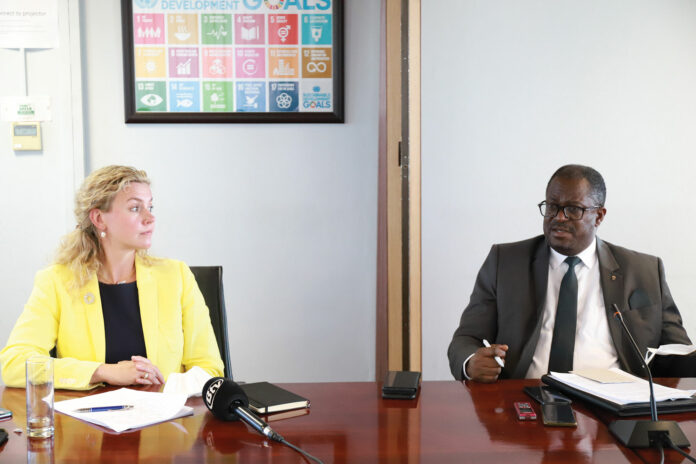
“The Working Group would like to thank the UN Country Team, the Resident Coordinator, and their staff for supporting the visit. The Working Group also recognizes the numerous stakeholders within the country who shared their perspectives on the arbitrary deprivation of liberty, including representatives from civil society and lawyers. The Group thanks all of them for the information and assistance they provided,” the group’s representatives Elina Steinerte and Mumba Malila told the media on Friday. A full report is expected to be released in September 2022.

