

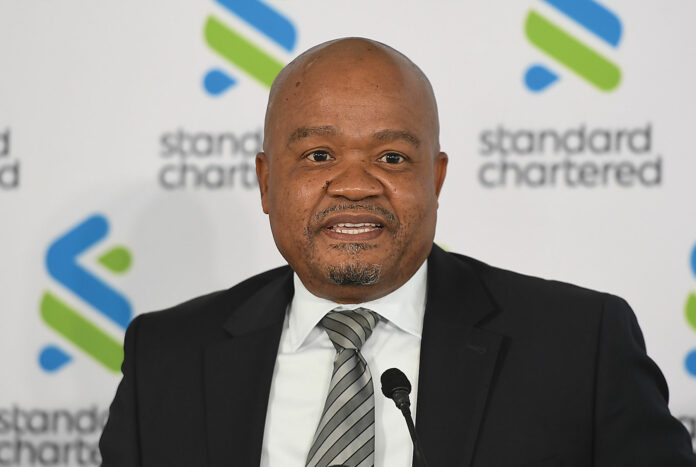
It’s hard to believe that Standard Chartered Bank has been in Botswana for over 100 years – since 1897, to be exact. Since then there have been really difficult times. And Standard Chartered went through all of them. The bank saw two world wars. The economic meltdown of 2008/13 is another flashpoint. Having to let go of a big book comprising of the diamond polishing companies was another big drag on the bank as was the closure of BCL Mine at Selibe Phikwe. Around 2017/18 Standard Chartered Bank of Botswana had about 80 percent of an entire diamantaires book. When a decision was made to close the book it felt like waking up one morning and having to throw away P150 million off the balance sheet.
Coupled with the BCL Mine closure, the two ensured a cumulated loss of close to P200million. In the end the year 2018 has been the year in which the bank emerged from one of its toughest times since operating in Botswana. The book shrank significantly as the bank was also getting abnormally cautious in its dealing with state entities. Yet the bank persisted in cleaning the book. To get back on track, the bank needed to make an upward swing of P500million – that was not possible given the prevailing conditions. When Covid struck, Standard Chartered had an exceedingly clean book – 1.5 percent in impairments against a 5 percent industry standard. It was a wake-up call, says the Chief Executive Officer Mpho Masupe who had only joined the bank a few years prior as Chief Finance Officer. So far nothing has come close to the hardships brought about by the pandemic disruptions. Yet during the Covid-19 Standard Chartered registered some profit – however minimal. Masupe says Standard Chartered attaches a high premium to due diligence.’
“Everytime there is stress, we run to protect our balance sheet,” says Masupe. This is done to protect funds, but also the brand and customers. Immediately preceding Covid-19, Standard Chartered was on an upward trajectory, and according to Masupe excitement was palpable among staff. “We had put on a good strategy,” he says to anchor the interview. That strategy was three-pronged. First it involved fixing governance, secondly it included recovering money from customers that had defaulted. Equally important was training staff to bring them to up to speed with what was expected of them. Masupe’s fighting spirit has been unparalled. On the governance front, he is upfront that the bank was failing many audits. “Our own audits are very stringent, and we were failing them. We were worried that the franchise was not as strong as it needed to be. And to get that right we needed to train people.” Standard Chartered has always been decidedly the most risk averse of Botswana’s top three banks; the trio included ABSA (formerly Barclays) FNBB and of course Stan Chart. The Chief Executive is aware of public perceptions that Standard Chartered is conservative. It is a reputation he gleefully embraces and he attributes it all to their high standards of due diligence.
“Long before it was a legal requirement, Standard Chartered insisted on ‘know your customer,’” says Masupe. “We mind losses. We are not after a quick buck. We are careful who we bank with and who we loan. In fact that’s how we were able to make money during Covid,” Masupe says with some measure of discernible pride. But Masupe has been ruthless in cutting jobs and closing down branches. To put the closures into context he closed down all branches at Mochudi, Lobatse and Molepolole. Several others were closed down in Gaborone. A high threshold was set to determine which branches would ultimately remain. Covid-19 pushed too many businesses to the brink. “By all accounts during Covid we made good profits for the circumstances. Our book was very clean and we relied heavily on investments we had already made on technology.” Says Masupe.
Exactly where Standard Chartered fits in the new post covid world is still open to interpretation. A lot of work has gone into rebuilding the Standard Chartered brand and growing the market share. As at the last reporting schedule in February consolidated full year profit before tax for 2021 went up by 42 percent. Profit after tax for the same period (FY2021) went up by 21 percent. Customer deposits alsowent up by 6 percent year-on-year. The 2020 & 2021 sets of financials were a build up on 2019’s momentum after the bank tripled its pre-tax profit for the financial year ended December 2019 to P69.5 million, up from P23 million registered in 2018. But Masupe reckons an era of hundreds of millions in profit are unlikely to come back because today’s economic fundamentals are different.
Today’s levels of interest rates are making bigger profits especially harder to achieve.. There is a certain irony in the fact that for much of its existence in Botswana, a long time, Standard Charted was a key member of the top three; Barclays Bank, as it then was, Standard Chartered and First National Bank. Today FNBB is ahead of the two by a mile. And Stanbic has overtaken Standard Chartered. Standard Chartered’s share price, like that of all its peers has tanked; the stock crashed from the heights of P12 a share to P2 from where it is still recovering. Masupe is painfully aware that it might not reach its previous heights any time soon, but is adamant that it’s only a matter of time before the bank is back on the driver’s seat. All the ducks are on a row with the bank in a very sound capital structure, he insists. But he is realistic on chances of Standard Chartered ever becoming the biggest bank in Botswana.
“We are not looking to being number 1. What we want are the best on returns.” For him that means achieving double digits. At the moment returns sit between 4 and 5 percent. He speaks non-stop about the possibilities offered by huge digital investments that Standard Chartered has made. “We are able to open a bank account without a customer setting foot into the bank. We are truly digital.” During Covid, Standard Chartered used their digital platforms not only to make money but to also protect lives. In the end the bank lost one member of the team. The quality of people at Standard Charted is a recurring theme during the interview. “Our people are by far our biggest strength. We are changing the culture and soon we will be the best paying bank in the country. Our goal is to make our people future-ready. Our culture is unique and because of that people who leave always end up coming back.” Not only is he training his people because he wants them in turn to improve service, he says the ambition is to use service to distinguish the bank from competitors.
In the 1990s these trio, which at the time dominated the Botswana stock exchange were heavily criticized for the liquidity woes. The accusation was that being foreign owned, they had released too few shares for trading on the BSE, an accusation that was not altogether unfounded. Masupe is now putting extra weight on Standard Chartered growing its governance and prudence. He says he is comfortable with the people working around him. And that is not all. “ I am now happy with the leadership team I have. I believe they can take the business forward. We demonstrated resilience and also weathered the storm. We now have to demonstrate growth,” he says as a matter of fact. Standard Chartered is in a process of building a strong digital platform that will revolutionise how banking is done in Botswana. Another area where Masupe exudes passion has to be awake to climate change.
He understands the dynamics quite well and says Standard Chartered is course to be an industry leader shown chiefly by the slant of its lending. He said Standard Chartered in Botswana will not immediately push for net zero as a fast rule, but will support a well-managed transition to renewable energy. He is aware of what that would mean for Botswana and indeed much of the developing world where energy production remains overly dependent on fossil fuels. He is of the view that new fossil projects can still be financed while insisting on cutting emissions. Masupe cut his teeth at Morupule Colliery Mine before moving to Debswana. In his heart he still has some attachment to coal.

