

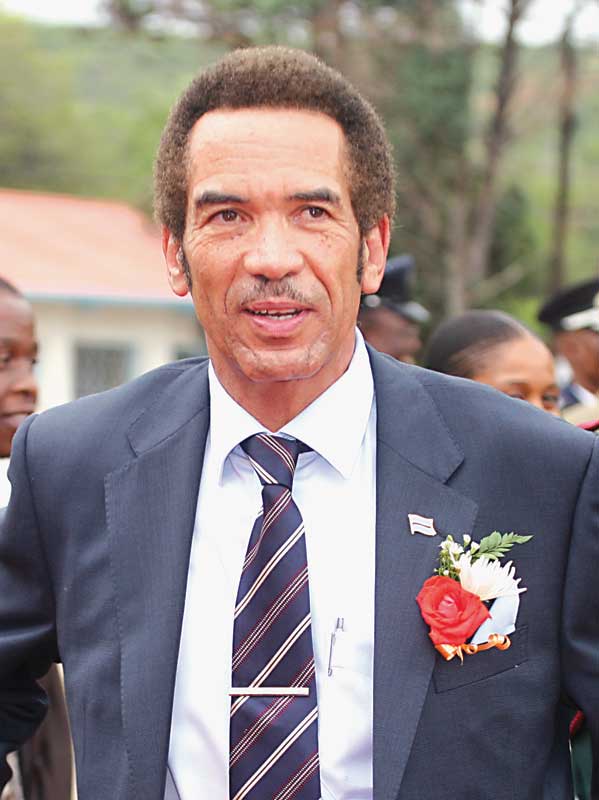
For a very good reason, President Ian Khama would prefer that Batswana were less showy with their material possessions.
“Every citizen must (especially the political leadership) strive to maintain our culture of modesty and avoid extravagance at all costs,” Khama said in his inauguration speech on April 1.
For their own reasons, some Batswana prefer to be extravagant. At one level, the problem is that some of them have known or seen extravagance all their lives. Undoing mentality that has entrenched itself over decades is not going to be a walk in Tsholofelo park, not even for first the citizens.
Around the time the president was still Brigadier Seretse Khama Ian Khama in the Botswana Defence Fence, there was this group of workers called “makonteraka” ÔÇô male workers contracted to work in South African mines through an employment agency called The Employment Bureau of Africa (TEBA). When these men got back home after a year, they would be awash with cash. Some of them used that money very wisely by putting their children through school, buying livestock, starting businesses – generally investing the money wisely – and are now sitting pretty. However, there was also a group that did the opposite of investing wisely and is now sitting ugly.
Naturally, the tales would differ but this is the writer’s recollection of what he saw in Mahalapye. Around that time, chicken was a once-in-a-blue-moon treat but these men would make sure it was on the menu every evening. When they went out to drink they would have a special seat in the shebeen queen’s living room where they would be attended by the host’s most beautiful daughter. All too often their generosity came with emotional abuse on the beneficiaries. The on-leave mine worker would be going out to relieve himself and, finding knots of broke men crowded around near-empty cups of traditional beer, would eyeball each one of them long and hard. With a theatrical snarl and contemptuous wave of his hand at the men, he would instruct the shebeen queen: “Ba siele ka o fela.” He would then saunter back into the hut, purposefully ignoring profuse expression of gratitude behind him.
These men who, towards the end of this contract working system, would be referred to as “Maboso” were natty dressers. The object was not to coordinate colours but pile as many different colour clothes on themselves as they could. One would, for instance, wear a white suit with a red shirt, green tie, pink-rimmed ‘dimmers’ ÔÇô sunglasses, and black platform shoes. Just when he was about to go out, he would check himself out in the mirror and feeling under-dressed, would throw a faux gold necklace over the suit jacket and for a bit more dramatic effect, strap on an extra rinky-dink watch over the cuff of the jacket. The entire wardrobe would have come into the miner’s possession by way of mail-order catalogues like Mahomedy’s or African Wholesalers.
Their mode of transport of choice was the Humber bicycle and often when cycling through the village they would be clutching a black briefcase they would support with the handle bars. The case would contain a jumble of papers when some of them could not even read. They would breeze into the shebeen queen’s yard cycling at top speed, ram on the brakes, sending up a cloud of dust that would choke whoever was around.
They had proper, 10 centimeter-long Setswana names but when they got back they would have acquired new Sotho or Zulu names prefixed with “Aubuti” (brother) and would not finish a sentence without throwing in a soupcon of Fanagaloo, the lingua franca used in the mines. They referred to each other as ‘mfo.’
When not speeding on his Humber, the high roller mine workers would be pimp-strolling from shebeen to shebeen, chest puffed out. Behind would follow a train of free-loading, stay-at-home hangers-on from his neighbourhood.
Showy makonteraka were role models of the time and almost every impressionable young boy aspired to be like them when they came of age.
“Every boy in Molepolole wanted to be like them. They had the biggest houses, wore the best clothes, played the best music and went out with the most beautiful girls,” recalls Sunday Standard’s editor, Outsa Mokone.
As a young boy growing up in Molepolole, Mokone had no grander ambition than to work in South African mines.
Fast forward to 2008. Khama is now lieutenant general, has retired from the army and is state president. On the extravagance scene, the players have changed but the game and its rules are still the same. The Humber has been replaced by the Hummer; the shebeen by the gastropub; Fanagaloo by English; the Xhosa click in the South African mine lingua franca by the Third World posh-school twang; ‘mfo’ by ‘dawg’ and ‘my man’; the chicken by exotic western dishes; the pimp-stroll by the more rhythmic and languid suburban swagger; the rinky-dink watch by a two-tone lapis lazuli-face Cartier; Western Deep Level money by the CEDA loan; dimmers by made-in-Italy shades; the faux gold necklace by real gold necklace; the shebeen queen’s daughter by beauty-queen waitresses; the lazy-day getup by designer shorts, muscle top, baby-fist-small retractable Nokia cellphone, mineral water bottle, hand towel slung over shoulders and P1000 trainers; “Ba siele ka o fela” by “Give everybody a drink, when I drink everybody drinks”; the black briefcase by trendy laptop computers; platform shoes by overpriced, hideous Giuseppe Zanotti creations with square toe caps; the shebeen freeloader by the pub-crawling lager beggar; Mahomedy’s by amazon.com; and, luxury cars kick up more dust around pedestrians than they ever did.
Khama’s complaint about Batswana’s extravagance marks the second time a president has been as concerned as to publicly appeal to the nation’s abler logic. In his 2006 state-of-the-nation address, his predecessor, Festus Mogae, expressed concern about Batswana’s “ostentatious lifestyles” financed by loan money.
“Instead of investing our income in fixed assets, our children’s education and other income generating activities, a lot of us are borrowing simply to fund luxurious motor vehicles and extravagant lifestyles,” Mogae lamented.
During his presidency, Mogae also featured at a Botswana Society symposium convened to highlight the nationwide problem of spending lavishly on funerals. Everybody agreed that this was a big problem but later when tragedy struck, agreed with other family members of necessity to lay out a lavish send-off for the departed.
Extravagance as a form of public indiscipline has snowballed over time and to the extent possible, become an equal opportunity affair in terms of tribe, class, gender and geographic location.
Outside the country’s borders, Batswana high rollers are mostly the so-called leaders of tomorrow. A good number of Batswana students studying abroad are anything but modest. A Motswana student who made the most of her time in the United States remembers how a fellow Ugandan student who transferred to her college was shocked at her general attitude towards money and studies. The Ugandan told her about her experience with some Batswana students at the college where she had studied earlier.
During month end shopping sprees they would go on a shopping spree of high-end apparel, party occasionally – and hard, lived in what for other African students would be expensive accommodation and generally live large. All this would be at the expense of their studies. The situation is reportedly no different in places like South Africa, Malaysia and Australia and the Ministry of Education now has to counsel departing students, often through lectures provided by ‘born-again’ Batswana spenders who studied abroad.
Extravagance is without doubt a sign of indiscipline and its prevalence bodes ill for the success of the fourth pillar of Khama’s 4D model ÔÇô discipline. It presents particular challenge to Khama because while it is possible to legislate against some other acts of indiscipline (like alcohol abuse) it would be impossible to enact a law forbidding Gaborone yuppies from buying R800 socks at exclusive Sandton boutiques. There is a very good example to back that up. In May 2002, the House of Chiefs (as it was called then) passed a motion calling for an end to spending lavishly on funerals. The motion passed but such spending has not stopped.
Money has always had an amazing effect on people and Botswana’s experience has been that the more the economy improves, the more extravagant people become. As the economy begins to boom on the back of an expanded development budget, Johnnie Walker Blue bottles are already flying off the shelves.
Can Batswana afford this level of extravagance? Are they rich? Not so, says a University of Botswana economics lecturer, Dr. Oupa Tsheko. About 80 percent of the national wealth is in the hands of 20 percent of the population. He estimates that roughly 2 percent in the 20 percent bracket are indigenous Batswana.
“The wealth distribution is certainly not skewed in favour of Batswana; in fact, not many Batswana are millionaires in US dollar terms. A bulk of the top 20 percent will comprise of people from outside the country. If you see a Motswana driving an X5, chances are he would have financed the purchase with a bank loan,” Tsheko says.

