

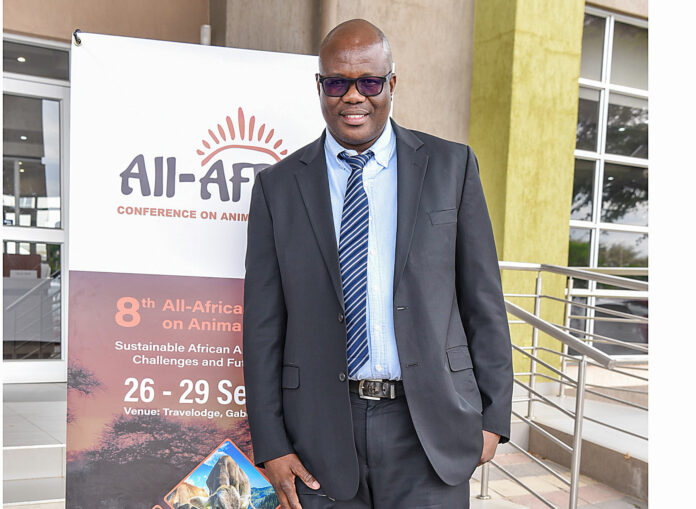
Dr. Leonard Baleseng – an animal nutritionist – has presented research findings of the morula kernel cake as a potential livestock feed at the 8th All Africa conference on animal agriculture held recently.
Dr. Baleseng, who is also the secretary general of the Botswana Society of Livestock Science and production (BSLSP), has told The Telegraph that the morula kernel cake (MKC) can be used in diets of ruminants such as cattle, goats and sheep or in non-ruminants such as broiler chickens and pigs.
“When using MKC in diets of young non-ruminants it can be used to partially replace conventional protein supplements such as soybean meal in order to lower feed expenses and also to avoid compromising animal growth since MKC is limited in lysine (amino acid) when compared to soybean meal,” he said.
Dr. Baleseng said recently broiler chicken studies were conducted at the Botswana University of Agriculture and Natural Resources (BUAN) on the same aspect and it was concluded that MKC does not compromise broiler chicken growth.
“With regard to ruminants (sheep or cattle), MKC can be included in animal diets in small quantities to avoid exceeding required fat level in diets of ruminants. High fat content in diets of ruminants interfere with digestion of fibre or other nutrients in the diet,” said Dr. Baleseng.
He explained that the morula kernel cake is a by-product obtained after oil extraction from morula fruits. He added that the MKC is a potential feed resource that can be used to feed livestock and poultry.
“The main nutrients found in the MKC are protein (46%) and fat (28.5%). The amount of protein in MKC is comparable to that of soybean meal. MKC is also rich in phosphorus and magnesium. MKC can be used to supplement protein or energy in animals especially during dry season (winter) when both forage amount and quality are limited,” Dr. Baleseng explained.
“With regards to ruminants (sheep or cattle), MKC can be included in animal diets in small quantities to avoid exceeding required fat level in diets of ruminants. High fat content in diets of ruminants interfere with digestion of fibre or other nutrients in the diet,” said the scientist.
His research is not only limited to nutritional benefits but cost minimization of expenses in livestock and poultry production as well as feed costs account for between 60% and 70% especially for livestock under feeding intensification.
“For instance, in Botswana most of the conventional supplementary feeds such as soybean meal, sunflower seed cake and cottonseed meal are imported from South Africa at exorbitant prices. Therefore, to make animal agriculture sustainable in the long run exploration of non-conventional feed ingredients should be undertaken to make livestock production affordable especially for smallholder farmers,” said Dr. Baleseng.
How does the use of the morula kernel cake on animal diets influence meat quality?
“Despite the challenges of limited feed resources and expensive conventional protein supplements, the modern consumer expects to get healthier livestock food products (meat or milk) in the market. Recent “consumer sensory analysis” studies conducted locally at BUAN using cooked meat from either broiler chickens or sheep indicated that MKC enhances sensory attributes of meat in general,” the scientist said.
Dr. Baleseng desires that animal agricultural scientists embark on need-based researches to enable easy adoption of generated feed technologies as an example.
“Basically, feed evaluation entail determining potential feed ingredients chemical composition, digestibility and consumption rate by the animal. Therefore, animal agriculture scientists working with farmers or other stakeholders can identify, screen, analyze, document browse plants preferred by animals or other industrial by-products from food processing industries that can be subjected to holistic feed evaluation,” he said.
“Currently in the Southern Africa Development community (SADC) region and in other parts of Africa, there is on-going research looking at possible use of products from the following trees as animal feed; Baobab (Mokolwane), Mongongo (Schiniziophyton rautanenii) and Macademia (Macademia integrifolia).In most Africa countries, livestock get the bulk of their feed from natural pastures. The pastures are usually good during the rainy season and farmers supplement their animals minimally. However, during the dry season (winter) pastures are limited in quality and quantity. At this time of the year farmers are compelled to spend a lot of money on supplementary feeding. In the worst case scenario some farmers may be forced to zero graze their animals if their grazing areas are overgrazed,” said Dr. Baleseng.
He said the government of Botswana, through programmes such as Livestock Management and Infrastructure Development (LIMID, is encouraging farmers to grow feed for their animals such as lablab, Napier grass and Cenchrus ciliaris (Molekangwetsi).
“Farmers should periodically be capacitated by extension agents on how to use crop residues in diets meant for livestock and poultry, Researchers should continue inventorying and evaluating non-traditional feed ingredients that can be used to supplement either protein or energy,” advised Dr. Baleseng.
Asked if there is a need to cultivate under-utilized plants found in harsh environment conditions, such as those of Botswana to enhance plant biodiversity, he said, using the morula tree as an example, that it is important that members of the community are educated on how to exploit the resources from the tree without overharvesting to allow sustainability.
“Few fruits should be left on the trees to allow natural regeneration. There should also be a policy developed by the government to control the harvesting process. On the other hand, morula seedlings can also be planted in agricultural fields to promote their sustainability. This practice is already being done in countries like South Africa and Eswatini,” he said.
How can Botswana increase animal productivity in challenging situations of high temperature, water scarcity and soil degradation inflicted by the ongoing climate change?
“Interventions should include stocking animals properly in their natural grazing areas and avoiding overgrazing, by periodically rehabilitating bare patches of land in natural grazing areas, Periodic use of supplementary feeds (crop residues, commercial supplements and use of browse plants) to augment poor natural pastures, promoting use of local breeds (Tswana and Tuli) and their crossbreds. Local breeds are very important as they have survived in Botswana for over a very long time and therefore can tolerate the harsh environment found in Botswana, and also matching calving of livestock with availability of enough forage supply,” said Dr. Baleseng.

